
Nir Karki
Talk to an Expert (Nir Karki)
Last-minute Deals
Book Now
Price from
US$1750

Everest Three High Passes Trek

257 reviews
29 reviews
Duration
15 Days
Trip Grade
Strenuous
Country
Nepal
Maximum Altitude
5,545m
Group Size
Min 2 Pax
Best Time
(Sep-Nov) and (Mar-May)

If you are dreaming of a complete adventure in the Himalayas, the Everest Three Passes trek delivers it all taking you across high passes and remote landscapes. From the highest peaks of the world to turquoise lakes and a close encounter with Sherpa culture, it is the ultimate trekking circuit in Nepal’s Khumbu region.

For over two weeks, you go deep into the remote valleys of the Everest region while crossing over 5,000m mountain passes. The trek takes you over the spectacular high passes, namely Kongma La (5,535m), Cho La (5,420m) and Renjo La (5,360m).

This is a challenging and demanding trek in terms of landscapes, high-altitude weather and remoteness of the trail. Yet the experience turns out to be rewarding when you get to see some of the highest peaks of the world, be it Everest, Lhotse, Makalu or Cho Oyu.

Then, there are other lesser-known summits too that you will encounter along the route of the Everest Three High Passes Trek. Not to forget the beautiful Gokyo Lakes that are beneath the Khumbu Icefall. Add to that the special connection you share with the ethnic Sherpa community while walking and living with them for days.

With ample experience, a good fitness level, and determination, you can conquer this trek despite it being of a strenuous grade. It is more than an ordinary trek that comprises an exploration of breathtaking views and authentic cultures. And you are guaranteed an experience that stays with you for your lifetime.

Trip Highlights

  • Cross three high mountain passes above 5,000m - Kongma La, Cho La, and Renjo La
  • Reach Everest Base Camp and Kala Patthar for views of Mt. Everest from diverse angles
  • Climb Gokyo Ri to get the glorious sunrise view and explore the Gokyo Lakes
  • Explore traditional Sherpa villages of Namche Bazaar, Thame, and Dingboche
  • Experience less-frequented trails and remote valleys
  • Witness wild landscapes comprising glaciers and rocky passes
  • Get a spiritual experience through a close encounter with a rich Buddhist heritage
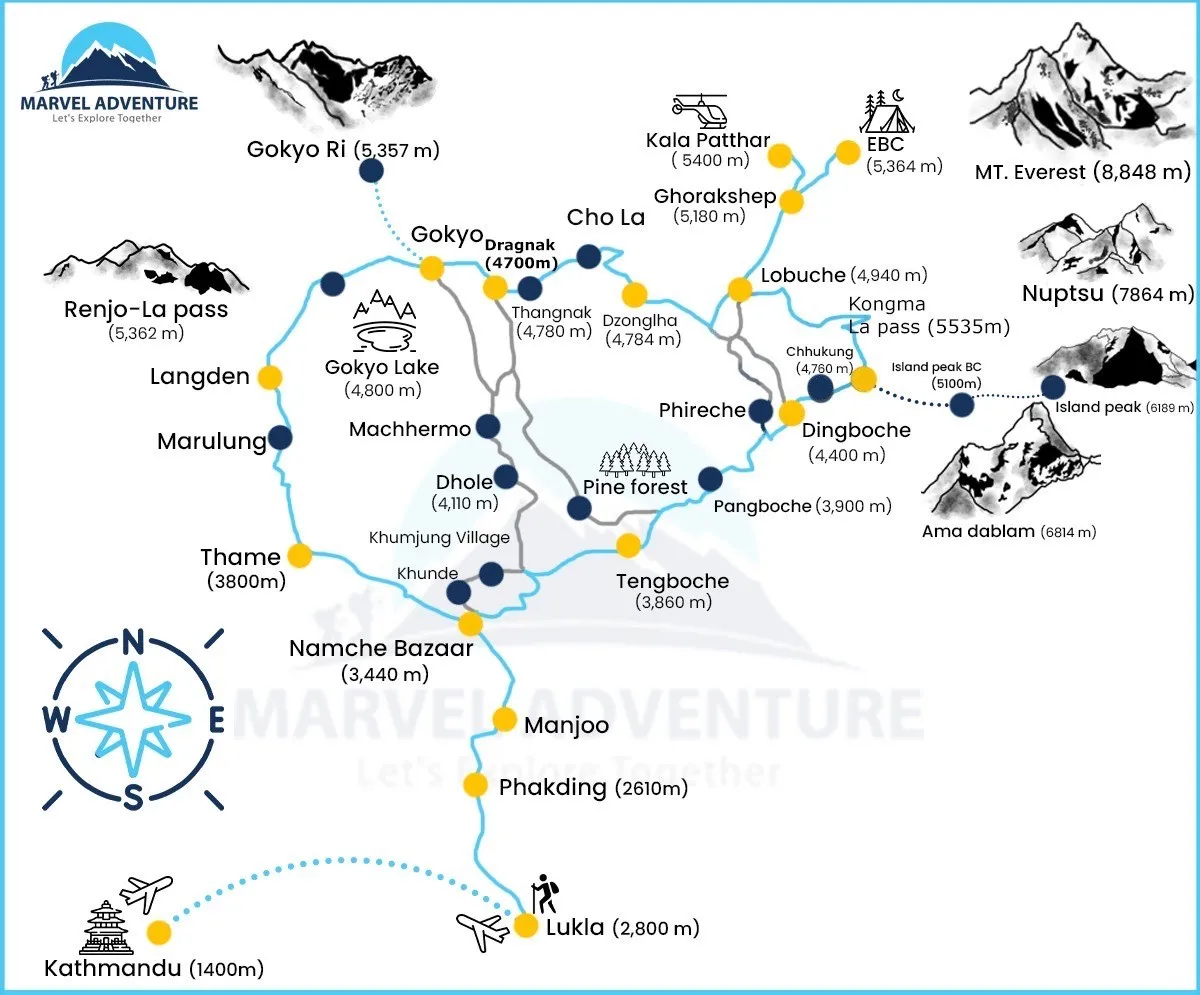
Everest Three High Passes Trek Detailed Itinerary

Day 1

Fly to Lukla (2,860m) and Trek to Phakding (2,610m)

Today marks the beginning of your true Himalayan adventure. Following an early morning drop-off at the Tribhuvan International Airport, you will board a flight to Lukla. It is a thrilling 35-minute flight to the Tenzing-Hillary Airport, popularly known as Lukla Airport. Lukla is renowned as the launch point for all Everest treks, including the Everest Three Pass trek.

The aerial view of terraced hills, river valleys, and Himalayan peaks, including a quick first peek of Everest, will enrich your flight experience. The view upon landing at the airport is no less mesmerising. First, the runway itself is a wonder for being a short and dramatic airstrip in the world. Add to that the dramatic setting of mountains.

After arriving in Lukla, you will enjoy a brief rest. You may also utilize this time to make final gear checks. Upon confirming that you are up-to-date with everything, you will begin your trek towards Phakding. It is a hike to the riverside village along the banks of the Dudh Koshi River.

You will experience a significant elevation gain by the time you reach Phakding. This is a gain if you regard Kathmandu (1,400m) as the starting point of your trek. Otherwise, you will experience elevation loss because the trek from Lukla to Phakding requires a descent.

You will walk down pine forests, suspension bridges, and Sherpa villages like Chheplung and Ghat before arriving in Phakding.

It is comparatively an easy day in the Everest Three High Passes Trek. Therefore, you will experience a pleasant trek on this day. At Phakding, you will check into teahouses and rest.

Max Altitude: 2,610m (8,562ft)
Duration: 3-4 hours
Distance: 8 km
Meals: Breakfast, Lunch and Dinner
Accommodation: Teahouse
Day 2

Trek to Namche Bazzar (3,440m)

Unlike the first day, the second day is the day to ascend your trekking trail and enter the Sagarmatha National Park. The endeavor will begin with an early breakfast in Phakding. Then you will set off on the trail northward along the Dudh Koshi River. You will cross this river multiple times during the trek. And in most places, you will be using suspension bridges for this purpose. Even these bridges are a sight to look at because of the prayer flags draped around them.

Lush pine forests, rhododendron woods, and Sherpa villages will welcome you with their serenity and beauty as you pass through them. You will come across Bengkar, Toktok, Monjo, and Jorsalle villages, to name a few.

You will need to present your permits for trekking in Monjo. The authorities there will check whether you have obtained the permit to enter the Sagarmatha National Park or not.

Once cleared, you will head to Jorsalle, where you can take a break. The break is desired, anticipating the upcoming steep trek to Namche Bazaar. Among the many suspension bridges you will cross during the Everest Three Passes trek, the Hillary Suspension Bridge is the most notable.

The trail will require you to make many ascents and descents before walking on a continuous ascending route. Finally, you will arrive at the beautiful town of Namche Bazaar.

Along the route, you will get to see magnificent views of different peaks, including Mt. Thamserku. You might even see the first view of Mt. Everest today. As Namche is the destination for the day, you will settle into the lodge and rest.

Max Altitude: 3,440m (11,286ft)
Duration: 5-6 hours
Distance: 10.7 km
Meals: Breakfast, Lunch and Dinner
Accommodation: Teahouse
Day 3

Acclimatization day at Namche

Acclimatization is an important part of your Everest Three Passes trek. Therefore, our itinerary also includes this aspect. For this trek, the first acclimatization day is the third day. And you will rest and acclimatize at Namche as preparation for the upcoming adventure.

Amidst the cooler temperature of this Sherpa town, you will learn to adjust via short hikes and explorations of the area.

One of the best ways to address that is by participating in morning hikes. One can hike to places including Everest View Hotel, Sherpa Cultural Museum, and Khumjung Monastery, to name a few.

If you are trekking to the Everest View Hotel, you need to walk an uphill trail via rhododendron and juniper forests. The route will allow you views of the mountains like Thamserku, Ama Dablam, Kobgde Riu, and Kumbila. And from the hotel, you can enjoy an excellent view of Everest itself.

After that, descend to Namche, where you can enjoy your lunch and set off ot explore the area. You can even relax in one of the local cafes or bakeries as the area has plenty of such facilities.

Nonetheless, remember that it is a rest day, but not without activity. You will need to remain active at a relaxed pace to prepare your body for the challenging trek ahead.

You will also realise how your body responds to high altitude and changes in altitude. On this rest day, be sure to stay hydrated and refrain from drinking alcohol.

Max Altitude: 3,440m (11,286ft)
Meals: Breakfast, Lunch and Dinner
Accommodation: Teahouse
Day 4

Trek to Tengboche (3,867m)

The trek on the fourth day is moderately challenging as you will need to climb a steep trail in certain sections. The steepness is evident in the initial ascent as you step out of Namche, as well as in the final climb.

But the path will not always be steep from here onwards, and it will flatten out in certain places. This will allow you stunning views of the Mahalangu Himalayan Range. The sights of Everest, Lhotse, and Ama Dablam are a feast for the eyes.

One of the first settlements you will reach along the route is Khyangjumpa or Kenjompa. It is a small Sherpa village that is about 5-7 km north of Namche Bazaar. Dense rhododendron forests surround it, and there are teahouse facilities to serve your needs. You can rest here for a while before descending to the Dudh Koshi River.

The descent is sharp, and you go down up to 3,250 m at Phunke Tenga. It is another Sherpa settlement located near the confluence of the Imja and Dudh Koshi rivers. Generally, you will take a brief pause here for lunch.

From Phunge Tenga, you will cross the suspension bridge and start a steady ascent. The trail will lead you through a forested hill. You might also spot wildlife, including Himalayan Thar, musk deer, and pheasant, along the route.

Then you will take the final ascent to Tengboche. And, you will need to walk cautiously to avoid any injury or fall as the ascent is steep.

Finally, you will be at Tengboche, which is home to Tengboche Monastery. It is known as the largest monastery in the Khumbu region. After the long trek along the windy trails, it will be time for you to unwind in the lap of the Himalayas during your Everest Three Pass trek.

Max Altitude: 3,867m (12,687ft)
Duration: 4-5 hours
Distance: 9.2 km
Meals: Breakfast, Lunch and Dinner
Accommodation: Teahouse
Day 5

Trek to Dingboche (4,410m)

Leaving Tengboche without visiting its iconic landmark, the Tengboche Monastery, is out of the question. So, early in the morning, you will visit the revered site, witness the rituals there, and take some photographs with spectacular mountains as the backdrop.

Then you will head to Deboche from there. It is a descent of about 40m as Deboche is located at an altitude of 3,820m. The downhill trek is gentle. It will require you to pass through a forest area.

Once again, you will cross a suspension bridge swaying over the Imja Khola and ascend to Pangboche at an altitude of 3,930m. The village is usually visited by those who trek and climb to the nearby Ama Dablam, as it serves as the mountain’s base camp.

You may also visit the Pangboche Monastery, the oldest in the region. It is also known for the legendary yeti relics (yeti scalp and hand) it once housed, the latter of which was reportedly stolen.

The climb will continue following this spiritual and cultural immersion. You will walk along the Valley with the views of Lhotse, Island Peak, and Ama Dablam.

You will be heading above 4,000m in this part of the Everest Three Passes trek. As such, the more you ascend, the more you will realise that vegetation gets sparse. You will be entering alpine terrain, leaving behind tree cover.

And the trek for the day will come to a final stop upon arrival at Dingboche. It is a wide and windswept village surrounded by fields with stone walls.

Here, you will spend the night at a lodge while enjoying the views of Imja Valley along with Mt. Makalu and Mt. Cholastse.

Max Altitude: 4,410m (14,468ft)
Duration: 5-6 hours
Distance: 10.5 km
Meals: Breakfast, Lunch and Dinner
Accommodation: Teahouse
Day 6

Trek to Chukkung (4,730m)

The trek from Dingboche to Chhukkung marks a divergence from the regular route to the Everest Base Camp trek.

Your journey will begin with a departure from Dingboche following the trail that goes northeast along the Imja Valley. One of the first settlements you will encounter is Bibre. It is a small yak herding settlement, often used for short breaks during the trek.

The ascent will take you through the trail's sparse vegetation. You will not find any trees in this area. The only vegetation seen is low-lying shrubs along the route.

Towering mountains border the vast landscape. You will see Ama Dablam to your right, and Island Peak, Lhotse, Nuptse, and Makalu can be seen ahead, in the distance.

The sixth day’s trek will be relaxing in the sense that the uphill climb is modest. The trail is well-maintained, too.

But keep in mind that you will be on a high-altitude trek as part of the Everest Three Passes trek. So, the trek can be difficult if you do not maintain a gradual pace and do not follow the principles of acclimatization. Nonetheless, the trek feels tiring due to the high altitude.

Experiencing the visual treat, comfortable paths, and tiring trek, you will finally arrive at Chukkung. It is a small cluster of teahouses where trekkers rest overnight before heading to the Kongma La Pass, the first of the Everest Three Passes.

Chukhung is also a base for acclimatization for trekkers who hike to Chukhung Ri or summit Chukhung Peak.

Max Altitude: 4,730m (15,518ft)
Duration: 3-4 hours
Distance: 4.5 km
Meals: Breakfast, Lunch and Dinner
Accommodation: Teahouse
Day 7

Chukkung to Lobuche (4,940m) via Kongma La pass (5,535m)

On the seventh day, you will reach one of the first destinations of the Everest Three High Passes trek. You will set off early in the morning to conquer the first pass of the journey, the Kongma La Pass. There are two trail options to access this pass, the highest of all three high passes in this trek.

One of the routes climbs over the hill to the northwest of Chhukung. The rocky hill is a part of the moraine field left by the Nuptse Glacier. As such, this section of the trek has loose rocks and glacial debris. Based on the season of your trip, you might pass through small glacial lakes. Experiencing a significant elevation gain of about 800m, you will reach Kongma La Pass.

The other route requires you to walk back to Bibre. You will need to climb the trail from there. The Niyang Khola lies beneath it. Then, you will take the southwest direction from Chukkung. It comprises a gradual incline. But the first route is steeper.

You will ultimately reach the Kongma La Pass, regardless of the route taken. Upon reaching this high-altitude mountain, you can see Lhotse, Makalu, Ama Dablam, and Island Peak, along with Khumbu Glacier and the Nuptse face.

The itinerary then requires you to descend to Lobuche. Walking down the rocky and loose terrain, you will first reach the Khumbu Glacier basin. Then you will need to cross the Khumbu Glacier. It is a challenging affair and requires brief ups and downs.

Now that you have dealt with the glacier, you will need to climb uphill. After a short yet tiring trek, you will reach Lobuche. Louche turns out to be a warm retreat after a long day's trek, during the Everest Three Pass trek, offering hot meals and a good night’s sleep.

Max Altitude: 4,940m (16,207ft)
Duration: 8-9 hours
Distance: 11 km
Meals: Breakfast, Lunch and Dinner
Accommodation: Teahouse
Day 8

Trek to Gorakshep (5,164m) and Everest Base Camp (5,364m)

Now that you have arrived in Lobuche, you will once again join the trekkers en route to the main Everest Base Camp trek. The itinerary of the Everest Three High Passes trek, prepared by Marvel Adventure, also includes an ascent to the Everest Base Camp.

You can break today’s trek into two parts. In the first leg, you will ascend to Gorakshep from Lobuche. The trail gradually ascends and becomes rockier as you enter the moraine zone of Khumbu Glacier. You will walk past loose stones and icy patches before reaching Gorakshep.

It is a small dry land with seasonal settlements and serves as your rest stop before you embark on the second leg of your trek to Everest Base Camp. Following a short rest, you will head to the base camp, one of the dream destinations of many trekkers joining the Everest Three Passes trek.

The path from Gorakshep to Everest Base Camp continues along the edge of Khumbu Glacier. You will need to walk along a rugged, winding trail with boulder fields and frozen ridges.

But the challenge is worth it, and you will realize that upon reaching Everest Base Camp. Prayer flags, stones, and colorful expedition tents mark the area. You will witness panoramic views of Himalayan peaks, including Nuptse, Lhotse, and Pumori. Mt. Everest is seen, but not the peak. The dramatic view of the Khumbu Icefall adds to the experience.

After you satiate your desire to stand on the foothills of Mount Everest, you can descend to Gorakshep. You will return via the same route. Following a comparatively easy descent, you will rest at the Gorakshep lodge overnight.

Max Altitude: 5,164m (16,942ft)
Duration: 7-8 hours
Distance: 13 km
Meals: Breakfast, Lunch and Dinner
Accommodation: Teahouse
Day 9

Hike to Kalapatthar (5,545m) and Trek to Dzongla (4,830m)

The view of the peak of Mt. Everest was missing on the eighth day of the trip to the base camp. And on the ninth day, the short trek to the Kalapatthar will allow you that opportunity. For this, you should begin early in the morning. The goal is to be able to see the sun rise over Everest and its surrounding peaks. It will be a great photography opportunity.

After sunrise, photography and some rest, you will head down to Dzongla. You will trek down nearly 715m during this journey. First, you will return to Gorakshep from Kalapatthar, grab a quick breakfast, and descend to Lobuche.

Leaving the classic Everest Base Camp trek trail at this point, you will head westward toward Dzongla. One of the rest stops in this section is the Dughla (Thukla) junction at an altitude of 4,620m, which rests just below the Thokla Pass.

The trail takes a northwest direction from here, offering you views of Cholatse among other peaks. You will need to tread along rocky and exposed trails as well as occasional icy sections.

And by afternoon, you will arrive at Dzongla, a small village located between Lobuche and Cho La Pass. It links the trail of the Everest Base Camp trek with Gokyo Valley and Chola La Pass, another major highlight of the Everest Three Passes.

The village of Dzongla not only offers an overnight rest and warm meal, but it is also a viewpoint offering a breathtaking view of mountain ranges, including Ama Dablam, Taboche, and Cholatse.

Max Altitude: 4,830m (15,846ft)
Duration: 6-7 hours
Distance: 10.8 km
Meals: Breakfast, Lunch and Dinner
Accommodation: Teahouse
Day 10

Cross Cho La pass (5,420m) and Trek to Gokyo (4,790m)

You will cross Cho La pass on the tenth day, the second destination of the Everest Three Passes trek. For this, an early departure from Dzongla is essential. That is because you will be heading to a high pass, and the afternoon winds will be very strong there.

The trek will start with a challenging ascent over loose glacial rocks. It will be a challenging ascent as you will need to traverse steep inclines and icy rocks. Meanwhile, the calm and beautiful Chola Lake and Ama Dablam will provide relief from the fatigue and frustration due to the difficult terrain.

Nonetheless, once you make it to the top — 5,420m — you will be welcomed with the dramatic landscapes all around it. You can also see the Ngozumpa Glacier, the longest glacier in Nepal. Gokyo Valley, Makalu, and Lhotse are also within the reach of your eyes. Prayer flags and cairns can also be seen atop the pass.

After spending some time here, the journey will require you to descend through a glacier section. You will need to navigate loose rocks and icy patches as you descend to Cho La Phedi and then to Dragnag.

You can rest for a while at Dragnag, a small settlement that you encounter along the route, and then continue a gentle walk along the edge of the Ngozumpa Glacier. After a short walk, you need to cross the glacier. From there, you will make a short climb to Gokyo village, your pause point for the day.

The village rests beside the Gokyo Lake, at the foot of Gokyo Ri. It is one of the highest settlements in the world and a seasonal settlement on the Everest Three Pass trek.

Max Altitude: 4,790m (15,715ft)
Duration: 7-8 hours
Distance: 12.5 km
Meals: Breakfast, Lunch and Dinner
Accommodation: Teahouse
Day 11

Hike to Gokyo Ri (5,357m) and explore for a day

For several days, you will be trekking continuously from one destination to another, without a pause. You will get that real break on the eleventh day of the trek, as you will not head to the new destination. Rather, you will hike to Gokyo Ri and then explore other places.

Start your day with an early morning hike to Gokyo Ri, a 5,360m peak. The steep climb promises one of the finest mountain panoramas in the entire Everest Three Passes trek. Once again, you will be visually delighted to see Everest, Lhotse, Makalu, Cho Oyu, and the Ngozumpa Glacier.

A hike in the early hours will also allow you to witness the sun gradually rising over the Himalayas. These are bound to be some of the best moments to witness and capture through your cameras.

Then you will descend back to Gokyo village, where you will have breakfast and a rest. Next, you can spend some time discovering the Gokyo Lakes. Passing by the Fourth Lake, aka the Thinak Tsho, you will reach the Fifth Lake. It is known as Ngozumba Tso. These are less-visited lakes but offer serene and amazing views to spectators.

You will spend time to your heart’s content there and return to the village sometime in the late afternoon. Then you can have ample rest as you will head to the last pass of your destination the next day.

Max Altitude: 4,790m (15,715ft)
Meals: Breakfast, Lunch and Dinner
Accommodation: Teahouse
Day 12

Trek to Lungden (4,370m) via Renjo La Pass (5,360m)

On the twelfth day, you will reach the final destination of the Everest Three Passes trek — the Renjo La Pass. From an altitude of 5,360m, it offers a marvelous view of the Everest mountain range. Along with Everest, the views of Lhotse, Makalu, Cho Oyu, and Ama Dablam greet you from here.

You can witness the Gokyo Lakes from this Pass. Snow leopards and red pandas inhabit this region. And you might see them.

For the unversed, the Renjo La Pass used to be a trade route to Tibet. It is said that the Sherpas would walk across Nangpa La to reach Tibet from here.

To cross the spectacular high pass of the Khumbu region, you will start an early morning trek from Gokyo. Passing through cairns and prayer flags, and traversing the rocky moraine terrain, you will reach the summit of Renjo La Pass.

Towards the end of reaching the summit, you will ascend a steep stretch, the most demanding section of the trail. You will pause at the Pass to take photos and immerse yourself in the breathtaking scenery before descending to Lungden.

You will typically arrive at Lungden village in the afternoon, where you will check into the lodge and rest.

Max Altitude: 4,370m (14,337ft)
Duration: 7-8 hours
Distance: 12 km
Meals: Breakfast, Lunch and Dinner
Accommodation: Teahouse
Day 13

Trek down to Namche (3,440m)

It is all about descent on this day of the Everest Three Pass trek. The trek will begin with a walk from Lungden. After about an hour of walking, you will climb a small raised hilltop. From here, you will go down to cross the stream. And in the next 3-4 hours, you will arrive at Thame.

You will go through the villages of Maruling and Targna, to name a few, along the route. Thame is at an altitude of 3,820m and houses the renowned Thame Monastery. You will visit this historic monastery, have lunch or tea at the local tea house, and rest for a while.

Then you will continue your descent along the pleasant trail surrounded by pine and rhododendron forests. You will also pass through Samde and Thamo villages and cross suspension bridges as you trek down.

But you will arrive at Namche after making a moderate ascent towards the final section of the trek. That is because Namche Bazaar sits on a bowl-shaped slope. While this day’s trek is mainly about descending, you will experience short uphill stretches before reaching Namche.

Arriving here means you have made a full circuit of the Everest region. You will rest here today and spend the time exploring local shops and bakeries, and maybe even buying some souvenirs.

Max Altitude: 3,440m (11,286ft)
Duration: 6-7 hours
Distance: 18.3 km
Meals: Breakfast, Lunch and Dinner
Accommodation: Teahouse
Day 14

Trek down to Lukla (2,860m)

You will head down to Lukla after breakfast in Namche. The descent will begin from Namche’s upper ridge as you will retrace your steps of ascent.

You will be walking down the zigzag stone steps that are famous for making both the ascents and descents challenging. Nonetheless, without that, the descent and the ascent would be more difficult. So, you can trust that these steps are manageable. You will have realized that thing during the ascent, and the descent will also prove that to you.

As you step out of Namche, you will cross the famous Hillary Suspension Bridge over the Dudh Koshi River. The trail will then continue down through small settlements. Pine forests are also found along the route.

Monjo and Jorsalle are other villages you will encounter along the trek as you continue to descend. The next destination is Phakding, where you can stop for lunch.

Crossing more suspension bridges, you will start climbing from Chheplung up to Lukla. You will arrive at your destination following a long day of descents with a few uphill walks.

Check into your lodge, relax, and celebrate the completion of your Everest Three Passes trek.

Max Altitude: 2,860m (9,383ft)
Duration: 5-6 hours
Distance: 19 km
Meals: Breakfast, Lunch and Dinner
Accommodation: Teahouse
Day 15

Fly back to Kathmandu (1,400m)

On the last day, you will rise to savour your last breakfast in Lukla, and get ready to fly back to Kathmandu. You will board the plane at the Tenzing-Hillary Airport following check-in and security procedures.

Usually, the flights are early in the morning due to weather conditions. You will arrive in Kathmandu in a maximum of 45 minutes. During the flight, you will once again revisit the landmarks that you had tread before. Add to that the terraced field, farmlands, and green hillsides that will signal that you are heading to a lower altitude, away from the mountainous terrain.

As you will land at the domestic terminal of the Tribhuvan International Airport, you can go back to your hotel. You can choose between resting and exploring the city.

Max Altitude: 1,400m (4,593ft)
Duration: 35 minutes
Meals: Breakfast
Accommodation: Hotel
Mode of Transportation: Flight
Have Questions? We're Here to Help
Like this itinerary but want to make a few changes? Every traveler is unique, and your journey should be too. Our local travel experts will design a personalized experience tailored to your interests, preferred pace, travel dates and budget.
Route Map & Altitude Profile

Cost Details

Includes

  • Airport pick up and drop by private vehicle
  • All Domestic flights and airport tax as listed in the itinerary
  • Standard meals (breakfast, lunch and dinner) during the trek
  • Government license holder guide 
  • Stong and helpful porter with proper equipment (1 porter for 2 people)
  • Salary, food, accommodation and insurance for guide and porters
  • Tea house/lodge accommodation during the trek
  • Sagarmatha National Park entry permit
  • Pasang Lhamu Rural Municipality entry permit
  • Comprehensive first aid kit with oximeter
  • All the government and local taxes

Dates & Availability

Aug 2026
Sep 2026
Oct 2026
Nov 2026
Dec 2026
Jan 2027
Feb 2027
Mar 2027
Apr 2027
May 2027
Jun 2027
Jul 2027
Aug 2027
Sep 2027
Oct 2027
Nov 2027
Dec 2027
Start Date
03 Aug, 2026
End Date
17 Aug, 2026
Status
Guaranteed
Price
US$1750
US$1875
Start Date
06 Aug, 2026
End Date
20 Aug, 2026
Status
Guaranteed
Price
US$1750
US$1875
Start Date
10 Aug, 2026
End Date
24 Aug, 2026
Status
Guaranteed
Price
US$1750
US$1875
Start Date
13 Aug, 2026
End Date
27 Aug, 2026
Status
Guaranteed
Price
US$1750
US$1875
Start Date
17 Aug, 2026
End Date
31 Aug, 2026
Status
Guaranteed
Price
US$1750
US$1875
Start Date
20 Aug, 2026
End Date
03 Sep, 2026
Status
Guaranteed
Price
US$1750
US$1875
Start Date
24 Aug, 2026
End Date
07 Sep, 2026
Status
Guaranteed
Price
US$1750
US$1875
Start Date
27 Aug, 2026
End Date
10 Sep, 2026
Status
Guaranteed
Price
US$1750
US$1875
Start Date
31 Aug, 2026
End Date
14 Sep, 2026
Status
Guaranteed
Price
US$1750
US$1875

Meet Our Expert Guides

Khilaraj Nachhiring
Trekking Guide
Phinjo Sherpa
Trekking Guide
Dibash Mainali
Trekking Guide
Dhana Tamang
Trekking Guide

Equipment List

Upper Body Layers
  • Breathable, quick-dry base layers
  • Comfortable t-shirts
  • Lightweight insulating jacket
  • Down jacket for cold conditions
  • Waterproof and windproof jackets
Lower Body Layers
  • Thermal base layer
  • Waterproof trekking pants
  • Comfortable pants for evenings in teahouses
  • Comfortable hiking shorts for warmer sections
  • Waterproof and windproof outershell for rain or snow
Footwear & Accessories
  • Trekking boots with ankle support (preferably Waterproof)
  • Multiple pairs of quick-dry socks
  • Warm socks for cold nights
  • Gaiters for snowy, muddy, or dusty trails
  • Trekking poles to reduce strain on knees
Head & Sun Protection
  • A hat or a cap to block the sun
  • Warm beanie for cold mornings and evenings
  • UV-protected sunglasses
  • Neck gaiter or buff to prevent dust, cold, and sunburn
  • Sunscreen (30-50+ SPF) for face and exposed skin
  • Lipbalm with SPF
Personal & Medical Kits
  • Personal medications
  • Diamox (Acetazolamide) for altitude sickness
  • Ointment
  • Hand sanitizers and wet wipes
  • Quick-dry towel
Travel Documents
  • Valid Passport
  • Passport-sized photos for permits
  • Travel insurance
  • Flight tickets
  • Cash in Nepali Rupees
  • Emergency contact details
Miscellaneous
  • Daypack (30-45L) with raincover
  • Reusable water bottles
  • Headlamps for early morning hikes
  • Water purifying tablet or filter
  • Phone or Camera for capturing the adventure
  • Powerbank for an easier charging option
  • Notebook, books, or cards for free time
  • Snacks like energy bars and chocolates
  • Drybag to keep your gear safe from rain

Essential Information

How Difficult is the Everest Three Passes Trek?

The Everest Three High Passes trek difficulty is graded as a strenuous adventure. The reason is that the journey involves climbing to higher altitudes, crossing glaciers and challenging climbs, with basic trekking equipment.

Continue reading to learn about the elements that make the Everest Three High Passes trek strenuous:

High Altitude

During the trek, you will need to cross passes at higher altitudes, all above 5,000m. Therefore, ascending to Kongma La, Chola and Renjo La is not an easy task. Reaching the destinations requires steep ascents and descents.

Also, you will spend a significant number of trekking days above 4,000m. The thin air and low oxygen level at these altitudes will not make the trek easier. You are prone to the risks of high-altitude impacts, including Acute Mountain Sickness.

A proper acclimatization is mandatory, even for experienced trekkers, at such an altitude.

Rugged Terrain

The trails are slippery as you have to walk past snowy terrains. Add to that the rugged landscapes with loose rocks. All these features of the terrain make the walk difficult. The narrow mountain passes demand careful navigation. A slight mistake can turn out to be an expensive affair during the trek. There are chances of being injured if you happen to lose your footing along the rocky slopes, all adding to the difficulty level.

Long Duration

The trek typically takes over two weeks to complete. As such, you will be spending a long duration in the high altitudes. Also, you need to walk long distances every day. To cover the trek distance of 166 km, you will have to walk for around 6-8 hours daily. This will be a challenging affair.

Other Factors

The unpredictable Himalayan weather can add to the difficulty level. There might be snow, high winds, and sudden temperature drops, even during the prime trekking season. The weather can change abruptly, causing difficulties during the trek. Likewise, the remote terrains and lack of resources along the route are the limitations of the Everest Three Passes trek.

Experience and Fitness Required for the Trek

The Everest Three High Passes trek is not just another trek. It is a serious venture that is filled with challenges. Thus, it demands a good experience and fitness from the trekkers.

If you plan to be a part of the Everest Three High Pass trek, here are a few things that you should know beforehand:

Recommended Experience

This trek is not for inexperienced trekkers. You must possess previous experience of high-altitude trekking. You should have treaded on challenging terrains before opting for this trek. Therefore, it is recommended to complete at least one multi-day trek at a moderate altitude before this.

This is required because you need to have an experience of hiking on rocky and icy trails as well as scree slopes. This is what you will encounter during the Everest Three High Passes trek. And without prior experience, it becomes difficult to navigate such terrain.

Fitness Requirements

An excellent mental and physical fitness is inevitable for this trek. Therefore, train yourself both physically and mentally at least 3-4 months before embarking on this journey.

Physical Fitness: Before you arrive for this trek, prepare yourself physically to attain cardiovascular endurance, leg strength and stamina. For that, you can hike regularly in a hilly or mountainous area. You should carry a loaded backpack to simulate the real trekking conditions and hike.

Likewise, run, cycle and swim 3-4 times a week as a part of cardio training. This helps improve the capacity of your lungs.

Strength training should focus on the legs and core. These factors will improve your overall physical fitness.

Mental Preparation: You should be mentally prepared for this trek to be resilient enough to endure long days, basic conditions and high altitude discomforts.

While regular physical training also improves your mental strength, you should also have a positive mindset to deal with adverse situations. Limit your expectations and learn to understand how to deal with the upcoming challenges. Practice meditation and deep breathing exercises to handle yourself during overwhelming situations.

Best Time for Everest Three High Passes Trek

The best time to visit the Everest Three High Passes trek is generally in autumn and spring. The seasons bring stable weather conditions and offer the trekkers a rewarding experience on the high passes.

The following section of the article helps you further decide on which time of the year to trek to the Everest Three Passes.

Spring: March to May

If you want to trek to some of the highest altitudes amidst warm daytime temperatures, clear skies and rhododendron blooms, then spring is the right time for you.

The temperatures range between 17°C and 25°C during the day in the Everest region. They drop to -15°C at night. While the warm lodge stay helps you battle the cold weather at night, the daytime temperature allows you to have a comfortable trek.

Also, the daylight hours are longer, which helps cross the passes. Another perk of opting for the spring trek to the Everest Three Passes is the excellent views of the mountains, possible because of the clear skies.

Nonetheless, with such favorable weather conditions, the trails can be busy during spring. Yet they are not as crowded as autumn.

Autumn: September to November

If you want to be in the Everest region during the most popular season of the year, then the autumn trek is suitable for you. The trails and lodges are busy, especially in October.

Favorable weather conditions are one of the factors behind that. You can expect crisp and stable weather during this time. The visibility is clear. There is minimal precipitation, leading to dry trails.

The spring temperatures in the Everest region are somewhere between 15°C and 20°C during the day. At night, the temperature can drop to -10°C. Overall, the cool daytime temperatures enhance the experiences of the Everest Three Pass trek.

Winter: December to February

It is possible to trek in winter with some precautions, but one should be able to deal with the extreme weather conditions. The mountain conditions are harsh in winter. The winter temperatures are around 0°C to 4°C during the day, and drop up to -15°C at night in the Everest region. As such, whenever there is heavy snow, and it is there in winter, the high passes can remain closed. Likewise, many lodges in the high villages are also closed due ot the extreme weather conditions. It can add to the challenge of the Everest Three High Passes trek.

Summer / Monsoon: June to August

The trails are less crowded in this part of the year in the Everest Three Passes. You will also get to see greenery everywhere. But some challenges come with his season.

Persistent rain and cloud cover, risk of landslides, slippery trails and poor visibility will make your trek a challenging endeavor.

Yet if you can look beyond that, then with proper caution, you can trek during these months too. As per the temperature, it ranges between 20°C and 25°C during the day. It averages around -5°C at night.

Accommodation and Meal During Everest Three Passes Trek

The route of the Everest Three Passes trek is undoubtedly remote and challenging. Yet you will get to stay in welcoming lodges with basic facilities and warm meals.

Accommodation

You will spend all your nights are locally run lodges if you book the Everest Three High Passes trek with us. These lodges offer twin rooms with basic facilities of wooden beds, mattresses, pillows and blankets.

Shared bathrooms are a regular thing. You might also have to manage with the square-style toilets in some villages. However, Namche Bazaar and Dingboche, among other places offer better lodges with attached bathrooms. You will have to pay an extra fee to get hot showers, provided that they are available in these accommodations.

Along the route, you will be eating in common dining halls. You need to pay extra to charge your electronic devices, despite the availability of electricity in most villages. But as the electricity is unreliable at high altitudes, you should bring along your power bank or solar charger.

You can find WiFi and mobile networks in some places like Namche, Dingboche and Gokyo. The signals might be weak or even non-existent in other places.

Meal

The teahouses and lodges en route provide hot meals that are freshly cooked. You will not get varied options. But the options in the list of simple, nutritious and filling meals comprise breakfast, lunch and dinner.

You can savour Tibetan bread, porridge, muesli, pancakes, eggs, tea, coffee and hot lemon in your breakfast. The lunch is usually made of Dal Bhat along with fried rice, pasta, chowmein and spaghetti. It may also include Sherpa stew, momos and potato dishes. You can expect a similar option for your dinner. Meanwhile, you might need to pay extra for boiled water.

Packing for the Everest Three High Passes Trek

Packing the right clothes and equipment is essential to tackle the Everest Three High Passes trek safely. Before collecting the required items for packing, keep in mind that you should opt for multiple layers of clothes. This helps you deal with the changing weather. Pack as light as possible so that you have a lightweight backpack. Do not forget to ensure you are able to walk in your boots comfortably before leaving home.

Permits and Insurance

Necessary Trek Permits

To trek the Everest Three High Passes, you should obtain the Sagarmatha National Park Entry Permit. It is required to trek within the national park. Meanwhile, the Khumbu Pasang Lhamu Rural Municipality Permit is needed for all treks in the Everest region. It has replaced the TIMS card. Carry the permits at all times because you will need to show them at different checkpoints.

Travel Insurance

Please secure travel insurance before trekking to the Everest Three Passes. It should be a comprehensive policy covering emergency medical evacuation. This should cover helicopter evacuation above 5,000m. The policy also must include high-altitude coverage of trekking up to 5,500m, along with accident and medical care expenses.

Health and Safety Measures

For a safe Everest Three Passes trek, you need to know the risks associated with it. Only with a proper understanding of the related dangers can you prepare yourself for the challenges.

Here is what you need to know to stay safe for the trek:

Altitude Sickness and Acclimatization

Altitude-related sickness is one of the major health concerns in the Everest Three High Passes trek, as you need to travel over 5,000m many times.

One of such risks is Acute Mountain Sickness (AMS). If you experience symptoms of nausea, headache, dizziness, loss of appetite and fatigue, then you might be suffering from it. You are at risk of developing AMS in high altitudes because your body is unable to adjust quickly to the reduced oxygen level.

Acclimatization is essential to prevent it. And gradual ascent is one of its major rules. Likewise, you need to stay hydrated, avoid drinking alcohol and smoking and eat enough calories. Resting is recommended if symptoms appear. If symptoms worsen, descending to a lower altitude may be necessary. Or emergency evacuations may be needed, depending upon the situation.

Cold-related Illnesses

Due to the below-freezing temperatures at high altitudes, you might suffer from conditions like hypothermia and frostbite, too. Common signs of hypothermia are shivering, confusion, and slurred speech. You need to dress in layers to prevent this situation.

Meanwhile, symptoms of frostbite include numbness and pale skin of fingers, toes or face. Wearing gloves, hats and dry socks will help reduce the risk of frostbite. And change damp clothes immediately to reduce the risk.

Evacuation and Emergency Response

In case of any medical or other emergency situation, a helicopter response is available throughout the Everest region. Your travel insurance policy must cover that aspect for the high-altitude rescue. Other than that, the guides who accompany you during the tour are trained to recognize the symptoms of altitude sickness and other illnesses. They will provide you necessary help along with organizing quick evacuations during the Everest Three High Passes trek.

Respect for Culture and Environment

Travelling to the three high passes of the Everest region takes you through the Sherpa settlements, where you get a close view of their cultural aspects. Likewise, the Everest region is home to different flora and fauna along with the pristine mountains. You must trek here responsibly to preserve the environment and honor the local people.

As a way to show your respect for local culture, greet people warmly with a smile. Dress modestly before entering temples or prayer halls. Also, do not forget to remove your shoes in such places of religious importance. Always get consent before taking photos of people.

As you trek, always carry the non-biodegradable waste with you. It is advised to use refillable bottles instead of carrying or buying plastic water bottles. To avoid damaging the fragile alpine flora, stick to the established trails. And support the local communities by buying local products, staying in local teahouses and giving fair tips.

Everest Three High Passes Trek FAQs

How difficult is the Everest Three High Passes Trek compared to Everest Base Camp?

The Everest Three High Passes Trek is significantly more challenging than the Everest Base Camp trek. You will be crossing three high mountain passes above an altitude of 5,000 meters. So, expect longer walking hours, rougher terrain, and basic teahouse facilities. We often recommend trekkers to go for the Everest Base Camp trek before they step up for this adventure.


Which pass is the hardest in the Everest Three High Passes Trek?

Based on the feedback from our clients, most of them find Kongma La Pass (5,535m) to be the hardest one. The reason behind its difficulty is steep ascent, rocky terrain, and long walking hours. Also, the weather and snow can add more challenges while crossing these passes.

How many days does the Everest Three High Passes Trek take?

Our standard Everest Three High Passes Trek is completed in 15 days. From years of experience in operating in the Everest Region, we have created a perfect itinerary with proper acclimatization days to improve your overall trekking experience.

What permits are required for the Everest Three High Passes Trek?

The Everest Three High Passes Trek requires two permits: the Sagarmatha National Park Permit and the Khumbu Pasang Lhamu Rural Municipality permit. The costs for your permits are included in our package, so you can enjoy the trip without having to worry about getting the permits. 

How physically fit do I need to be for this trek?

The Everest Three High Passes trek demands strong physical fitness. You will be trekking at altitudes above 5,000 meters for consecutive days. The strong wind, snowy trails, thin air, and long walking hours at this altitude demand good cardiovascular fitness.

Is the trek possible without prior trekking experience?

Yes, it is, but it requires a really high level of preparation. You need good physical fitness and to seriously train in cardio for 6 months before heading out for this trek. If you are a first-time trekker, we still recommend the Everest Base Camp trek before you take on this challenge, so you can get a sense of how your body handles high altitude.

What happens if Lukla flights are delayed or cancelled during the trek?

We have seen a lot of short delays and flight cancellations over the years. In fact, it's quite common in the Everest Region due to frequent weather changes. In such a case, we will work to reschedule the next flight based on availability. You can also go with the helicopter option at an additional cost or drive to Salleri. This is exactly why we advise keeping buffer days in your schedule.

How much does the Everest Three High Passes Trek cost?

Our standard Everest Three High Passes Trek costs USD $1750 for a group of a minimum of 2 people. If the group consists of only one person, the charges will include a slight additional cost. We also offer discounts for early bookings depending on the group size and itinerary.

Is altitude sickness common on the Everest Three High Passes Trek?

Yes, the mild symptoms of altitude sickness, such as headache, nausea, and disrupted sleep, are very common as you head above 3,500m. We have noticed some of these symptoms in most of our clients. You can be an experienced trekker and still get affected by altitude sickness. Some of the serious altitude sickness (HAPE or HACE) is far less common, but still can happen.

What is the best time of year for the trek?

Spring (March-May) and Autumn (September-November) are the most popular and reliable trekking seasons. This is when the skies are clearest, the views are amazing, the weather is stable and the trial conditions are perfect. During the peak trekking season, the teahouses are filled quickly. So, we suggest making an early booking.

Do I need a guide for the Everest Three High Passes Trek in Nepal?

As of the recent regulation, trekkers must be accompanied by a licensed guide in the Everest Region. The Nepali law no longer allows solo trekking in this region. And to be fair, having a guide genuinely helps you with route insights and local connections that make a real difference in the trail. Marvel Adventure provides guides who have been operating in the Everest region for years and have deep knowledge about this trek.

What should I pack for the Everest Three High Passes Trek?

Warm layered clothing, a quality down jacket, waterproof gear, trekking boots, gloves, sunglasses, and a sleeping bag are essential. In the Everest region, the weather can change very quickly, especially around the high passes. Do check out the equipment section to learn about the packing essentials in detail.

What is the highest altitude reached during the trek?

The maximum altitude of this trek is Kalapatthar, at 5,545m. The Kongma La Pass sits at an altitude of 5,565m, the Chola Pass at 5,420m, and the Renjo La at 5,360m. However, you need to understand that on the trail above Dingboche (4,410m), altitude might affect you as the air becomes much thinner.

Is the Everest Three High Passes Trek possible in winter?

The trek is still technically possible in winter, but it comes with extreme challenges. Deep snowfall could block the trails and make the passes completely impossible to pass through. The teahouse options get very limited as most of them are closed, and the ones that are operating have minimal staff. The temperature at night can easily drop to -20° C, especially above Gorakshep.

What happens in case of an emergency during the trek?

In case of an emergency, our guides will help you with immediate assistance, including helicopter evacuation if necessary. In Everest region, helicopter is the fastest option for serious altitude sickness our injuries. We will be in contact with our Kathmandu office and local rescue services throughout the trek.

Price Per Person
US$1750
US$1875
All inclusive price
  • 2 - 4 paxUS$1750
  • 5 - 9 paxUS$1725
  • 10 - 20 paxUS$1700
Book This Trip
Talk to Our Travel Experts

What Our Clients Say

November 23, 2025
3 High passes and EBC

Great experience hiking the 3 high passes and EBC. The Team at marvel provided great support from start to finish.
Airport pick up and ensured we had the correct gear required for the hike....

s
sandrachiodo
Australia
November 09, 2025
Trip of a lifetime

We did the 3 high passes and Everest Base Camp hikes, over approximately 3 weeks. Its an experience that I will never forget, for all the right reasons. Apart from the actual beautiful and unique...

W
Wander60886771829
Austria

You May Also Like

everest base camp cho la pass gokyo trek
Duration: 14 Days
5.0(23 Reviews)

Everest Base Camp Chola Pass Gokyo Trek

US$1575US$1575
Difficulty Level: Strenuous
everest base camp trek with island peak
Duration: 16 Days
5.0(10 Reviews)

Everest Base Camp Trek with Island Peak

US$2195US$2195
Difficulty Level: Technically Challenging
gokyo renjo la pass trek
Duration: 12 Days
5.0(7 Reviews)

Gokyo Renjo La Pass Trek

US$1350US$1350
Difficulty Level: Moderate
Need Help? Call Us+977 986-0313572
Everest Three High Passes Trek | Ultimate Everest Adventure