
Nir Karki
Talk to an Expert (Nir Karki)
Last-minute Deals
Book Now
Price from
US$1800

Manaslu and Tsum Valley Trek

257 reviews
29 reviews
Duration
19 Days
Trip Grade
Moderate
Country
Nepal
Maximum Altitude
5,106m
Group Size
Min 2 pax
Best Time
(Sep-Nov) and (Mar-May)

Manaslu and Tsum Valley trek is a mixed adventure that explores the attractions of both the popular Manaslu trekking route and the remote part of the Tsum Valley. This immersive trekking experience of the Himalayas is known for its dynamic mountain vistas, dramatic landscapes, layered hills, and cultural prospects enriched by the Tibetan-influenced traditions.

This adventure that starts following the trails of the Soti Khola moves along the Budhi Gandaki River and takes you to Mu Gompa before reaching the highest elevation point of the entire trek at Larkya La Pass (5,213 meters) and concluding the adventure at Dharapani.

The exploration of the Tsum Valley, which is also known as the ‘hidden valley’ makes this expedition really exhilarating as you explore the northern prospects of the Manaslu region that is isolated from the crowd of the mainstream routes.

So, if you are up for this iconic expedition in solitude that helps you reconnect with Mother Nature, Marvel Adventure offers a fully guided 19 Day- Manaslu and Tsum Valley Trek for a memorable and gratifying experience.

Marvel Adventure organises Manaslu and Tsum Valley Trek with a carefully designed itinerary and professional guides. So, come and explore with us to make sure that you have one of the most memorable treks in the nation of the Himalayas. Feel free to contact us if you have any queries regarding this trek.

Manaslu and Tsum Valley Trek Highlights

  • Traversing to the foothills of the eighth-highest mountain in the world, Mt Manaslu (8,163 meters)
  • Majestic views of the Himalayan massifs like Manaslu, Ganesh Himal, Boudha Himal, Shringi Himal, Himal Chuli, and Phungi
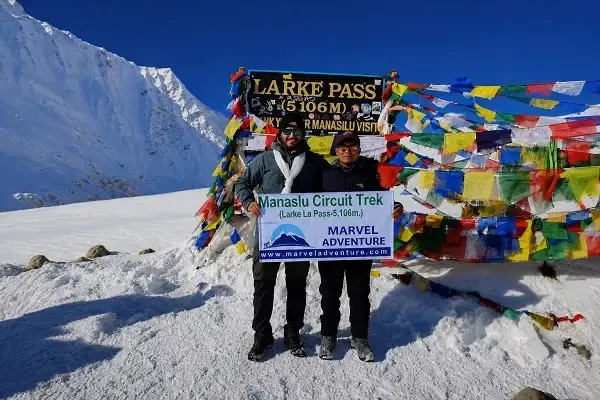
  • One of the longest and highest passes in the Himalayas, Larkya La Pass (5,106 meters)
  • Ancient monasteries Mu Gompa, Dhephu Doma Gompa, Rachen Gompa, and Lungdang Gompa
  • Remote, less crowded, and scenic trails of Tsum Valley
  • Beautiful culture, traditions, and hospitality of Gurung and Tibetan Nupri inhabitants

Best Season for Manaslu and Tsum Valley Trek

This beautiful expedition in the solitude of the Manaslu region is best suited for the ideal peak seasons, as other seasons further elevate the difficulty factors of its remote route. Manaslu and Tsum Valley Trek are most enjoyable during the peak season, like Spring (March- May) and Autumn (September- November).

The weather and temperature during both spring and autumn seasons are on the warmer side; similarly, the days are bright with mostly clear skies. The temperature of the Manaslu region is around 15°C - 20 °C in the daytime and can drop up to 6°C or below at night and early mornings.

In comparison, the autumn season is on the breezy side as the mild temperature of 13°C - 19 °C encourages the day’s adventure; the mornings and nights in this season are especially chill and breezy, making it one of the best seasons for trekking adventure.

If you are planning your adventure for the off-season, like monsoon (June- August) and Winter (December- February), you might not be able to enjoy the Manaslu and Tsum Valley Trek exploration as much as other peak seasons.

Especially during the monsoon, which sees every rainfall can halt the advancement for a tiring number of days, similarly, the slippery trails and risk of landslides contribute to the risk factors during this season. Monsoon is the summer season in Nepal, so when you are not dealing with the depressing downpours, the hot temperature will make the trek a bit challenging (temperature during the monsoon, 15°C- 25°C).

On the other hand, winter is the harshest season for the adventure due to the cold climate. The normal temperature of the region is around -6°C to -10°C, even during the daytime at the higher elevations. Also, the trails are mostly covered in snow, making it even more difficult to overcome even a simple trekking route.
Manaslu and Tsum Valley Trek Detailed Itinerary

Day 1

Drive from Kathmandu to Machha Khola

Your Manaslu and Tsum Valley kick start after a scenic drive from Kathmandu to Machha Khola after breakfast. Driving across the diverse landscapes from high green hills to low valleys, soaring rivers, waterfalls, and beautiful, vibrant settlements across the Prithivi Highway, you will arrive at Malekhu during the first part of the drive.

Then, moving along the trails across Dhading, Arughat, and Gola Bhanjyang following the Trishuli River, will finally switch to the trails of Soti Khola. From here, it's about a 1.5 to 2 hours drive to reach Machha Khola. On this day’s drive, you will also be able to enjoy the spectacular views of the Himalayan massifs like Manaslu, Ganesh Himal, and other adjacent peaks.

Max Altitude: 870m (2,854ft)
Duration: 7-8 hours drive
Distance: 160 km
Meals: Breakfast, Lunch and Dinner
Accommodation: Lodge
Mode of Transportation: Public Bus
Day 2

Trek to Jagat (1,340m)

Switching to trekking from the previous day’s driving adventure, on Day 2 of your Manaslu and Tsum Valley Trek, you will follow the trail alongside the Budhi Gandaki River that ascends and descends over the lush hills. Moving along the trail, you will pass the beautiful settlements of Khola Besi as you make your way toward Tatopani, the famous natural hot spring destination with significant religious norms.

Then, during the final stretch of this day’s adventure, you will cross a suspension bridge over the Budhi Gandaki River and ascend on a rocky trail to reach Doban. You will cross a second suspension bridge over Yaru Khola, moving along the trail, then, after overcoming the climbing section to Thado Bharayng, you will push for the ridge that takes you to Jagat. This beautiful Himalayan settlement is the entrance point to the Manaslu Conservation Area.

Max Altitude: 1,340m (4,396ft)
Duration: 5-6 hours
Distance: 22 km
Meals: Breakfast, Lunch and Dinner
Accommodation: Teahouse/Lodge
Day 3

Trek to Lokpa (2,240m)

After entering the restricted area of the Manaslu region, you will kick-start this day’s adventure by climbing a ridge to Salleri. Then again, moving along the riverbanks of the Budhi Gandaki River, you will cross a long suspension bridge towards Philim. Moving along this day’s trekking route, you will arrive at Ekle Bhatti, which separates trails toward the Tsum and Manaslu regions.

Then, following the trails toward Lokpa village, you will pass several other high Himalayan settlements, and will follow the right side of the Tsum Valley to reach Lokpa Village. Passing the scenic Syar Rivers moving towards the valley, this day’s trek will also be blessed with stunning views of the Himalayan ranges like Boudha Himal, Himalchuli, Shringi Himal, and Ganesh Himal.

Max Altitude: 2,240m (7,349ft)
Duration: 5-6 hours
Distance: 16 km
Meals: Breakfast, Lunch and Dinner
Accommodation: Teahouse
Day 4

Trek to Dumje (2,460m)

Day 4 is an adventurous day’s trek in your Manaslu and Tsum Valley Trek as you start your exploration following the ridge of the Ganesh Himal Base Camp, leaving Lokpa behind. This day’s trek offers enchanting views of the Himalayan gems as you follow the ridge moving toward Chumling. Descending the Lungwa River Valley, the subtropical dense forest of rhododendrons and pine trees will brighten this day’s adventure as you follow the empty path in solitude that doesn’t house any civilization until you reach Chumling from Lokpa.

You have to cross the Syar Khola to reach Chumling, then you will be ascending further on the trail to arrive at Dumje, located above Chumling, which is also known as ‘Lower Tsum Valley’.

Max Altitude: 2,460m (8,070ft)
Duration: 5-6 hours
Distance: 25 km
Meals: Breakfast, Lunch and Dinner
Accommodation: Teahouse
Day 5

Trek to Nile Chule (3,360m)

This day’s trek follows the trails of the Upper Tsum Valley as you move along the path to the Nile, which is located on the western side of the Sikhar Khola, and further ascent to Chhule is just about 20 minutes from the Nile. Chulle is the last settlement in the Upper Tsum Valley. As you move along the trail to this last village, you will also pass Bgakyu Leru, where you can find farmers working on their fertile fields.

Moving ahead on the trail, you will pass Lamagaon and finally arrive at the Milarepa Piren Phu Cave, which is near the Burji Village at the foothills of a rocky cliff. During the final stretch of this day’s adventure, you will cross the Shiar River to finally arrive at the Nile.

Max Altitude: 3,360m (11,023ft)
Duration: 5-6 hours
Distance: 14 km
Meals: Breakfast, Lunch and Dinner
Accommodation: Teahouse
Day 6

Trek to Mu Gompa (3,710m)

Day 6 of your Manaslu and Tsum Valley Trek will explore the cultural and religious prospects of the region. Starting your adventure early in the morning, you will follow the trail on the west bank of the valley close to the Tibetan border as you make your way toward the Mu Gompa, the biggest monastery in the region. You will trek on the yak pastures with clear, wide Himalayan vistas as you push for the Mu Gompa, which takes approximately just around 3- 4 hours.

After arriving at the Mu Gompa, home to Kangyur, a life-sized statue of Tara, Guru Padmasambhava, and Avalokieshwara, you will also get an opportunity to explore another ancient monastery of the Tsum Valley, Dhephu Doma Gompa.

Max Altitude: 3,710m (12,171ft)
Duration: 4-5 hours
Distance: 8 km
Meals: Breakfast, Lunch and Dinner
Accommodation: Teahouse
Day 7

Acclimatization and exploration day at Mu Gompa

As it is recommended you should acclimatize properly after reaching an elevation point over 2,500 meters, Day 7 of your Manaslu and Tsum Valley Trek will be the first acclimatization day. You can start your day with a morning hike around the region and explore the beautiful region influenced by Tibetan culture and traditions.

After exploring some of the major highlights of this spiritual realm, you will spend your night here tonight in Mu Gompa preparing for the adventure tomorrow.

Max Altitude: 3,710m (12,171ft)
Meals: Breakfast, Lunch and Dinner
Accommodation: Teahouse
Day 8

Trek to Rachen Gompa (3,240m)

You can expect this day’s adventure to be slightly easier, as you leave behind the Mu Gompa descending toward the Rachen Gompa, another religious hub of the Tsum Valley. Following the trails along the My Gomoa, you will arrive at the nunnery located in the Shiar Khola Valley, Rachen Gompa is located at the border area of China and Nepal.

This is one of the largest settlements in the Tsum Valley that houses the nuns from the Ngak-Pa Sect, you will be enchanted by the 1,000 Avalokiteshvara statues at the Gompa premises.

Max Altitude: 3,240m (10,629ft)
Duration: 4-5 hours
Distance: 14 km
Meals: Breakfast, Lunch and Dinner
Accommodation: Teahouse
Day 9

Trek to Chumling (2,385m)

It is a long day’s adventure today, leaving the nunnery behind, you will head toward Chumling, passing through the high and lower elevation points. Descending from Chhokung Paro, you will head along the trail stretching towards the Gho. The wide Himalayan views of this day’s trek make the experience really exhilarating.

Moving further, you will cross a suspension bridge near the Gho, you will push for Rainjam Village, the onward path from here descends down to the Tsum Valley, and you will finally arrive at Chumling following the downward trail. After a tiring day’s trek, you will enjoy the delicious delicacies and warm hospitality of the local lodge at Chumling.

Max Altitude: 2,385m (7,824ft)
Duration: 6-7 hours
Distance: 10.2 km
Meals: Breakfast, Lunch and Dinner
Accommodation: Teahouse
Day 10

Trek down to Deng (1,860m)

On day 10 of your Manaslu and Tsum Valley Trek, your trail further descends to Deng from Chumling. It’s a relatively easier day’s trek as you move along the banks of the Shair Khola to push for the Lokpa Village during the first segment. On a nice, clear day, you will pass through the large flocks of Himalayan sheep and goats grazing on the pasture and hills as you keep descending towards the Budi Gandaki River.

Enjoying the majestic views of the Ganesh Himal, Mansllu, and other adjacent peaks in the Himalayan range, you will cross several gorges. The solid bridge over the Budi Gandaki River leads you toward the narrow gorges with several ascending and descending points. During the final stretch of this day’s adventure, you will cross a suspension bridge heading towards Nupri and passing through the scenic bamboo forest trail, and finally arrive at Deng, a beautiful Gurung settlement.

Max Altitude: 1,860m (6,102ft)
Duration: 4-5 hours
Distance: 8 km
Meals: Breakfast, Lunch and Dinner
Accommodation: Teahouse
Day 11

Trek to Namrung (2,630m)

This day’s adventure will kick off with an uphill ascent and switch towards the short descent that leads to the Budhi Gandaki River. Leaving the Deng behind, you will push for the Rana (1,910 meters), ascending uphills from there, you will follow the path stretching towards Bhimphedi (2,130 meters). Moving ahead across the alley cannons, you will cross Serang Khola, which will lead you toward Ghap (2,160 meters).

From here, the trail of the valley becomes steeper as you leave Ghap behind; however, it's a scenic trail filled with the fresh aroma of rhododendron and bamboo forest, so there isn’t much to complain about. After the long climb during the last stretch, you will cross the wild rivers of the region a couple of times before finally arriving at the Namrung Village. This beautiful settlement of the Himalayas houses Tibetan descendants and is also known as the entrance point of the Nupri region.

Max Altitude: 2,630m (8,628ft)
Duration: 5-6 hours
Distance: 19 km
Meals: Breakfast, Lunch and Dinner
Accommodation: Teahouse
Day 12

Trek to Lho (3,180m)

Day 12 of your Manaslu and Tsum Valley Trek, reconnect with the religious trails influenced by the Buddhist culture. During the first segment of this day’s trek, you will ascend a steep section that will lead to the forested areas heading toward Lihi. From there, the path will pass through the religious trails with prayer flags, chortens, and mani walls.

Then, moving along the trail, you will enter the Simnang Valley and onward to Sho Village. This beautiful Himalayan village is known for the massive herds of yaks and the unprecedented views of Manaslu North (7,157 meters) and Manaslu from its vantage point. Relishing the spiritual vibration of the region and admiring the Tibetan-influenced architecture of the local monasteries, you will spend your night here.

Max Altitude: 3,180m (10,433ft)
Duration: 5-6 hours
Distance: 10.5 km
Meals: Breakfast, Lunch and Dinner
Accommodation: Teahouse
Day 13

Trek to Samagaun (3,500m)

This is another beautiful day’s adventure today, savoring the great mountain views, especially of Peak 29As you leave Lho, you will follow the riverbanks heading towards Samagaun. Moving along the trail, you will pass through the scenic forest, which brings you to Shyala Village, where the views of Manaslu, Himal Chuli, and Phungi are quite spectacular from its vantage point.

As you move forward, leaving Shyala behind, you will finally reach Samagaun, which is popular for the Sama Gaon Monastery located close to the Tibetan border.

Max Altitude: 3,500m (11,482ft)
Duration: 5-6 hours
Distance: 17.5 km
Meals: Breakfast, Lunch and Dinner
Accommodation: Teahouse
Day 14

Second acclimatization day at Samagaun

Day 14 of your Manaslu and Tsum Valley Trek expedition will be your second acclimatization day. You will spend this day exploring the surroundings of Samagaun and doing some close hiking around the region for an effective acclimatization process. The main attraction of this day’s acclimatization will be the short scenic hike to the Pungyen Gompa, which is situated at the hilltop of Samagaun; from its vantage point, you can enjoy the stunning views of the Himalayas and the sparkling glaciers right beneath them.

After the exploration region, you will climb down to Samagaun and spend the night here preparing for the adventure tomorrow.

Max Altitude: 3,500m (11,482ft)
Meals: Breakfast, Lunch and Dinner
Accommodation: Teahouse
Day 15

Trek to Samdo (3,860m)

Starting your adventure early in the morning, you will follow the trail alongside the terraced field and mani walls, then you will switch to the route of the Budhi Gandaki River. From there, you will cross a wooden bridge that takes you to another mani wall that marks the start of your ascent of the Larkya La Pass.

During the second part of the trek, you will follow moderate trails covered with prayer flags as you cross several ridges alongside the Budhi Gandaki River to finally arrive at Samdo. The warm embrace of this Himalayan community and just spectacular views of the Samdo Peak (6,335 meters) from its vantage point will mark the end of this day’s adventure.

Max Altitude: 3,860m (12,664ft)
Duration: 6-7 hours
Distance: 16.5 km
Meals: Breakfast, Lunch and Dinner
Accommodation: Teahouse
Day 16

Trek to Dharamsala (4,480m)

Day 16 of your Manaslu and Tsum Valley Trek starts with the ascent toward the Larkya Glacier. On this day, you will cross two streams as you continue this day’s adventure. Then, further up ahead, you will trek around the Salka Khola Valley, then ascending over an inclining trail during the last part of your trek, you will finally arrive at a stone guest house also known as Dharmasala.

This popular resting destination, Dharamshala, is also known as ‘Larkya La Phedi’, and from here you can catch the impressive views of the Manaslu, including several other adjacent massifs, as well as the stunning views of the Larkya Glacier.

Max Altitude: 4,480m (14,698ft)
Duration: 5-6 hours
Distance: 11.7 km
Meals: Breakfast, Lunch and Dinner
Accommodation: Teahouse
Day 17

Trek down to Bimtang (3,720m) via Larke La Pass (5,106m)

After breakfast, you will set out on this adventure quite early, as you have to overcome the toughest section and the highest elevation point of this entire trek, the Larke La Pass. You have to cross this pass as the strong, midway howling winds start to hit the pass by midday. The path stretches with a gentle climb across the moraine, and as it descends slightly towards a lake, it starts getting challenging on the steep grassy section.

You will continue your trail toward the two cairns, then move across the four frozen legs and arrive at the final steep climbing section of the pass. From here, you can enjoy the spectacular views of the Himalayan peaks like Himlung Himal, Kanguru, Minjung, Cheo Himal, and Annapurna II. Savoring the magical views from the vantage point of Larke La Pass, you will switch to the descending trails on top of the moraine to the west. At the base, the trails become gentler as you move toward a small meadow, and the broadening path will take you to a large meadow past a mani wall that brings you to Bimtang.

Max Altitude: 3,720m (12,204ft)
Duration: 6-7 hours
Distance: 24 km
Meals: Breakfast, Lunch and Dinner
Accommodation: Teahouse
Day 18

Trek to Dharapani (1,960m)

Leaving the stony glacier and moraine behind, this day’s adventure in your Manaslu and Tsum Valley Trek will finally lead you to the lush, densely forested area. You will start your adventure early in the morning, leaving Bimtang. You will follow the descending route toward Karcher, following the trails of Sangore Kharka and Hompuk. On this descending trail, you will also be able to enjoy stunning views of mountain ranges like Cheo Himal, Himlung Himal, Manaslu North Peak, Manaslu, and Phungi Himal.

Then you will cross the landslide areas following a steep climb over a ridge that ultimately takes you to the riverbank at Gho. Then, moving ahead, you will follow the route to Tilje as you trek across the Marsyangdi Valley, after an uphill ascent during the final stretch over the suspension bridge on Dudh Khola to Thonje Village. Dharapni is located just located a short trek farther from here, this is en route to the most popular trekking route in the Annapurna regionAnnapurna Circuit Trek.

Max Altitude: 1,960m (6,430ft)
Duration: 6-7 hours
Distance: 22 km
Meals: Breakfast, Lunch and Dinner
Accommodation: Lodge
Day 19

Drive back to Kathmandu (1,400m)

Your Manaslu and Tsum Valley trekking expedition officially concludes on this day. Starting your adventure early in the morning, after breakfast, you will drive back to Kathmandu via a private vehicle. The direct route connecting to Besisahar from Dharapani is about 4 hours, and from there, the driving journey gets more comfortable on the paved road. Along the scenic drive, you will cross several small settlements along the trail, like Bhulbhule and Khudi.

Then your trail switches to the route on the Prithvi Highway that takes you across the soaring Marsyangdi and Trishuli Rivers. This day’s adventure follows the route alongside the terraced farms, densely forested areas at the bank of the rivers, vibrant settlements spread across the route, and the amazing views of the Himalayan massifs from your side windows. After you arrive in Kathmandu, our representative will drop you back at your respective hotels, which will mark the end of our affiliation. Depending on the time of arrival, you can stroll out to check out the nightlife of this brightly lit capital, or the popular cafes and restaurants.

Thank you for traveling with us. Have a safe journey!

Max Altitude: 1,400m (4,593ft)
Duration: 8-9 hours drive
Distance: 220 km
Meals: Breakfast and Lunch
Accommodation: Hotel
Mode of Transportation: Jeep / Public Bus
Have Questions? We're Here to Help
Like this itinerary but want to make a few changes? Every traveler is unique, and your journey should be too. Our local travel experts will design a personalized experience tailored to your interests, preferred pace, travel dates and budget.
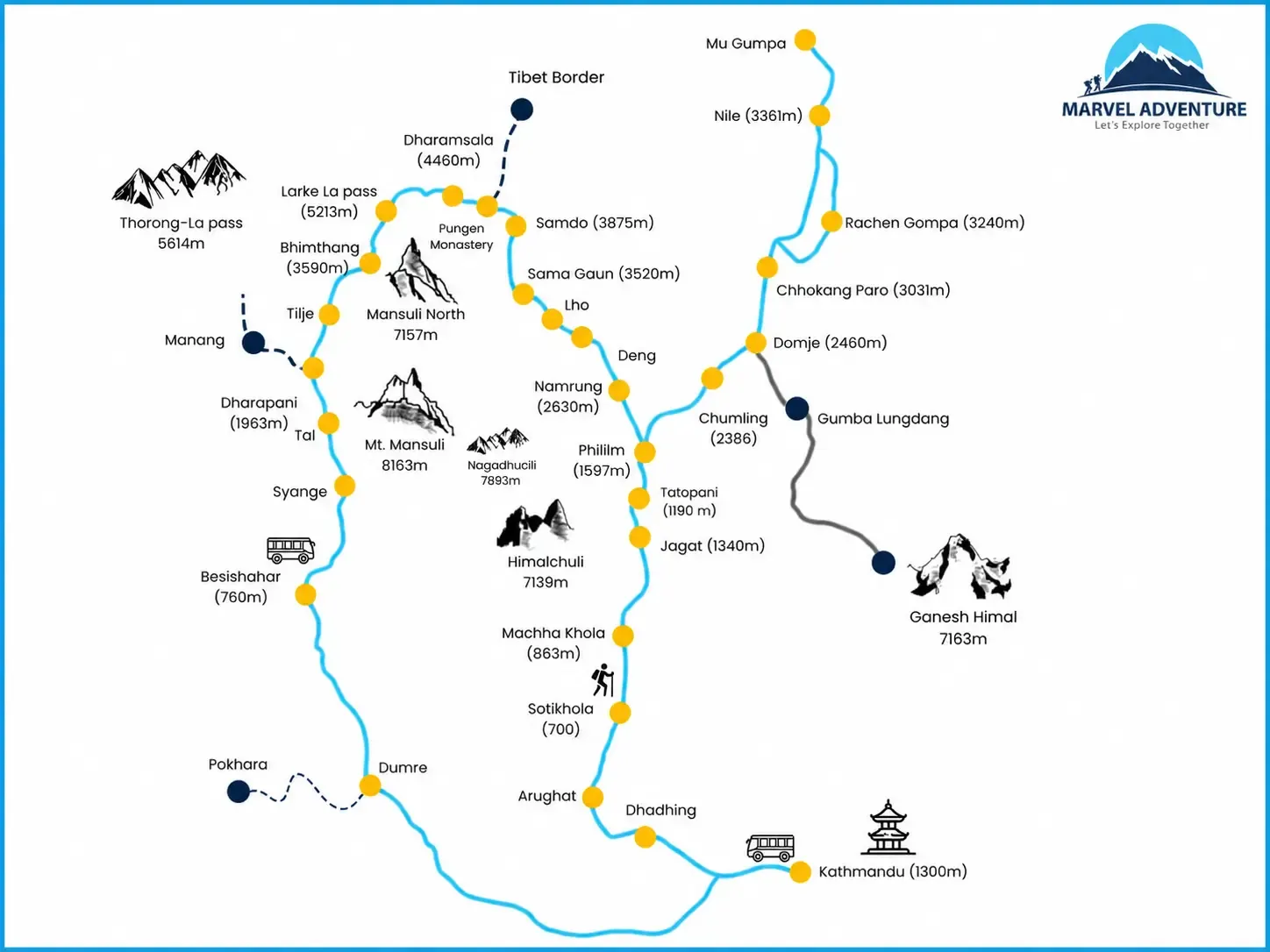
Route Map & Altitude Profile

Cost Details

Includes

  • Airport pick-up and drop-off by private vehicle
  • Standard meals (breakfast, lunch, and dinner) during the trek
  • Government license holder guide 
  • Strong and helpful porter with proper equipment (1 porter for 2 people)
  • Salary, food, accommodation, and insurance for guides and porters 
  • Tea house/lodge accommodation during the trek
  • Fresh fruits every night after dinner
  • Public bus transportation as per the itinerary
  • ACAP and MCAP entry permits
  • Special permits for the Manaslu region and Tsum Valley
  • Comprehensive first aid kit with an oximeter to measure oxygen level daily
  • All government and local taxes

Dates & Availability

Aug 2026
Sep 2026
Oct 2026
Nov 2026
Dec 2026
Jan 2027
Feb 2027
Mar 2027
Apr 2027
May 2027
Jun 2027
Jul 2027
Aug 2027
Sep 2027
Oct 2027
Nov 2027
Dec 2027
Start Date
02 Aug, 2026
End Date
20 Aug, 2026
Status
Guaranteed
Price
US$1800
US$1950
Start Date
06 Aug, 2026
End Date
24 Aug, 2026
Status
Guaranteed
Price
US$1800
US$1950
Start Date
09 Aug, 2026
End Date
27 Aug, 2026
Status
Guaranteed
Price
US$1800
US$1950
Start Date
13 Aug, 2026
End Date
31 Aug, 2026
Status
Guaranteed
Price
US$1800
US$1950
Start Date
16 Aug, 2026
End Date
03 Sep, 2026
Status
Guaranteed
Price
US$1800
US$1950
Start Date
20 Aug, 2026
End Date
07 Sep, 2026
Status
Guaranteed
Price
US$1800
US$1950
Start Date
23 Aug, 2026
End Date
10 Sep, 2026
Status
Guaranteed
Price
US$1800
US$1950
Start Date
27 Aug, 2026
End Date
14 Sep, 2026
Status
Guaranteed
Price
US$1800
US$1950
Start Date
30 Aug, 2026
End Date
17 Sep, 2026
Status
Guaranteed
Price
US$1800
US$1950

If there is only one person for the trip, there will be a USD 200 additional cost.

Meet Our Expert Guides

Khilaraj Nachhiring
Trekking Guide
Phinjo Sherpa
Trekking Guide
Dibash Mainali
Trekking Guide
Dinesh Rai
Trekking Guide

Equipment List

Upper Body Layers
  • Breathable, quick-dry base layers
  • Comfortable t-shirts
  • Lightweight insulating jacket
  • Down jacket for cold conditions
  • Waterproof and windproof jackets
Lower Body Layers
  • Thermal base layer
  • Waterproof trekking pants
  • Comfortable pants for evenings in teahouses
  • Comfortable hiking shorts for warmer sections
  • Waterproof and windproof outershell for rain or snow
Footwear & Accessories
  • Trekking boots with ankle support (preferably Waterproof)
  • Multiple pairs of quick-dry socks
  • Warm socks for cold nights
  • Gaiters for snowy, muddy, or dusty trails
  • Trekking poles to reduce strain on knees
Head & Sun Protection
  • A hat or a cap to block the sun
  • Warm beanie for cold mornings and evenings
  • UV-protected sunglasses
  • Neck gaiter or buff to prevent dust, cold, and sunburn
  • Sunscreen (30-50+ SPF) for face and exposed skin
  • Lipbalm with SPF
Personal & Medical Kits
  • Personal medications
  • Diamox (Acetazolamide) for altitude sickness
  • Ointment
  • Hand sanitizers and wet wipes
  • Quick-dry towel
Travel Documents
  • Valid Passport
  • Passport-sized photos for permits
  • Travel insurance
  • Flight tickets
  • Cash in Nepali Rupees
  • Emergency contact details
Miscellaneous
  • Daypack (30-45L) with raincover
  • Reusable water bottles
  • Headlamps for early morning hikes
  • Water purifying tablet or filter
  • Phone or Camera for capturing the adventure
  • Powerbank for an easier charging option
  • Notebook, books, or cards for free time
  • Snacks like energy bars and chocolates
  • Drybag to keep your gear safe from rain

Essential Information

Manaslu and Tsum Valley Trek Difficulty

Unlike other high-trekking adventures in Nepal, you don’t have to spend a significant amount of time above 4,000 meters in elevation in the Manaslu and Tsum Valley Trek. This beautiful expedition is at a moderate elevation; however, it also doesn’t mean that this Himalayan expedition is like a walk in the park either.

Due to its difficulty factors like trek distance, relatively high elevation, and remoteness, including physical and mental challenges, the Manaslu and Tsum Valley Trek has been graded a ‘moderate’ level of difficulty.

It means that without a proper amount of preparation and determination, this trekking expedition can be a challenging adventure. Here are some brief elaborations on the major difficulty factor of this trekking expedition.

Is this trek suitable for you?

Manaslu and Tsum Valley Trek is a unique and epic adventure that explores the core of both popular Manaslu and Tsum Valley. So, in case you are wondering if you are well-suited for this amazing Himalayan expedition, fret not, this trek has a moderate difficulty level, not as challenging and strenuous as a mountain expedition.

With a basic level of fitness and a good amount of preparation, anyone can complete this glorious Himalayan exploration. As for the age limit, there isn’t a specific age requirement for this trekking adventure; however, this high-altitude trek is not recommended for children below the age of 10. Many trekkers over the age of 70 have completed this trek.

As for the experience, you don’t need prior trekking experience or any technical skills to complete this trek; it also doesn’t matter whether you exercise regularly or if you are into sports. The only thing you have to pay heed to is preparing for this spectacular adventure in the recommended time frame.

Nobody understands your physical capabilities more than yourself, so in the recommended period, you can work on polishing and enhancing your stats. Also, this is a fully guided trekking adventure.

The guide and crew members of Marvel Adventure will pay special attention to your comfort level for the best value experience. So, in case of any discomfort or complication, you will be able to communicate with our team anytime.

Trekking Distance

This 19-day Manaslu and Tsum Valley Trek is a long expedition of the Himalayas that can be physically exhausting if you haven't trained enough. Although it is a slow-paced adventure, you will be trekking for about 5- 6 hours (approx 15- 20 km) on average during each day of the expedition. Still, you get two days to acclimatize properly and get enough rest in between to move along the trail more comfortably.

Trek Remoteness

As Manaslu and Tsum Valley Trek is a remote exploration that explores the northern prospects of the Manaslu region, the services of the region are pretty much limited.

In general, the food and accommodation facilities throughout this remote exploration are pretty much basic; the same goes for transportation, medical facilities, and other modern amenities. So, you have to make peace with yourself for this journey in solitude that takes you farther from a luxurious and modern lifestyle.

Risks of Altitude Sickness

With the rise in elevation points, the risk of getting altitude sickness also potentially rises. As the risk for altitude sickness increases over 2,500 meters, you need to pay attention to the causes of altitude sickness, such as dizziness, nausea, fatigue, shortness of breath, and insomnia.

Staying hydrated throughout the expedition, eating a healthy, balanced diet, and getting enough rest are the best remedies to tackle altitude sickness.

Training and Preparation

With a proper amount of training, you will be able to significantly reduce the difficulty level of this epic adventure in the Himalayas. You won’t find the Manaslu and Tsum Valley Trek very difficult if you have previous experience in high-altitude adventure.

However, if you are a trekking enthusiast who has never been on a high-altitude exploration, you need to prepare at least 4- 6 weeks before this trek starts. If you are already in sports or exercise, then you can assess your own physical ability and determine how much you have to train.

Here are some of the exercises that you can include in your training program for the trek:

Strength and Endurance Exercises

When it comes to the high altitude long day of adventure, you need to enhance your strength and endurance level. You won’t get drained away easily and can endure the long hours of adventure carrying your stuff; your exploration becomes more enjoyable when you are not trying to catch a breather every other minute.

Exercise like planks, deadlifts, weight lifts, pushups, bicep curls, squats, lunges, etc., works best for strength and endurance training. You can also hike up on natural inclining trails carrying a significant weight in your backpack; this will help you get accustomed to the trail demands of the Himalayan region.

Cardiovascular Exercises

Focusing on cardiovascular exercises improves your body’s capability to acclimatize properly to the high altitude. These exercises improve your flexibility and enhance your adaptability for the long hours of trekking with the rising altitude.

Jogging, cycling, jumping rope, dancing, lunges, rowing, etc., are some exercises you could include in your training program to improve your cardiovascular ability.

Manaslu and Tsum Valley Trek FAQs

What is the Manaslu and Tsum Valley Trek?

The Manaslu and Tsum Valley Trek combines the classic Manaslu Circuit with the hidden Tsum Valley. At Marvel Adventure, we often describe it as one of Nepal’s most authentic trekking experiences, blending remote Himalayan landscapes with ancient Tibetan-influenced culture.

How difficult is the Manaslu and Tsum Valley Trek?

The trek is considered challenging due to its length, remote terrain, and high altitude. Most trekkers find the long trekking days more demanding than the trails themselves.

Is the Manaslu and Tsum Valley Trek suitable for beginners?

Honestly, No. And we'd rather tell you that upfront than have you find out later. The trek is remote, the rescue infrastructure is limited compared to more popular routes, and the Larkya La crossing demands both physical and mental reserves that take experience to build. If this is your first Himalayan trek, we recommend EBC or the Annapurna Circuit first.

How many days does the Manaslu and Tsum Valley Trek take?

Our standard itinerary takes around 19 days to complete the entire trek. We can also customize your itinerary depending on the route, acclimatization schedule, and side trips included along the way.

What is the highest altitude reached during the trek?

The highest point is Larkya La Pass at approximately 5,106 meters. The Tsum Valley section stays at lower elevations before joining the Manaslu Circuit route.

Is altitude sickness common on the Manaslu and Tsum Valley Trek?

Mild AMS symptoms are common above 3,500m, with headaches, fatigue, and disrupted sleep affecting most trekkers at some point on this circuit. On the Manaslu Circuit, descending quickly isn't always straightforward, and helicopter access depends heavily on weather. This is exactly why proper acclimatization at Samagaun is non-negotiable on our itineraries.

What makes Tsum Valley special?

Tsum Valley is a hidden Himalayan sanctuary tucked into the northern corner of the Manaslu Conservation Area, bordering Tibet. It's one of the last places in Nepal where ancient Tibetan Buddhist culture has survived largely.

Is Tsum Valley less crowded than Everest and Annapurna?

Yes, the trail is significantly less crowded than the classic Everest or Annapurna trek. You will realize, many days on the trail feel quiet and remote compared to Nepal’s more popular trekking regions.

Why is Tsum Valley called the Hidden Valley?

The valley remained isolated from mainstream tourism for many years. Its unique culture, traditions, and remote location have earned it the nickname "Hidden Valley." To be fair, you will truly understand the answer to this while you are on the trail.

What are the main highlights of the Manaslu and Tsum Valley Trek?

The highlights of the Manaslu and Tsum Valley trek include Tsum Valley, Mu Gompa, Rachen Gompa, traditional Tibetan villages, Manaslu views, Samagaon, and crossing Larkya La Pass. The remoteness and the culture that you will experience during the trail are truly amazing.

Do I need a guide for the Manaslu and Tsum Valley Trek?

Yes, on this route it's both a legal requirement and a genuine safety necessity. The Manaslu Restricted Area permit cannot be issued without a licensed guide. Beyond the regulation, the trail marking is inconsistent, and the Larkya La approach involves navigation above the snowline. Our guides know this circuit well, including which teahouses to trust, where the trail disappears in snow, and when the weather window for the pass is closing.

What kind of accommodation is available during the trek?

Teahouses are present throughout the trek, but quality and availability vary more dramatically than on the Everest or Annapurna circuits. In the lower sections of the trek, teahouses are basic but consistent. Higher up, the lodges are simple and, in some cases, the only option in the village.

Are hot showers, charging, and Wi-Fi available during the trek?

You can find hot showers at most teahouses, but they usually cost about 3$ - 5$ extra. You can also find common charging ports in the dining hall of the teahouse. However, you might have to wait for your turn, so we always recommend carrying a power bank for your devices. WiFi is available in most of the lodges, but we have noticed that they are quite unreliable at higher altitudes.

Is drinking water safe during the trek?

We suggest not drinking any tap water or untreated streams during the trek. It can be really helpful if you carry a quality water filter or purification tablets. The most practical and widely available option in the mountains is boiled water from the teahouses. Trekkers need to stay hydrated, especially when they are at higher altitudes.

What transportation is used for the Manaslu and Tsum Valley Trek?

The trek starts from Machha Khola, which is a 7-8 hour jeep drive from Kathmandu. At the end of the circuit, we will exit through Dharapani and connect to Pokhara or back to Kathmandu by jeep or tourist bus.

Is this trek more remote than the Manaslu Circuit Trek?

Yes. Tsum Valley receives fewer trekkers and has fewer facilities than the main Manaslu Circuit route. Many trekkers choose it specifically for its remoteness and cultural authenticity.

Is the Tsum Valley section of the trek physically demanding?

The Tsum Valley trail is less about extreme altitude and more about sustained days on a remote, rugged trail with very limited teahouse infrastructure. The valley reaches around 3,710m at its upper end near Mu Gompa, high enough to feel, but lower than Larkya La.

What permits do I need for the Manaslu and Tsum Valley Trek?

You'll need the Manaslu Restricted Area Permit (RAP), the Tsum Valley Restricted Area Permit (separate from the Manaslu RAP and priced differently), the Manaslu Conservation Area Permit (MCAP), and a TIMS card. Both restricted area permits require a licensed guide and a minimum of two trekkers.

Why book the Manaslu and Tsum Valley Trek with Marvel Adventure?

Based on our experience operating treks in restricted regions, this route requires careful permit management, acclimatization planning, and local knowledge. Our guides help trekkers experience both the cultural richness of Tsum Valley and the adventure of the Manaslu Circuit while keeping the journey smooth, safe, and enjoyable.

Price Per Person
US$1800
US$1950
All inclusive price
  • 2 - 4 paxUS$1800
  • 5 - 9 paxUS$1700
  • 10 - 20 paxUS$1600
Book This Trip
Talk to Our Travel Experts

What Our Clients Say

January 10, 2026
Tsum Valley

November last year I was travelling with the travel agency XYZ in Nepal for a month, 18 days of which were net in the mountains. We did the Tsum Valley tour and hiked over the...

S
Sherpa47791737210
France
December 06, 2025
authentic 2-week trek around the Manaslu and Tsum Valley

We did a 2-week trek around the Manaslu Circuit and into the Tsum Valley. Everything was well planned from start to finish. Preliminary meeting at the hotel. The arrival and departure was organized by jeeps....

F
Frederic
France

You May Also Like

manaslu circuit trek
Duration: 12 Days
5.0(4 Reviews)

Manaslu Circuit Trek

US$1175US$1175
Difficulty Level: Moderate
short manaslu circuit trek
Duration: 8 Days
5.0(2 Reviews)

8 Days Short Manaslu Circuit Trek

US$975US$1075
Difficulty Level: Moderate
budget manaslu circuit trek
Duration: 10 Days
5.0(1 Reviews)

10 Days Budget Manaslu Circuit Trek

US$965US$965
Difficulty Level: Moderate
Need Help? Call Us+977 986-0313572