
Nir Karki
Talk to an Expert (Nir Karki)
Last-minute Deals
Book Now
Price from
US$1995

Manaslu and Annapurna Circuit Trek

257 reviews
29 reviews
Duration
21 Days
Trip Grade
Strenuous
Country
Nepal
Maximum Altitude
5,416m
Group Size
Min 2 pax
Best Time
(Sep-Nov) and (Mar-May)

Manaslu and Annapurna Circuit Trek is an incredible expedition that combines two of the mainstream trekking routes of the Himalayan region in a single itinerary.

This 21-Day adventure takes you across scenic landscapes, popular highlights, religious landmarks, and the vibrant traditional high Himalayan settlements of both the Manaslu and Annapurna regions.

Besides the exploration of the Manaslu Conservation Area and Annapurna Conservation Area, you will also take on two of the fascinating high Himalayan passes, like Larkya La Pass [5,106 meters/ 16,751 feet] and Thorong La Pass [5,416 meters/ 17769 feet] in this expedition.

Following the circumnavigating trails around the eighth-highest mountain in the world, Mt. Manaslu [8,163 meters/ 26,781 feet], during the first part of this adventure, you will then move along the exploration of the foothills of the tenth-highest mountain in the world, Mt. Annapurna [8,091 meters/ 26,545 feet].

Manaslu and Annapurna Circuit Trek is a remarkable Himalayan adventure if you are looking for an extended adventure to explore the magnificent regions beneath two of the towering massifs in the Himalayas.

Trip Highlights

  • Thrilling adventure of the two 8,000-meter class mountains in the Himalayas: Manaslu (8,163 m) and Annapurna (8,091 m)
  • Exploration of the diverse flora and fauna of the Manaslu Conservation Area (est. 1998) and Annapurna Conservation Area (est. 1985)
  • Traversing across two high Himalayan passes, Larkya La Pass and Thorong La Pass
  • Incredible views of the Himalayan peaks like Manaslu, Lamjung, Annapurna, Dhaulagiri, Tukuche, Ganesh Himal, Himchuli, and Gangapurna
  • Glacial lakes, deep gorges, Himalayan streams, and charming waterfalls of both naturally flourishing regions
  • A diverse trekking trail passing through the traditional villages of Gurung, Magar, Nubri, and the Tsum ethnic group
Manaslu and Annapurna Circuit Trek Detailed Itinerary

Day 1

Drive from Kathmandu (1,400m) to Machhakhola (870m)

You will start your Manaslu and Annapurna Circuit Trek on Day 1 with a scenic drive from Kathmandu to Machhakhola. Driving on Prithivi Highway, you will follow the crusading Trishuli and Marshyangdhi Rivers. Proceed further on your driving trails; you will drive past several settlements, lush high hills, fascinating settlements, streams, and waterfalls, enjoying the stunning Himalayan vista on the left corner.

After crossing the Trishuli River to head toward Dhading Bensi, you will continue toward Arughat, following the Dorandi Khola to the north. Then, from here, moving past the traditional Gurung and Magar settlements at the Sotikhola, you will reach Machhakhola, your resting destination tonight after a long day’s drive.

Max Altitude: 870m (2,854ft)
Duration: 8-9 hours
Distance: 160 km
Meals: Breakfast, Lunch and Dinner
Accommodation: Lodge
Mode of Transportation: Bus
Day 2

Trek to Jagat (1,350m)

Commencing the trekking adventure from Day 2 in your Himalayan exploration, you will cross the Tharo Khola during the first part and head upstream to Khola Beni. The route stretching forward across a bridge takes you to the small settlement of Khorlabesi and then onward to Tatopani, the natural hot spring in the area.

Then, moving forward with this day’s trekking adventure, you will follow the eastern bank of the Budhi Gandaki River and cross a suspension bridge heading toward Doban. From here, you will cross another suspension bridge, over the Yaru Khola to reach the stone stairs of the Thado Bharyang. During the last stretch of this day’s adventure, you will cross the west bank of the Budhi Gandaki River, follow the ridge over the river, and finally arrive at Jagat, the entrance of the Manaslu Conservation Area.

Max Altitude: 1,350m (4,429ft)
Duration: 6-7 hours
Distance: 22 km
Meals: Breakfast, Lunch and Dinner
Accommodation: Teahouse
Day 3

Trek to Deng (1,860m)

After breakfast, moving further ahead with the trekking adventure of this day, you will leave the Jagat behind and follow the ascending trails over the village, heading toward Salleri. The trail further ahead then descends to the Sirdibas village and moves along the wide Budhi Gandaki River Valley, continuing upstream the Ghatta Khola.

Then, after crossing a suspension bridge over the river, you will push for the large traditional Gurung settlement of Philim. From here, the trail stretches toward the north across the millet fields toward Ekle Bhatti and descends on the grassy slopes to cross the Budhi Gandaki River. Your trekking trail further up ahead goes across the east bank of the river through bamboo forests; then, after passing Pewa, you will shortly arrive at Deng.

Max Altitude: 1,860m (6,102ft)
Duration: 6-7 hours
Distance: 20 km
Meals: Breakfast, Lunch and Dinner
Accommodation: Teahouse
Day 4

Trek to Namrung (2,630m)

It’s an exciting day trekking adventure in your iconic Himalayan exploration; ascending past the Rana, you will push for the Bhi. Then, moving across the captivating rhododendron, fir, and pine forests, you will head toward Ghap. You will also have the opportunity to enjoy the spectacular views of the Siringi Himal from the Prok Village.

Proceeding further with your trekking route, you will cross the Budhi Gandaki River several times on this day and trek closer to the Tibetan border. As you get closer to Namrung, you will be able to witness the Tibetan culture-influenced communities and monasteries. This beautiful high-altitude settlement is just 6 km farther from the Tibetan border; the natives of the region speak the Tibetan language and follow Tibetan culture and traditions.

Max Altitude: 2,630m (8,628ft)
Duration: 5-6 hours
Distance: 19 km
Meals: Breakfast, Lunch and Dinner
Accommodation: Teahouse
Day 5

Trek to Shyala

It's a short and scenic day’s trekking adventure in your Himalayan exploration; after breakfast, you will trek past the lush landscapes across the rhododendron, fir, and oaks forest heading toward Lihi. Then, moving further in your trekking trail, enjoying the incredible views of Himalayan massifs like Manaslu, Ganesh Himal, and Himchuli, you will arrive at Sho.

A short trekking distance from the Sho village will then take you to the Lho Village, which is known for its traditional settlements of stone houses and the rich Tibetan-culture-influenced lifestyle of the natives. From here, you will trek for about one and a half hours to reach Shyala Village, your resting destination tonight; this charming high-altitude settlement offers a stunning view of the Ngadi Chuli to the southwest side.

Trek Duration: 4 hours

Trek Distance: 13 km

Duration: 4-5 hours
Distance: 16.5 km
Meals: Breakfast, Lunch and Dinner
Accommodation: Teahouse
Day 6

Trek to Samagaun (3,500m) via Pungyen Monastery

Leaving one of the largest villages in the Manaslu Conservation Area behind, today, after breakfast, you will again traverse across lush pine and rhododendron forest. Enjoying the stunning views of the Manaslu, you will move along the yak pastures on the trail and head toward Pungyen Monastery.

After reaching the monastery, it is mostly a downward trek. Samagaun is at a distance of just 5km from Pungyen, and you will enjoy trekking on the gradual trail before arriving at the Kani Gate, the entrance point of Samagaun. Along the trekking trail, the spectacular views of Manaslu and Himalchuli will loom on the south side, and meanwhile, the pristine Ganesh Himal greets you on the east side. Enjoying the hospitality of the Nubri inhabitants, you will rest here tonight, enjoying the magical Himalayan ambiance.

Trek Duration: 5-6 hours

Trek Distance: 8 km

Max Altitude: 3,500m (11,482ft)
Duration: 4-5 hours
Distance: 17 km
Meals: Breakfast, Lunch and Dinner
Accommodation: Teahouse
Day 7

Acclimatization at Samagaun

You will take a break from your Himalayan expedition on this day, as you have gained a significant altitude; today will be a rest day. You will use this day in your Manaslu and Annapurna Trek to acclimatize properly to the rising altitude before proceeding any further.

Samagaun is a perfect acclimatizing destination with a lot of exploration prospects; you can do hikes to Birendra Tal, or the Manaslu Base Camp [4,800 meters/ 15,748 feet] that are popular among trekkers. In the evening, you can just stroll around the traditional village, exploring the immersive culture and traditions of the natives. Overnight stay at Samagaun.

Max Altitude: 3,500m (11,482ft)
Meals: Breakfast, Lunch and Dinner
Accommodation: Teahouse
Day 8

Trek to Samdo (3,860m)

Starting your trek after breakfast on this exciting day’s adventure, you will traverse across the terraced fields and old mani walls as you descend down to the Budhi Gandaki River. Moving further ahead in your trekking trail, you will cross the junction point of the Birendra Tal and the Manaslu Base Camp to reach Kermo Kharka.

During the last stretch of this day’s trekking adventure, you will cross a wooden bridge over the Budhi Gandaki River and arrive at Kani, the entrance gate of the Samdo Village. You will rest here tonight, enjoying the magnificent views of the Pangpche Peak [6,620 meters/ 21,719 feet] and other adjacent massifs.

Max Altitude: 3,860m (12,664ft)
Duration: 5-6 hours
Distance: 16.5 km
Meals: Breakfast, Lunch and Dinner
Accommodation: Teahouse
Day 9

Trek to Dharamsala (4,480m)

Today, you will head toward Dharmasala, also known as ‘Larkya La Phedi,’ the last resting destination (temporary tent) before Larkya La Pass. During the first leg of this day’s trekking adventure, after breakfast, you traverse across suspension bridges over the Budhi Gandaki River. Then, the ascending trail from here takes you across a bridge, Mani's walls, and some stone huts along the route before reaching Larkya Bazaar.

This bazaar used to be an old salt trade hub, where people from all over the valley used to come to buy salt. A short walk from here will take you to Dharamsala; it is not your typical teahouse lodging facility but more of a resting destination for the trekkers in the region. Dharamsala is the highest rest destination in the entire Manaslu Circuit Trek.

Max Altitude: 4,480m (14,698ft)
Duration: 5-6 hours
Distance: 11.7 km
Meals: Breakfast, Lunch and Dinner
Accommodation: Teahouse
Day 10

Trek to Bimthang (3,720m) over Larkya La Pass (5,106m)

It is an epic day’s trekking adventure today, as this day’s journey will take you across one of the highest Himalayan passes, Larkya La Pass. After breakfast, you will follow the ascending trail to reach the north side of the Larkya Glacier; then, you will continue your trek across the glacial moraines to reach the Larkya La Pass. You will cover an approximate distance of 7.1 km to reach the top of the pass; moving slowly on the steep section of the pass, you will reach the top. From here, you will catch incredible views of the Himalayan peaks like Manaslu, Naike Peak, Pangboche Peak, Larkya Peak, Annapurna II, Kusum Kanguru, and Himlung Himal.

After releasing the magical ambiance of the mystic Himalayas from the top of the pass, you will begin your descent to the west toward a grassy moraine. First, you will reach Bhimthakoti [3,942 meters/ 12,933 feet] during your descent, which is at a distance of 6.9 km from the top of the pass. Then, trekking across a small meadow, you will head down to a wide open meadow and enter the treeline sections. From here, the trail stretches all the way to Bimthang, past an old mani wall and a small rest house. You will trek about 3 km to reach Bimthang from Bhimthakoti, your resting destination tonight.

Max Altitude: 3,720m (12,204ft)
Duration: 6-7 hours
Distance: 24 km
Meals: Breakfast, Lunch and Dinner
Accommodation: Teahouse
Day 11

Trek to Dharapani (1,960m)

Proceeding further with your descending trail after completing the exploration of the Manaslu region, you will make your descent to Surki Khola during the first leg. Then, proceeding further in this day’s trekking adventure, you will descend to the Dudh Khola and Soti Khola, heading toward the Gho Village. Then, you will move further ahead across the terraced farmlands and lush forested areas on the north bank of the Dudh Kholka to reach the Gurung village of Tilije.

From here, you will continue descending further to reach Thonje, and during the final leg of this day’s trek, you will cross a suspension bridge over the Marsyangdi River to reach Dharapani. Overnight stay at Dharapani.

Max Altitude: 1,960m (6,430ft)
Duration: 6-7 hours
Distance: 22 km
Meals: Breakfast, Lunch and Dinner
Accommodation: Teahouse
Day 12

Trek to Chame (2,650m)

Moving further with the second part of your iconic Himalayan exploration in your Manaslu with Annapurna Circuit Trek, on this day, you will follow the lush pine, fir, oak, and rhododendron forests to reach Danakyu Village during the first leg. In this day’s scenic trekking trail alongside the Marsyangdi River, you will be accompanied by spectacular peaks in the Himalayas, like Lamjung Himal, Annapurna II, and other adjacent peaks.

Following the steep climbing section up ahead, you will then make your way to the Timang Village. Chame, the headquarters of the Manang district, is just at a short walking distance from Timing on the gradual route. You can visit the natural hot spring on the banks of the Marsyangdhi River after your arrival at Chame before turning in for the night.

Max Altitude: 2,650m (8,694ft)
Duration: 5-6 hours
Distance: 15.7 km
Meals: Breakfast, Lunch and Dinner
Accommodation: Teahouse
Day 13

Trek to Upper Pisang (3,300m)

After breakfast, you will continue your trek alongside the Marsyangdi River on its northern bank. Moving further ahead in your trekking trail, you will pass the Paungda Danda Rock, 1,500 meters (4,921 feet) above the Marsyangdi River, before you follow the steep ascend through the lush pine forest to reach the top of the ridge.

As you continue forward in this day’s trekking adventure, It will take about 2 hours for you to reach the Bhratang Village. Along the route, the spectacular views of the Lamjung, Pisang, and Annapurna peaks will accompany your adventure on this day. Then, after you cross the Dikur Pokhari, your trekking trail further ahead descends to the floor of the Manang Valley, and you will shortly reach Lower Pisang. From here, you will climb about 50 meters on the other side of the river to reach your resting destination tonight, Upper Pisang.

Max Altitude: 3,300m (10,826ft)
Duration: 5-6 hours
Distance: 14 km
Meals: Breakfast, Lunch and Dinner
Accommodation: Teahouse
Day 14

Trek to Manang (3,519m)

On this day, you will ascend further toward the heart of the Annapurna region. You will follow the ascending route alongside a river to the northwest and enter a pine forest; moving past the Green Lake in the middle of the forest, you will make your way to Ghyaru. This high-altitude village offers astonishing views of Annapurna II, III, and IV, Tilicho Peak, Pisang Peak, and Gangapurna.

Proceeding further in this day’s trekking route, you will traverse past the Tibetan settlements and spiritual trails with chortens and praying flags. Then, you will make your way to Ngawal Village [3,660 meters/ 12,007 feet], which is at a trekking distance of 2 hours from Ghyaru. From here, a short trekking distance will take you to Manang; on the trail, you will also get the opportunity to explore the largest monastery in the region, Braga Monastery.

Max Altitude: 3,519m (11,545ft)
Duration: 6-7 hours
Distance: 19 km
Meals: Breakfast, Lunch and Dinner
Accommodation: Teahouse
Day 15

Exploration and acclimatization day at Manang

This will be the second acclimatization day in your Manaslu Annapurna Circuit Trek itinerary; you will use this day to explore the vibrant settlement of Manang and acclimatize properly to the rising altitude. For an effective acclimatization process, you can do some short hikes to Ice Lake and Gangapurna Lake, which are popular among trekkers.

You can also visit the Himalayan Rescue Association at Vraja Village or just stroll around the beautiful village, checking out this fascinating high-altitude tourist destination. Overnight stay at Manang.

Max Altitude: 3,519m (11,545ft)
Meals: Breakfast, Lunch and Dinner
Accommodation: Teahouse
Day 16

Trek to Yak Kharka (4,020m)

After acclimatizing properly to the rising altitude, you will proceed further with your inclining route. During the first part of this day’s trek, you will cross a stream ascending toward the Tenki Village. On this day, you will leave behind the Marsyandgi Valley and head north, pushing for the Jar Sang Khola Valley.

Then, traversing across the yak pasture and juniper forests, you will make your way toward the Gunsan Village. Ascending trail stretching ahead of this village across a wooden bridge then takes you to the wide, peaceful meadow of the Yak Kharka.

Max Altitude: 4,020m (13,188ft)
Duration: 4-5 hours
Distance: 9.5 km
Meals: Breakfast, Lunch and Dinner
Accommodation: Teahouse
Day 17

Trek to Thorong Phedi (4,560m)

After breakfast, you will leave Yak Kharka behind and follow the ascending route, crossing a wooden bridge over the Marsyangdi River to reach Ledar Village. Trekking further ahead, you will move along the east bank of the Jarang Khola and switch to the narrow trail across a narrow slope that descends to Thorong Phedi.

Thorong Phedi is the last Himalayan village before the Thorong La Pass, and from its vantage point, you will be able to enjoy the rewarding views of the Himalayan peaks like Chulu East, Chulu West, and other adjacent peaks from here.

Max Altitude: 4,560m (14,960ft)
Duration: 3-4 hours
Distance: 7.3 km
Meals: Breakfast, Lunch and Dinner
Accommodation: Teahouse
Day 18

Trek to Muktinath (3,760m) via Thorong La Pass (5,416m)

Today, you will take on another high Himalayan pass of this expedition, Thorong La Pass. Following the ascending ridge from Thorong Phedi, you will proceed to the eastern climbing route of the pass. Although it is a slightly tiring day’s adventure, the incredible and refreshing views of the Himalayan gems like Annapurna, Gangapurna, Dhaulagiri, Khatungkang, and other adjacent peaks will help you forget your tiresome journey.

After enjoying the views from the top of this pass, you will then follow the descending trail toward Muktinath from the west side of the pass. Muktinath is a significant religious site for both Hindus and Buddhists; there are 108 stone taps inside the temple flowing from the Kaligandaki River and an eternal flame that has been burning continuously for more than 2,000 years.

Max Altitude: 3,760m (12,335ft)
Duration: 6-7 hours
Distance: 14.5 km
Meals: Breakfast, Lunch and Dinner
Accommodation: Lodge
Day 19

Muktinath to Tatopani Drive (1,190m)

After immersing in the spiritual vibration of this religious site, you will proceed toward your descending journey. Boarding in a comfortable vehicle after breakfast, you will drive past some of the deepest gorges, scenic landscapes, and lush forests, and across the charming Himalayan settlements like Ghasa, Marpha, and Jomsom to reach Tatopani.

This vibrant settlement in the Annapurna region is famous for its natural hot spring with healing properties. You can take a dip here and relax after a long day’s drive to end this day’s adventure on a high note.

Max Altitude: 1,190m (3,904ft)
Duration: 6-7 hours drive
Distance: 71 km
Meals: Breakfast, Lunch and Dinner
Accommodation: Lodge
Day 20

Drive from Tatopani to Pokhara (820m)

Bidding farewell to the Himalayan region, today, you will make your descent to Pokhara. Following the trails alongside the Kali Gandaki River, you will drive past the terraced farmlands, lush forests, and beautiful traditional settlements along the way before reaching Pokhara.

After arriving at Pokhara, you can get some rest and do some sightseeing exploration around this bustling tourist hub. This will be the first day back to modern urbanization after a long Himalayan journey, so you will have plenty of opportunities to explore the top-tier restaurants, cafes, and bars. Tonight, you will rest comfortably in a star hotel, enjoying the luxurious amenities.

Max Altitude: 820m (2,690ft)
Duration: 5-6 hours drive
Distance: 105 km
Meals: Breakfast, Lunch and Dinner
Accommodation: Hotel
Day 21

Drive back to Kathmandu (1,400m) on a tourist bus

It is time to wrap up your remarkable expedition in the Himalayas; this day will officially mark the end of your remarkable Himalayan exploration. After eating breakfast, you will board a comfortable tourist bus. You will rejoin the soaring Marsyangdi River and Trishuli River along your driving trail as you drive past the dense forest, beautiful settlements, high hills, and charming streams and waterfalls as you make your way back to Kathmandu.

After arriving in Kathmandu, you will be dropped back at your respective hotels; you can use the rest of the day to check out the cafes, restaurants, or do some sightseeing of the nearby landmarks. Thank you for trekking with Marvel Adventure; we hope to see you again. Have a safe journey!

Max Altitude: 1,400m (4,593ft)
Duration: 8-9 hours drive
Distance: 204 km
Meals: Breakfast and Lunch
Accommodation: Hotel
Have Questions? We're Here to Help
Like this itinerary but want to make a few changes? Every traveler is unique, and your journey should be too. Our local travel experts will design a personalized experience tailored to your interests, preferred pace, travel dates and budget.
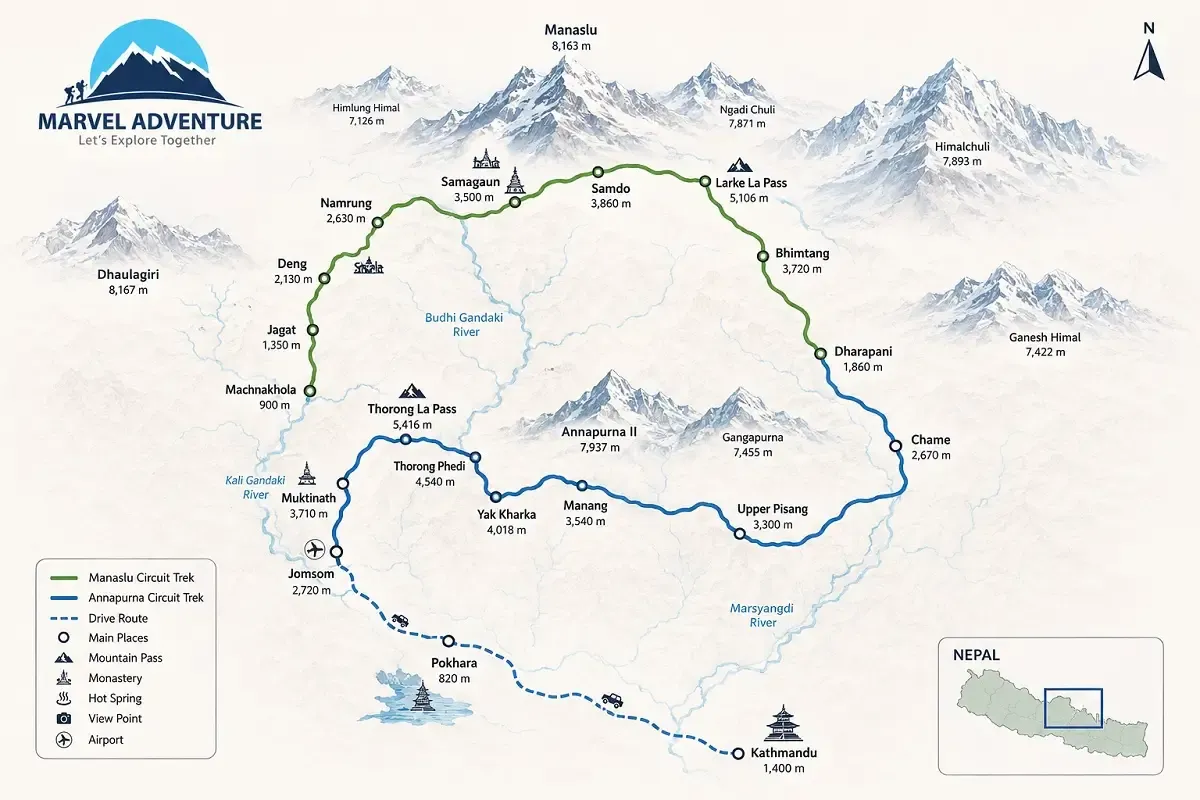
Route Map & Altitude Profile

Cost Details

Includes

  • Airport pick-up and drop-off by private vehicle
  • Government license holder guide with local expertise
  • Strong and helpful porter with proper equipment (1 porter for 2 people)
  • Salary, food, accommodation, and insurance for the guide and porter
  • 1-night Hotel in Pokhara on a BB basis
  • Tea house/lodge accommodation during the trek
  • Standard meals (breakfast, lunch, and dinner) during the trek
  • Fresh fruits every night after dinner
  • All land transportation as per the itinerary
  • ACAP and MCAP entry permits
  • Manaslu Restricted Area Permit
  • Comprehensive first aid kit with an oximeter to measure your oxygen level daily
  • All government taxes and official expenses
  • Duffel bag, sleeping bag, down jacket, and walking poles for the trek

Dates & Availability

Aug 2026
Sep 2026
Oct 2026
Nov 2026
Dec 2026
Jan 2027
Feb 2027
Mar 2027
Apr 2027
May 2027
Jun 2027
Jul 2027
Aug 2027
Sep 2027
Oct 2027
Nov 2027
Dec 2027
Start Date
02 Aug, 2026
End Date
22 Aug, 2026
Status
Guaranteed
Price
US$1995
US$2200
Start Date
05 Aug, 2026
End Date
25 Aug, 2026
Status
Guaranteed
Price
US$1995
US$2200
Start Date
09 Aug, 2026
End Date
29 Aug, 2026
Status
Guaranteed
Price
US$1995
US$2200
Start Date
12 Aug, 2026
End Date
01 Sep, 2026
Status
Guaranteed
Price
US$1995
US$2200
Start Date
16 Aug, 2026
End Date
05 Sep, 2026
Status
Guaranteed
Price
US$1995
US$2200
Start Date
19 Aug, 2026
End Date
08 Sep, 2026
Status
Guaranteed
Price
US$1995
US$2200
Start Date
23 Aug, 2026
End Date
12 Sep, 2026
Status
Guaranteed
Price
US$1995
US$2200
Start Date
26 Aug, 2026
End Date
15 Sep, 2026
Status
Guaranteed
Price
US$1995
US$2200
Start Date
30 Aug, 2026
End Date
19 Sep, 2026
Status
Guaranteed
Price
US$1995
US$2200

If there is only one person for the trip, there will be a USD 150 additional cost.

Meet Our Expert Guides

Khilaraj Nachhiring
Trekking Guide
Phinjo Sherpa
Trekking Guide
Dibash Mainali
Trekking Guide
Dinesh Rai
Trekking Guide

Equipment List

Upper Body Layers
  • Breathable, quick-dry base layers
  • Comfortable t-shirts
  • Lightweight insulating jacket
  • Down jacket for cold conditions
  • Waterproof and windproof jackets
Lower Body Layers
  • Thermal base layer
  • Waterproof trekking pants
  • Comfortable pants for evenings in teahouses
  • Comfortable hiking shorts for warmer sections
  • Waterproof and windproof outershell for rain or snow
Footwear & Accessories
  • Trekking boots with ankle support (preferably Waterproof)
  • Multiple pairs of quick-dry socks
  • Warm socks for cold nights
  • Gaiters for snowy, muddy, or dusty trails
  • Trekking poles to reduce strain on knees
Head & Sun Protection
  • A hat or a cap to block the sun
  • Warm beanie for cold mornings and evenings
  • UV-protected sunglasses
  • Neck gaiter or buff to prevent dust, cold, and sunburn
  • Sunscreen (30-50+ SPF) for face and exposed skin
  • Lipbalm with SPF
Personal & Medical Kits
  • Personal medications
  • Diamox (Acetazolamide) for altitude sickness
  • Ointment
  • Hand sanitizers and wet wipes
  • Quick-dry towel
Travel Documents
  • Valid Passport
  • Passport-sized photos for permits
  • Travel insurance
  • Flight tickets
  • Cash in Nepali Rupees
  • Emergency contact details
Miscellaneous
  • Daypack (30-45L) with raincover
  • Reusable water bottles
  • Headlamps for early morning hikes
  • Water purifying tablet or filter
  • Phone or Camera for capturing the adventure
  • Powerbank for an easier charging option
  • Notebook, books, or cards for free time
  • Snacks like energy bars and chocolates
  • Drybag to keep your gear safe from rain

Essential Information

..

Training and Preparation

To make your Manaslu and Annapurna Trek a remarkable and treasured adventure, you shouldn’t slack off on the preparation part. The general recommended preparation period for this trekking adventure is around 3 to 6 weeks.

However, if you are physically active and have previous high-altitude trekking experience, you may not have to put in too many hours for your preparation. Accordingly, if you are not that physically active and don’t have any prior high-altitude trekking experience, you should put in a few more hours for a comfortable experience.

Generally, this Himalayan journey takes you across the remote part of the Himalayas with many steep sections, so you should emphasize your leg muscles to handle the long days of trekking (trekking duration of 6-7 hours on average).

You will be carrying your backpack all the way throughout the trek, which can be a little vexing at the high altitudes; thus, focusing on strength and endurance training should be your next priority.

Here are some exercises that you can include in your training program during your preparation for the Manaslu and Annapurna Circuit Trek.

Strength and Endurance Exercise

Push-ups, pull-ups, weightlifting, deadlifts, bicep curls, dips, lateral raises, calf raises, squat, lunges, leg press, leg curl, etc.

Cardiovascular Exercises

Jogging, cycling, swimming, dancing, rope jumping, rowing, jumping jacks, lateral shuffle, aerobics, burpees, etc.

If you want a shorter version trek to experience the breathtaking beauty of the Annapurna region, we also offer an Annapurna Circuit Trek 12-day itinerary, allowing you to immerse yourself in the beauty of the Himalayas in a slightly shorter timeframe.

Best Time for Manaslu and Annapurna Circuit Trek

The peak seasons, like autumn (September to November) and spring (March to May), are known as the best seasons for an amazing Himalayan adventure.

For the best value Manaslu and Annapurna Circuit Trek experience, we recommend these peak seasons that have the most suitable weather conditions, warm temperatures, flourishing trekking trails, and clear days to enjoy the incredible views of the Himalayan vistas.

Even among the peak seasons, autumn and spring are known for their distinctive features; autumn is generally known for its stable climate and mild temperatures, perfect for outdoor adventures.

Likewise, spring is popular for its naturally enthralling trekking trails covered with dotted flowers of the blooming season. The stunning visuals of both the fall and blooming seasons are quite admirable if you are planning to do this trek.

You can expect the temperature of the Manaslu and Annapurna regions to average around 14°C to 18°C during the autumn season and can spike up to 23°C during the spring season.

The temperature of both regions is generally in minus degrees at alpine altitude (above 4,000 meters). Thus, make sure to pack accordingly for the journey.

Is Manaslu and Annapurna Circuit Trek Hard?

Manaslu and Annapurna Circuit Trek is a unique combination of the two mainstream trekking regions in the country. This exhilarating Himalayan expedition takes you across the remote high-altitude regions of both the Manaslu and Annapurna regions, so it may seem like a demanding exploration. However, this iconic Himalayan expedition is a ‘moderate to strenuous level’ trekking adventure that explores rugged but simple trekking routes.

You don’t have to overcome any technically demanding sections, and you don’t need to have any kind of prior trekking experience to do this trek. With a good health condition, basic fitness level and adequate preparation, you will be able to complete this exhilarating, extensive Himalayan expedition.

The success rate of the Manaslu and Annapurna Circuit Trek is 96% to 100%; it is a slow-paced adventure with enough acclimatization days for you to enjoy a comfortable and memorable Himalayan adventure.

The Larkya La Crossing

Larkya La (5,106m) is the physical and psychological midpoint of this combined trek. It is not just a high pass, but the transition point between two completely different trekking experiences.

The approach from the Manaslu side

  • Departure from Dharamsala (4,480m) typically starts at 4:00-5:00 am. It is a long, cold approach across glacial terrain before the final push to the pass.
  • The crossing takes most trekkers 7–9 hours, including the descent to Bimthang, which is the longest and hardest single day on the entire combined itinerary.

What makes Larkya La different from Thorong La

  • Larkya La is lower than Thorong La (5,106m vs 5,416m) but significantly more remote, longer, and logistically more demanding, with no teahouse at the top, no stream of other trekkers to follow, and a descent that's steeper and more technically demanding than Thorong La's relatively forgiving downhill to Muktinath.
  • The icy descent on the Bimthang side in early morning or after fresh snowfall is where traction gear matters. Our guides carry microspikes as standard for the crossing day.

The psychological transition

  • Most trekkers describe arriving at Bimthang after Larkya La as a turning point in the overall trip. The physical hardest day behind them, the Annapurna Circuit ahead, and a lodge meal that genuinely tastes better than anything since Kathmandu.
Two Permit Systems in One Trek

This combined route requires more permits than any other standard teahouse circuit in Nepal, and the Manaslu side has a fundamentally different regulatory structure from the Annapurna side.

Manaslu Circuit permits

  • Manaslu Restricted Area Permit (RAP): cost varies by season, requires a minimum group of two trekkers and a licensed guide, with no exceptions at checkposts.
  • Manaslu Conservation Area Permit (MCAP): standard conservation area fee.

Annapurna Circuit permits

  • Annapurna Conservation Area Permit (ACAP): NPR 3,000 for foreign nationals.
  • TIMS Card: NPR 2,000.

Why the permit transition matters logistically

  • Entering the Annapurna Conservation Area from the Manaslu side at Dharapani requires showing both sets of permits at the transition checkpost. It's a step most operators who haven't run this combined route regularly occasionally get wrong.
  • We process all four permits before departure and brief our guides specifically on the checkpost sequence at Dharapani. This is a detail that matters more than it sounds if it goes wrong.
Your Support Team on a Remote Combined Circuit

Why does guide experience on both circuits matter more here than on either alone

  • A guide who knows Larkya La but not Thorong La, or vice versa, is genuinely less equipped for this specific itinerary than for either circuit individually.
  • We're very clear about guide cross-circuit experience at booking and pair groups with guides who have completed the full combined route, not just individual circuits.

Porter structure across two different supply environments

  • Porters need briefing on both permit systems, both checkpoint sequences, and the logistical differences between the remote Manaslu supply chain and the more established Annapurna Circuit infrastructure as the combined trek demands more from support staff than either circuit does individually.

Office contact protocol

  • Our team tracks every group at three specific high-risk points: Larkya La crossing day, the approach to Thorong High Camp, and the Thorong La crossing day. These are the three moments across the combined itinerary where the altitude and remoteness combination is most significant.

Manaslu and Annapurna Circuit Trek FAQs

What is the Manaslu and Annapurna Circuit Trek?

It's one of the great Himalayan combinations with two iconic circuits joined into a single continuous journey. You will start on the Manaslu Circuit, cross the Larkya La Pass (5,106m), then head into the Annapurna Circuit and cross Thorong La (5,416m).

How does this trek differ from doing each route separately?

Doing them separately means two flights and two sets of logistics. In this combined itinerary, you build altitude gradually across the full journey, and the transition between the two circuits feels natural. The Manaslu side is wilder and more remote, whereas the Annapurna Circuit is more established with better teahouse variety. 

How difficult is the Manaslu and Annapurna Circuit Trek?

This is a strenuous, high-altitude trek. It is considered to be one of the more demanding teahouse routes in Nepal. You will be crossing two passes above 5,000m, spending multiple days above 4,000m, and covering 21 days of continuous trekking through remote terrain.

How fit do I need to be for the Manaslu Annapurna Circuit Trek?

You need to be comfortable walking 6-8 hours on consecutive days with a daypack, over varied terrain, at altitude. From our experience, the trekkers who handle this route best are those who've done at least one previous Himalayan trek and maintained regular cardio and hiking fitness in the months before departure.

Can beginners do the Manaslu and Annapurna Circuit Trek?

Honestly, no. This is one of those routes where we actively discourage a complete beginner, not to put you off, but because starting here without Himalayan experience means setting yourself up for a hard time above 4,000m. The Manaslu Annapurna Circuit will still be here, and you'll enjoy it a lot more with the right trekking experience.

What is the highest point of the Manaslu and Annapurna Circuit Trek?

Thorong La Pass on the Annapurna Circuit at 5,416m is the highest point of the combined route. The Larkya La Pass on the Manaslu Circuit reaches 5,106m, which is lower but arguably more demanding due to the remoteness and longer approach.

Is altitude sickness a serious risk on the Manaslu Annapurna Circuit Trek?

Yes, and it's the risk we take most seriously on this route. You're spending more consecutive days above 4,000m than on any other teahouse trek in Nepal. Mild AMS symptoms are common. Our guides carry pulse oximeters, monitor trekkers daily, and make descent calls without compromise if symptoms progress.

What happens if I need a helicopter evacuation on the trek?

Helicopter rescue is available on both circuits, but response times on the Manaslu section can be longer due to the remoteness of the valley and weather dependency. The Annapurna Circuit has slightly better access. Travel insurance covering helicopter rescue up to 6,000m is non-negotiable on this trek. We verify insurance details with every trekker before departure, not as a formality, but because we've seen what happens without it.

How many days does the Manaslu and Annapurna Circuit Trek take?

Our combined itinerary runs 21 days into the Manaslu and Annapurna region. We recommend a minimum of 20 days, as anything shorter than this cuts into acclimatization time on one or both circuits. Give this trek the time it deserves, as it's too good to rush.

Does the trek include Thorong La Pass and Larkya La Pass?

Yes, both pass crossings are included in the trek, and it is what makes it one of the great Himalayan multi-pass treks. Larkya La (5,106m), a long, demanding crossing that starts before dawn and takes most trekkers 7–9 hours. Thorong La (5,416m) is higher and more trafficked but still serious. Both crossings are what most trekkers describe as the highlight of their entire trip.

Is the Manaslu Annapurna Circuit Trek possible in winter?

Possible, but not something we recommend for most trekkers. Larkya La in December and January can be buried in deep snow with limited visibility, and the Manaslu valley teahouses are reduced in number and staffing. Yes, we have guided highly experienced trekkers, but the honest answer for most people is no.

What is the best time to do the Manaslu and Annapurna Circuit Trek?

Spring (March–May) and autumn (September–November) are the best seasons for trekking in Nepal. During these months, the weather is usually stable, and the mountain views around Thorong La and Larkya La are much clearer.

What permits do I need for the Manaslu and Annapurna Circuit Trek?

For the Manaslu Circuit, you need a Manaslu Restricted Area Permit (RAP), a Manaslu Conservation Area Permit (MCAP), and an Annapurna Conservation Area Permit (ACAP). For the Annapurna Circuit, you also need a TIMS card. We handle all permit logistics as part of our packages.

Is a guide compulsory for the Manaslu and Annapurna Circuit Trek?

Yes, and on the Manaslu section, it's a legal requirement. The Manaslu Restricted Area permit cannot be issued to solo trekkers, so you must have a licensed guide. On the Annapurna Circuit, Nepal's trekking regulations also now require a licensed guide. To be honest, beyond regulations, a guide on this combined route is genuinely essential.

Are there ATMs on the Manaslu and Annapurna Circuit Trek?

On the Manaslu side, no. On the Annapurna Circuit, ATMs exist in Besisahar, Chame, and Manang, but reliability is inconsistent, and machines run out of cash during peak season. We always recommend our trekkers to treat them as a backup, not a plan.

What is the accommodation like on the Manaslu and Annapurna Circuit Trek?

Two very different experiences depending on which circuit you're on. The Manaslu valley has basic teahouses with simple rooms and limited facilities, which reflect the remoteness of the route. The Annapurna Circuit is more developed, particularly around Manang and Muktinath, where lodges are comfortable with attached bathrooms in some places.

How difficult is the Larkya La Pass crossing on the Manaslu Circuit?

It's the hardest day on the Manaslu Circuit and one of the more demanding pass crossings in Nepal. The pass itself at 5,106m involves a long, exposed approach above the snowline with a steep technical descent on the far side. In autumn conditions, it's manageable without crampons, but our guides always assess conditions the evening before and carry traction gear as standard.

How difficult is the Thorong La Pass crossing on the Annapurna Circuit?

Thorong La Pass is the highest point of the trek. The climb starts very early in the morning, and the altitude makes everything feel slower and heavier. Most trekkers say the challenge is more about stamina and thin air than technical difficulty. Strong winds are common and can make the exposed sections genuinely dangerous.

Why book the Manaslu and Annapurna Circuit Trek with Marvel Adventure?

Based on our experience, this trek requires careful planning because of permits, logistics, and remote terrain. At Marvel Adventure, we focus on safe pacing, experienced guides, and smooth coordination between both regions so trekkers can fully enjoy the journey without stress.

Price Per Person
US$1995
US$2200
All inclusive price
  • 2 - 5 paxUS$1995
  • 6 - 9 paxUS$1950
  • 10 - 20 paxUS$1900
Book This Trip
Talk to Our Travel Experts

What Our Clients Say

December 10, 2019
Himal Himlung Trek! Spectacular!

Marvel Adventure and its proprietor Nir Karki are THE BEST address for your trekking experience in Kathmandu ! Highly professional, enthusiastic and always there when you need them ! Make sure you specifically ask for...

D
Dominik G
Germany
November 15, 2016
Nice guide and super trek

Last summer, I went to Nepal with friends to trek. I met Nir who‘s a really good trekking guide. He was really nice, reliable and knowledgeable. He cares about everything during the trek : accomodation,...

e
emelinet95
France

You May Also Like

manaslu circuit trek
Duration: 12 Days
5.0(4 Reviews)

Manaslu Circuit Trek

US$1175US$1175
Difficulty Level: Moderate
annapurna circuit trek
Duration: 14 Days
5.0(11 Reviews)

Annapurna Circuit Trek

US$1225US$1225
Difficulty Level: Moderate
annapurna base camp trek
Duration: 11 Days
5.0(15 Reviews)

Annapurna Base Camp Trek

US$795US$795
Difficulty Level: Moderate
Need Help? Call Us+977 986-0313572