
Nir Karki
Talk to an Expert (Nir Karki)
Last-minute Deals
Book Now
Price from
US$1750

Upper Mustang Trek

257 reviews
29 reviews
Duration
14 Days
Trip Grade
Moderate
Country
Nepal
Maximum Altitude
3,840m
Group Size
Min 2 pax
Best Time
(Sep-Nov) and (Mar-May)

Upper Mustang is often called an isolated region of Nepal, located in the Himalayan region in the north-western part of the country. This region is widely praised for its unique culture, striking mountain views, and diverse wildlife, which have been the key to successful tourism prospects throughout the decade.The 

Upper Mustang trek is a rewarding experience, and for travelers looking for a true Himalayan adventure and who are daring, it is the ultimate destination.

Upper Mustang is part of the trans-Himalayan region, which shares its border with Tibet. As it shares a border with Tibet, the culture and religion are somehow immersed in the autonomous region, giving it a unique character. It is home to the famous Buddhist pilgrimage site of Muktinath, so it has great significance from a religious point of view.

The Upper Mustang trek is a great way to explore Nepal's remote and magical part of the Himalayas. You can also experience the traditional lifestyle, culture, and traditions of the people and the community. Along with them, one of the main attractions of Upper Mustang is its outstanding scenery.

The trekking route trails up to the ancient capital, Lo Manthang, where you can view white-washed buildings and surroundings in the picturesque scenery. This place is well known for its beautiful insights, from the snow-capped peaks in the north and barren hills to vast plains to clean blue rivers.

Upper Mustang is very rich in its history and culture. You can find many ancient monasteries and traditional villages in this region. The people around here are mostly of Tibetan traditions; for example, you can visit the Thakali community, which has its distinct culture, language, and practices. Their cuisine, Thakali Khana Set, is one of the most renowned cuisines in the world.

Since most of the community is based on Tibetan culture, Buddhism is the main religion here. Monasteries, chortens, prayer flags, prayer wheels, and mani walls are some of the religious perks you can find. With all this richness in Upper Mustang, the region has become one of the most popular destinations for trekkers worldwide.

Trip Highlights

  • Explore Pokhara city and its tourist destinations like Phewa Lake, Mountain Museum, Sarangkot Hill, Mahendra Gufa, and many more.
  • Visit one of the windiest places in Nepal, Jomsom.
  • Explore the rain-shadow area in the Mustang region.
  • Visit Buddhist monasteries around the Upper Mustang region.
  • Explore Lo Manthang and visit the community rich in Thakali people, culture, and traditions.
  • Flight to Jomsom - Aerial view of the surroundings
Upper Mustang Trek Detailed Itinerary

Day 1

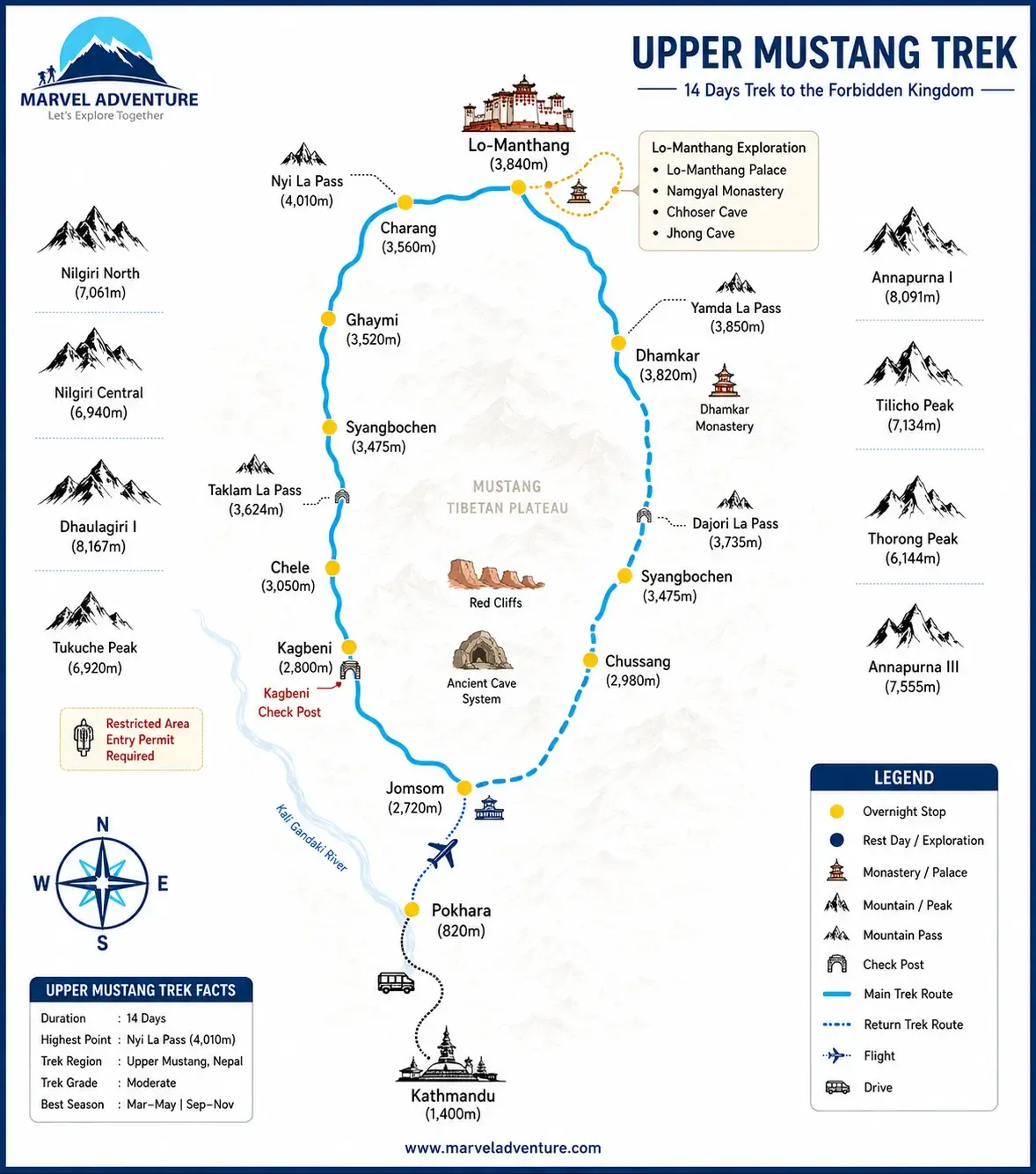
Drive to Pokhara (820m)

It is the first day of your Upper Mustang Trek - you will drive to Pokhara from Kathmandu after landing at Tribhuvan International Airport. Our agents will escort you to the transportation bus, bringing you to Pokhara in around 7 to 8 hours. You will be led to your hotel for an overnight stay. The basic amenities of the hotels in Pokhara include an attached bathroom, hot showers, electricity, and internet services.

Pokhara is a beautiful city of lakes in the mid-western part of Nepal. It is one of the major destinations for tourists all around the world.

Max Altitude: 820m (2,690ft)
Duration: 7-8 hours
Distance: 200 km
Meals: Breakfast, Lunch and Dinner
Accommodation: Hotel
Mode of Transportation: Bus
Day 2

Fly to Jomsom and Trek to Kagbeni (2,800m)

On the second day of your Upper Mustang trek, you will fly to Jomsom, a beautiful place in northern Nepal. You will catch a flight from Pokhara airport and land at Jomsom airport. It only takes around 20 minutes to reach Jomsom.

Jomsom is one of Nepal's windiest places and has a beautiful view of the surroundings and the snow-capped mountains.

After reaching Jomsom, the headquarters of Mustang, you will start a hike to Kagbeni at 2800 meters. You will take an uphill walk through the Kali Gandaki River to reach Kagbeni. Kagbeni is also called the Gateway to Upper Mustang and is a beautiful destination. The local Nepali apple and the wine 'Marpha' are very popular nationwide.

Max Altitude: 2,800m (9,186ft)
Duration: 5-6 hours trek
Distance: 10 km
Meals: Breakfast, Lunch and Dinner
Accommodation: Teahouse
Day 3

Trek to Chele (3,050m)

Once you wake up the following day after reaching Kagbeni, you will prepare to kick off your next hike. Your next destination is Chele, 3050 meters above sea level. It would be best to climb uphill from Kagbeni from the east bank of the Kali Gandaki River.

First, you will reach Chussang village after a short trek, and then climb via the substantial red mass of Conglomerate. You will leave the Kali Gandaki Valley behind and then reach the Ghyakar Khola Valley. You will pass across the rocky terrain before you step into Chele. 

Max Altitude: 3,050m (10,006ft)
Duration: 6-7 hours
Distance: 15.3 km
Meals: Breakfast, Lunch and Dinner
Accommodation: Teahouse
Day 4

Trek to Syangbochen (3,475m)

On the fourth day of the Upper Mustang trek, you will start your hike early in the morning at Chele and head towards Syangbochen village. On this day, you will elevate around 400 meters in altitude - Syangbochen village is located at a height of 3475 meters.

You will have to walk through the steep landscapes and the copper red canyon. Here, you can find a glimpse of Buddhism as you can see chortens and mani walls on the route. After passing the giant gorge, rocky terrains, and a valley with green terrace fields, you will finally reach Syangbochen village.

Max Altitude: 3,475m (11,400ft)
Duration: 6-7 hours
Distance: 11.5 km
Meals: Breakfast, Lunch and Dinner
Accommodation: Teahouse
Day 5

Trek to Ghaymi (3,510m)

Your next destination on the fifth day of the Upper Mustang Trek will be Ghaymi, at 3510 meters. First, you will reach Geling, from where you will climb uphill through the rugged routes through the valley's center.

From there, you will reach the Nyi La pass at 3,840 meters after a few hours of trekking. Similarly, you will be reaching Ghaymi within a matter of hours from there. Ghaymi is a famous village in a white-washed town. You can also view the overhanging cliffs in this village, where you will take shelter.

Max Altitude: 3,510m (11,515ft)
Duration: 6-7 hours
Distance: 9.3 km
Meals: Breakfast, Lunch and Dinner
Accommodation: Teahouse
Day 6

Trek to Charang (3,560m)

On the sixth day of your Upper Mustang Trek, you will leave Ghaymi early in the morning and set off for Charang village at 3560 meters. Remember, this is a high-altitude trek over 3500 meters, so you'd better be prepared with all you have.

Charang is considered the driest part of the Mustang district, and most of the area has a rocky terrain. Your trek to Charang will be physically challenging, so use your fitness, sturdy hiking boots, and other gear.

During the trek, you will reach Charang Chu Canyon and get to the red Gompas in its eastern part. The Gompa features one of the artistic Thangka Paintings and statues around, which portray the Buddhism of the region. You can get to Charang within a few hours of walking.

Max Altitude: 3,560m (11,679ft)
Duration: 5-6 hours
Distance: 10.7 km
Meals: Breakfast, Lunch and Dinner
Accommodation: Teahouse
Day 7

Trek to Lo-Manthang (3,840m)

The major attraction of Upper Mustang is Lo-Manthang, and you will be hiking to this beautiful place on the seventh day of our trek. You will begin your journey from Charang Village and walk for 6 to 7 hours to reach Lo-Manthang village.

Lo-Manthang is a trendy village that is rich in Buddhism and Tibetan culture. It features around 150 households. You can also see the habitats for the Buddhist Lama Guru (monks). Lo-Manthang was a Kingdom once, and to this date, you can find several ancient temples and monasteries around this region that carry great significance and reflect the ancient culture.

Max Altitude: 3,840m (12,598ft)
Duration: 4-5 hours
Distance: 11 km
Meals: Breakfast, Lunch and Dinner
Accommodation: Teahouse
Day 8

Rest and Exploration at Lo-Manthang

On the eighth day of your Upper Mustang Trek, you will take a full day's rest and acclimatize to the altitude. Since you will already be at 3840 meters above sea level, your body needs rest, and you need to acclimatize to avoid any health hazards like altitude sickness and other related illnesses.

It is recommended to make proper preparations for this trek. Eat healthy and nutritious food, stay hydrated, and take enough rest so that your body will retain energy and stamina for a successful hike.

Besides rest, you can also explore the Lo-Manthang valley. You can visit the ancient monasteries and monuments and study Buddhism and its significance around the region.

Max Altitude: 3,840m (12,598ft)
Meals: Breakfast, Lunch and Dinner
Accommodation: Teahouse
Day 9

Trek to Dhamkar (3,820m)

Your next trekking destination will be Dhamkar, 3820 meters above sea level. Dhamkar is located in the upper highland of the Upper Mustang region, which offers a mystic view of Lo-Manthang and Charang Valley. Similarly, the views of the snow-capped mountains around the area are breathtaking.

You will pass through the Dhila Pass at 4100 meters above sea level and then reach Dhamkar. The trek is physically challenging as it features rocky ridges and landscapes. Similarly, you have to pass through the high altitude pass, the Dhila Pass, which can be challenging to conquer. It's better to prepare well and acclimatize before starting the hike.

Max Altitude: 3,820m (12,532ft)
Duration: 6-7 hours
Distance: 17.2 km
Meals: Breakfast, Lunch and Dinner
Accommodation: Teahouse
Day 10

Trek down to Syangbochen (3,475m)

This is the tenth day of your trek, and you will descend back to Syangbochen on this phase of your Upper Mustang trek. You will be walking downhill and declining your altitude by 400 meters today. Stay hydrated and healthy since you must walk for hours to reach Syangbochen from Dhamkar.

Max Altitude: 3,475m (11,400ft)
Duration: 6-7 hours
Distance: 15 km
Meals: Breakfast, Lunch and Dinner
Accommodation: Teahouse
Day 11

Trek to Chussang (2,980m)

On the eleventh day of your Upper Mustang Trek, you will return to Chussang village at 2980 meters from Syangbochen. You will walk through the rugged terrains, rocky landscapes, valleys, and green forests to reach Chussang Village.

At Chussang village, you can find many tea houses and guest houses to stay. You can get basic amenities like shared bedrooms, bathrooms, hot showers, and traditional Nepali cuisine.

Max Altitude: 2,980m (9,776ft)
Duration: 7-8 hours
Distance: 20.5 km
Meals: Breakfast, Lunch and Dinner
Accommodation: Teahouse
Day 12

Trek to Jomsom (2,720m)

To reach Jomsom, you will take a different route from the one you used to ascend. Instead, you will go through Jharkot village and visit Jharkot Monastery, which reflects Buddhism and its significance.

You will walk through the seasonal route as you ascend to Jomsom, enjoying the Kali Gandaki Valley and Kagbeni Village views. After 6 to 7 hours, you will finally reach Jomsom, where you will stay at a tea house.

Max Altitude: 2,720m (8,923ft)
Duration: 6-7 hours
Distance: 22 km
Meals: Breakfast, Lunch and Dinner
Accommodation: Teahouse
Day 13

Fly to Pokhara and take a sightseeing tour

On the thirteenth day of your Upper Mustang trek, you will fly back to Pokhara from Jomsom airport. After 20 minutes, you will reach Pokhara airport and move to your hotel. After resting for some time, you will enjoy sightseeing activities around the beautiful city.

Some must-visit places in Pokhara are Phewa Lake, Begnas Lake, Mahendra Gufa, Chamero Gufa, Mountain Museum, White Pagoda, and Sarangkot Hill. If you are interested, you can get involved in adventurous activities like bungee jumping, paragliding, and cycling. Besides that, you can go out clubbing in the evening and enjoy the vibrant lifestyle of Pokhara with live music and drinks.

Max Altitude: 820m (2,690ft)
Duration: 25 minutes
Meals: Breakfast, Lunch and Dinner
Accommodation: Hotel
Mode of Transportation: Flight
Day 14

Drive back to Kathmandu (1,400m)

This is the last day of your Upper Mustang Trek - you will drive back to Kathmandu from Pokhara on this day. You will sum up the Upper Mustang Trek, take a bus, and then head towards the capital city of Nepal. You will pass through the beautiful districts and landmarks around Tanahun and Dhading, which feature the Marsyangdi River, Trishuli River, waterfalls, bridges, green terraced fields, and vibrant towns and villages.

Max Altitude: 1,400m (4,593ft)
Duration: 7-8 hours
Distance: 200 km
Meals: Breakfast and Lunch
Accommodation: Hotel
Mode of Transportation: Bus
Have Questions? We're Here to Help
Like this itinerary but want to make a few changes? Every traveler is unique, and your journey should be too. Our local travel experts will design a personalized experience tailored to your interests, preferred pace, travel dates and budget.
Route Map & Altitude Profile

Cost Details

Includes

  • Airport pick-up and drop service
  • Standard meals (breakfast, lunch, and dinner) during the trek
  • Professional guide with local knowledge and experience 
  • Strong and helpful porter with proper equipment (1 porter for 2 people)
  • Salary, food, accommodation and insurance for guide and porters 
  • Tea house/lodge accommodation during the trek
  • All land transportation as per the itinerary
  • Flight ticket ( Pokhara - Jomsom - Pokhara) along with airport taxes
  • TIMS (Trekking Information Management System) card
  • Annapurna Conservation Area Project (ACAP) entry permit
  • Special permit for Upper Mustang
  • Two nights standard Hotel in Pokhara with breakfast
  • Comprehensive first aid kit with oximeter
  • Government taxes and official expenses

Dates & Availability

Aug 2026
Sep 2026
Oct 2026
Nov 2026
Dec 2026
Jan 2027
Feb 2027
Mar 2027
Apr 2027
May 2027
Jun 2027
Jul 2027
Aug 2027
Sep 2027
Oct 2027
Nov 2027
Dec 2027
Start Date
03 Aug, 2026
End Date
16 Aug, 2026
Status
Guaranteed
Price
US$1750
Start Date
07 Aug, 2026
End Date
20 Aug, 2026
Status
Guaranteed
Price
US$1750
Start Date
10 Aug, 2026
End Date
23 Aug, 2026
Status
Guaranteed
Price
US$1750
Start Date
14 Aug, 2026
End Date
27 Aug, 2026
Status
Guaranteed
Price
US$1750
Start Date
17 Aug, 2026
End Date
30 Aug, 2026
Status
Guaranteed
Price
US$1750
Start Date
21 Aug, 2026
End Date
03 Sep, 2026
Status
Guaranteed
Price
US$1750
Start Date
24 Aug, 2026
End Date
06 Sep, 2026
Status
Guaranteed
Price
US$1750
Start Date
28 Aug, 2026
End Date
10 Sep, 2026
Status
Guaranteed
Price
US$1750
Start Date
31 Aug, 2026
End Date
13 Sep, 2026
Status
Guaranteed
Price
US$1750

If there is only one person for the trip, there will be a USD 300 additional cost.

Meet Our Expert Guides

Phinjo Sherpa
Trekking Guide
Dibash Mainali
Trekking Guide
Dinesh Rai
Trekking Guide
Jangbu Sherpa
Trekking Guide

Equipment List

Upper Body Layers
  • Breathable, quick-dry base layers
  • Comfortable t-shirts
  • Lightweight insulating jacket
  • Down jacket for cold conditions
  • Waterproof and windproof jackets
Lower Body Layers
  • Thermal base layer
  • Waterproof trekking pants
  • Comfortable pants for evenings in teahouses
  • Comfortable hiking shorts for warmer sections
  • Waterproof and windproof outershell for rain or snow
Footwear & Accessories
  • Trekking boots with ankle support (preferably Waterproof)
  • Multiple pairs of quick-dry socks
  • Warm socks for cold nights
  • Gaiters for snowy, muddy, or dusty trails
  • Trekking poles to reduce strain on knees
Head & Sun Protection
  • A hat or a cap to block the sun
  • Warm beanie for cold mornings and evenings
  • UV-protected sunglasses
  • Neck gaiter or buff to prevent dust, cold, and sunburn
  • Sunscreen (30-50+ SPF) for face and exposed skin
  • Lipbalm with SPF
Personal & Medical Kits
  • Personal medications
  • Diamox (Acetazolamide) for altitude sickness
  • Ointment
  • Hand sanitizers and wet wipes
  • Quick-dry towel
Travel Documents
  • Valid Passport
  • Passport-sized photos for permits
  • Travel insurance
  • Flight tickets
  • Cash in Nepali Rupees
  • Emergency contact details
Miscellaneous
  • Daypack (30-45L) with raincover
  • Reusable water bottles
  • Headlamps for early morning hikes
  • Water purifying tablet or filter
  • Phone or Camera for capturing the adventure
  • Powerbank for an easier charging option
  • Notebook, books, or cards for free time
  • Snacks like energy bars and chocolates
  • Drybag to keep your gear safe from rain

Essential Information

..

Preparation for Upper Mustang Trek

Before embarking on the Upper Mustang Trek, you have to be prepared well from your end to ensure your safety and a successful trek around the region. Being physically and mentally prepared is essential since this trek requires strength and stamina.

Here are some of the things you should know before taking on the Upper Mustang Trek:

Physical Fitness

Like other high-altitude treks, the Upper Mustang Trek is also physically challenging, requiring good physical fitness to complete it successfully. During the tour, you have to walk for several hours at high altitudes, cross passes, and walk through the rugged and rocky terrains around the region. This is the reason why you have to be in good physical condition.

You should prepare well by practicing short treks, including aerobic and strength training, to get yourself in good physical shape. If you have never been exposed to high altitudes before, you can train your lungs. A good fitness level will help you cope with the physical demands of the trek and reduce the risk of altitude sickness.

Altitude Training

Altitude Sickness is the major problem of the Upper Mustang Trek. Since you will reach an altitude of over 3800 meters above sea level, altitude sickness can be a concern. You need to do some altitude training before your trek. Before going on the Upper Mustang Trek, you can prepare by exposing yourself to high altitudes.

Mental Preparation

The Upper Mustang trek also brings mental challenges. Since you will be on unusual trekking routes, in unfamiliar terrain, and dealing with unpredictable weather conditions, you can be mentally exhausted while taking on the trek.

But you should have a strong mental mindset to overcome any challenges you may face during the hike. Do not let your mind go through the negative side of the trek; always be optimistic about the result, and do not panic in the case of emergencies or injury.

Acclimatization

Acclimatization is essential while taking a high-altitude trek like the Upper Mustang Trek. Set your plan to ascend through the elevation very slowly and gradually. Do not rush during the trek; rest enough, eat nutritious and healthy food, and stay hydrated throughout the journey. This will help you to complete the Upper Mustang Trek successfully and easily.

Best Time to Trek in Upper Mustang

What can be more advantageous than Spring and Autumn Seasons if you are looking for a good time to trek in the Upper Mustang region? Spring (March to May) and Autumn (September to November) seasons have excellent tourism prospects in Nepal as they have several benefits regarding nature's favor.

Spring Season

During the Spring Season, you can experience pleasant weather with mild temperatures. This is what makes Spring the ideal time for the Upper Mustang Trek. If you notice, the forests of Nepal are in full bloom during this time, making the landscapes more beautiful to view and travel. There is only one drawback of trekking in Spring, which is overcrowding. But with prior bookings and preparations, you can tackle it.

Autumn Season

The Autumn Season also shares the same environment and weather conditions as the Spring. The weather is favorable, the skies are clear, and the temperature is moderate. It will allow you to view the surrounding beauty without any hassle.

Upper Mustang Trek during the off-season

During the off-season trek to Upper Mustang, you might need help to view the significant scenery of the area. If you trek during monsoon times, natural calamities like landslides are prone to occur in this region. There is a high chance of rainfall, and the trails can be slippery and muddy during this time.

Similarly, during the winter, heavy snowfall and avalanches might bring you some issues accessing the region. Despite these hassles, off-season treks are considered budget-friendly, and there are fewer crowds in the Upper Mustang region.

Permits and Fees

There are two types of permits needed for trekking in Upper Mustang. They are the Restricted Area Permit and the Annapurna Conservation Area Permit.

The restricted area Permit Cost is $50 per person per day. Likewise, the cost of the Annapurna Conservation Area Permit is $30 per person for the entire trek.

Safety Tips for Upper Mustang Trek

The Upper Mustang trek can be a memorable experience, but what you should know about this trek is that you will be at a high altitude throughout the hike. Hence, safety and security come on the priority list. So what are the things you should consider for your safety? Here are some tips:

Choose a Reputable Trekking Company

Choosing a reliable trekking company for your trek can take time and effort. It is crucial to book your trek through a reputable one like Marvel Adventure. We offer licensed and experienced guides, 24/7 customer care services, and several other amenities regarding the hike. When it comes to the Upper Mustang Trek, you can get valuable guidance and assistance throughout the trek, ensuring your safety.

Get a Thorough Medical Check-up

Before taking on the Upper Mustang trek, it is advised to go through a thorough medical check-up from a certified physician. It lets you know whether you are fit to go on this trek. If you have any health issues, it is wise to inform your trekking agency and guide so they can plan your itinerary and activities accordingly.

Acclimatize

It would be best to acclimate to avoid altitude sickness and other related health hazards in the high altitude of Upper Mustang. Get enough rest, hydrate your body, and ascend slowly - it will help your body adjust to the altitude.

Follow the Advice of Your Guide

Listen to the instructions provided by your guide - your guide has experience and knowledge of the landscapes and the weather conditions of Upper Mustang. So, going through their advice will help you ensure your safety during the trek.

Carry a First-Aid Kit

First-aid kits are essential during the trek - they help to tackle injuries and ensure your safety. It would be best to pack basic medical supplies such as band-aids, pain relievers, antiseptic creams, and other prescribed forms of medication.

These are just some of the safety tips around Upper Mustang. By following these, you can ensure a safe and enjoyable trek. To ensure your utmost safety, you must follow your guide's advice and knowledge, be respectful around the region, and prepare well.

Food and Accommodation in Upper Mustang

Regarding food in the Upper Mustang region, you can experience traditional Nepali dishes, including Dal, Bhaat, and Tarkari. Besides, you can taste Dhindo, Gundruk, and other supplements. One of the famous cuisines of this region is the Thakali Khana Set, prepared by the Thakali people.

Similarly, accommodation during the Upper Mustang Trek can be either basic lodges or camping. You can find many tea houses around the route to Upper Mustang, where you can stay with basic amenities and food. You can also set up your tent camps to stay, but you must bring your equipment.

Besides, carrying energy bars and snacks alone is recommended, as they are needed during your hike.

Upper Mustang Trek FAQs

How difficult is the Upper Mustang Trek?

The trek is categorized as moderate but is completely different from what most people expect. The physical demands are lower than EBC or Manaslu, but the terrain, altitude, wind, and dust create a type of challenge that catches most people off guard.

Is the Upper Mustang Trek suitable for beginners?

Yes, but with proper preparation. The altitude is lower than EBC or Manaslu, the trail is well-defined, and the teahouse infrastructure in Lo Manthang and the other villages is better than people expect in a remote region like this.

How fit do I need to be for the Upper Mustang Trek?

A  basic fitness level is enough for the standard route. You need to be comfortable walking 5–7 hours daily on dry, uneven trails with a daypack. We have noticed that the trekkers who struggle most aren't the least fit; instead, they're the ones who underestimate the wind, the sun exposure, and the cumulative fatigue of multiple days on a plateau with no shade.

What is the best time to do the Upper Mustang Trek?

Upper Mustang has one of the most unusual seasonal windows of any trek in Nepal, and honestly, it's a genuine advantage. Because the region sits in the rain shadow of the Himalayas, the monsoon barely touches it. This makes it one of the few treks in Nepal that works well from May through October.

Can I do the Upper Mustang Trek during monsoon?

Yes, and this is one of Upper Mustang's most significant advantages over almost every other major trek in Nepal. The region sits in the Himalayan rain shadow and receives minimal rainfall during the monsoon. While the rest of Nepal is under heavy cloud and rain from June through August, Upper Mustang stays largely dry.

Why is Upper Mustang called a restricted area?

Upper Mustang, historically known as the Kingdom of Lo, borders Tibet and was only opened to foreign trekkers in 1992, making it one of the last restricted regions in Nepal to allow outside access. The restricted area designation exists to protect the region's extraordinary Tibetan Buddhist heritage and preserve the culture of one of the most archaeologically rich areas in the Himalayas.

What permits are required for the Upper Mustang Trek?

The Upper Mustang Restricted Area Permit (RAP) and the Annapurna Conservation Area Permit (ACAP) are the two permits required for this trek. A TIMS card is also required. We handle all permit processing as part of our packages and confirm current rates, as fees can be revised by the government.

Do I need a guide for the Upper Mustang Trek?

Yes, the Restricted Area permit cannot be issued without a licensed guide, and the minimum group size is two trekkers. Our guides have specific experience in the Mustang region and personal relationships with communities in Lo Manthang. This simply transforms what you see from interesting to extraordinary.

Can I do the Upper Mustang Trek solo?

No, the Restricted Area permit requires a licensed guide and a minimum group of two trekkers, enforced at checkposts along the route. A guide keeps you on track, keeps the itinerary moving efficiently, and gives you access to local knowledge and community hospitality that simply doesn't happen when you're walking alone.

What is the highest altitude of the Upper Mustang Trek?

The highest point on the standard Upper Mustang Trek is around Lo Manthang (3,840m). That said, you're spending multiple days continuously above 3,500m, which is enough to cause mild AMS symptoms in some trekkers, particularly on the first days above Kagbeni.

Is altitude sickness common on the Upper Mustang Trek?

Less common than on higher-altitude routes, but not absent. You spend several days above 3,500m, and mild headaches and fatigue are the most common symptoms, particularly in the first two days above Kagbeni. The main altitude risk in Upper Mustang isn't the height but the dryness, which increases dehydration and makes symptoms feel worse than they otherwise would.

What kind of accommodation is available during the trek?

Better than most trekkers expect for a restricted area. Lo Manthang has several established guesthouses with comfortable rooms, some with attached bathrooms, and a warm dining room culture that reflects the town's position as the ancient capital of the Kingdom of Lo.

Are hot showers, charging, and Wi-Fi available during the trek?

Hot showers are available in Jomsom, Kagbeni, and Lo Manthang that are solar-heated and usually available for a small extra charge. In smaller villages, don't rely on them. Charging is available at most teahouses along the route for a small fee. You can easily find Wi-Fi in Jomsom and Lo Manthang, and it is better than many people expect

What food is available during the Upper Mustang Trek?

You will find a more interesting menu than most restricted-area treks, particularly in Lo Manthang, where the guesthouses serve dishes reflecting the Tibetan cultural influence. The lower sections through Jomsom and Kagbeni have good teahouse menus with plenty of variety.

How many hours do we walk each day?

We will be walking for usually 5-7 hours depending on the stage. The terrain is mostly flat or gently rolling plateau with occasional short steep sections. The wind can make a 5 hour day feel significantly harder than it looks on paper, particularly on the stretch between Ghyami and Lo Manthang, where the plateau is fully exposed.

Is Upper Mustang very windy or dusty?

Yes, and this is something every trekker should prepare for seriously. The Kali Gandaki valley is one of the windiest gorges in the world and Upper Mustang sits at its head. Afternoons in particular can bring strong winds that kick up significant dust across the plateau. We always recommend trekkers to carry dust goggles, a buff and sun protection

Can the Upper Mustang Trek be done by jeep?

A rough jeep track now connects Jomsom to Lo Manthang. We have done this route fully in a jeep multiple times. However, we recommend a full route on foot, which is the best way to experience the ancient trade trails, the cave temples, the chortens, and the village culture that sits off the main jeep track.

Is the Tiji Festival included in the trek itinerary?

It can be included. Tiji is a three-day Tibetan Buddhist festival held in Lo Manthang in late May or early June, involving elaborate mask dances, ceremonial rituals, and the full participation of the Lo-pa community. We build Tiji timed itineraries specifically around the festival dates each year, and they book up early. If you're interested in combining the festival with the trek, contact us early.

What is included in the Upper Mustang Trek package?

Our standard Upper Mustang Trek package includes: Kathmandu airport transfers, flights from Pokhara to Jomsom, the Upper Mustang Restricted Area Permit (RAP) and ACAP permit, TIMS card, all accommodation on trail, all meals on trail (breakfast, lunch, and dinner), a licensed guide with specific Upper Mustang experience, and a porter.

Why book the Upper Mustang Trek with Marvel Adventure?

Because Upper Mustang rewards local knowledge in a way that few other treks do, and local knowledge is something you only get from an operator who has actually spent time in the region, not one running it off a template. We build itineraries that give you time in the places that matter, handle the permit logistics without shortcuts, and give you the Tiji option when timing aligns. It is one of the most extraordinary destinations we operate. We treat it accordingly.

Price Per Person
US$1750
US$1750
All inclusive price
  • 2 - 5 paxUS$1750
  • 6 - 9 paxUS$1725
  • 10 - 20 paxUS$1675
Book This Trip
Talk to Our Travel Experts

What Our Clients Say

November 07, 2024
Exceptional service and professionalism

Nir and his wonderful staff are absolute gems! Before and during our road trip to Upper Mustang, Nir was extremely patient, flexible and always available via WhatsApp, whether early in the morning or late at...

C
Christophe
South Africa
October 22, 2024
A great experience in Upper Mustang with an exceptional guide

We did a Trekkkingtour through the Upper Mustang for 20 Days. It was an amazing experience due to the perfect organisation of Marvel Adventures, it’s guide Phinjo and Porter Bigran. Our guide is a very...

T
Tara G
Austria

You May Also Like

annapurna circuit trek
Duration: 14 Days
5.0(11 Reviews)

Annapurna Circuit Trek

US$1225US$1225
Difficulty Level: Moderate
manaslu and annapurna circuit trek
Duration: 21 Days
5.0(2 Reviews)

Manaslu and Annapurna Circuit Trek

US$1995US$2200
Difficulty Level: Strenuous
jomsom muktinath trek
Duration: 6 Days
5.0(1 Reviews)

Jomsom Muktinath Trek

US$925US$925
Difficulty Level: Moderate
Need Help? Call Us+977 986-0313572