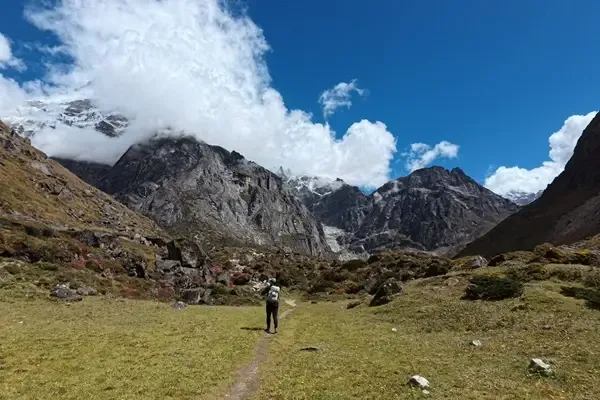
Kala Patthar Has the Better View of Everest
Yes, Kala Patthar is higher. That's not why it matters. What matters is the angle you get up there. From that ridge above Gorakshep, Everest, Nuptse, Lhotse, and Pumori finally line up the way you'd hoped for.
You don't get that at Base Camp. Nuptse is what sits right in front of Everest's summit and blocks the shot most people are chasing.
So that famous picture that trekkers imagine before they even book the trek, that's the Kala Patthar view. Not Base Camp.
What is Everest Base Camp Actually Like?
Forget whatever picture you have of Base Camp as some viewpoint overlooking Everest. That's not what you will find there.
At Base Camp, the glacier and the icefall take over everything. Half the time you're not even looking up. You're simply watching where you step, staring at the ice formations and the moraine right under your boots.
Then there are also the prayer flags, the Base Camp marker, and a small city of expedition tents that you will find if you are trekking in spring.
Here, you're standing inside the landscape, not looking across at it. That's why sometimes trekkers get there and feel like something is missing. But the truth is they've just shown up somewhere that was never built around a clean view.

Can You See Mount Everest From Base Camp?
Yes, but not the way most first-time trekkers expect it. Unlike what trekkers imagine, Base Camp doesn't actually give you that classic, wide-open shot of Everest's summit. Here, Nuptse blocks most of Everest, leaving only a limited glimpse of the summit from certain positions.
And that's got nothing to do with weather. Yes, the clouds can sometimes cover the view entirely, but even on a clear day, the geography remains the same.
That's the real difference between these two spots. Base Camp puts you inside Everest's world, whereas Kala Patthar puts you high enough to actually look at it.
What Do You See at Everest Base Camp?
EBC is where you need to stop looking for one big Everest photo and just look around instead. The glacier is what gets your attention first, with cracked ice, crevasses, and moraine everywhere you look. Above all that sits the Khumbu Icefall, and when you notice it from up close, it looks like it's still moving.
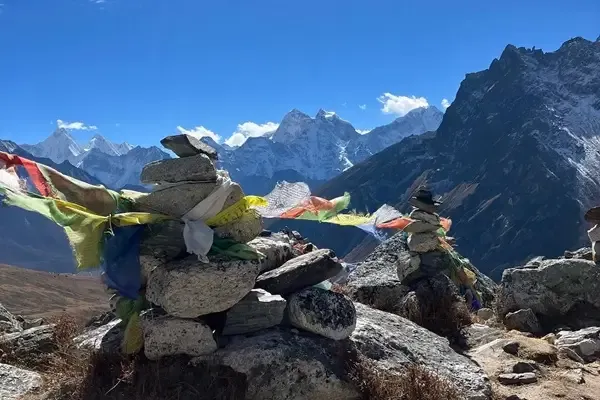
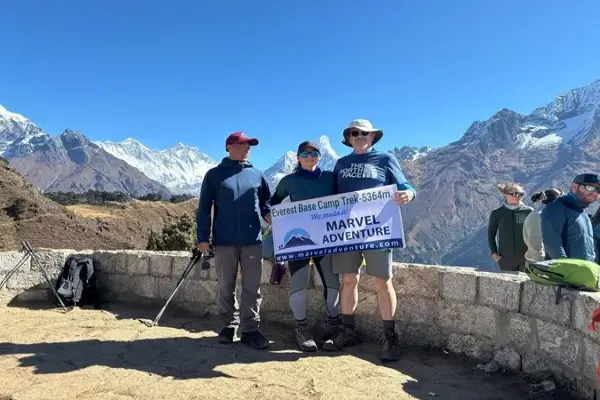
Nuptse stands steep on one side. Pumori sits off to the northwest. Somewhere in between, prayer flags mark the spot near the EBC marker where every single trekker takes the same photo.
If you are doing this trek in spring, Base Camp basically feels like a work site with tents everywhere, climbing teams checking gear, porters carrying loads back and forth, and everyone gearing up for a summit push.
Miss the spring window, and it empties fast. The tents and crowds are gone. Just glacier, rock, and mountain left standing. Some trekkers actually prefer this version, as nothing competes with the landscape for your attention.
Why Is the Everest View Better From Kala Patthar?
While standing in Kala Patthar, you are actually at a higher altitude than the Base Camp itself, with more exposed terrain. The result is a clearer Mount Everest view from Kala Patthar, along with a broader panorama of the surrounding Himalayan peaks.
The important point is not simply that Kala Patthar is higher. The higher position also completely changes the perspective.
From the ridge, the surrounding peaks become easier to distinguish and the scale of the Khumbu region becomes much clearer. You point at one peak and go, okay, that's Everest. Then Nuptse. Lhotse's right there. Pumori's further off to the side. Like somebody finally handed you the map you needed for this whole trek.
Which Mountains Can You See From Kala Patthar?
From up on Kala Patthar, Everest isn't alone anymore. Nuptse sits closer to you. Then there's Lhotse, the fourth-highest mountain in the world. Pumori, with its sharp shape, sits just a little to the west. From this angle, peaks at very different distances can appear close together.
So even people paying close attention get it wrong. This is where your guide comes in. Someone who knows the range can point at Everest's summit and show you exactly where it sits behind Nuptse, and now you're not just staring at mountains anymore. You know exactly which mountain you are looking at.
Does Everest Look Like the Biggest Mountain from Kala Patthar?
This confuses a lot of people when they are standing at the Kala Patthar viewpoint.
The reality is, the tallest mountain on the planet doesn’t look the biggest from where you're standing. From Kala Patthar, Nuptse is much closer to you, and it can look bigger even though it's nowhere near Everest's height.
So naturally you look at the biggest mountain in front of you and think, that's the one. Usually you'd be wrong. Everest's summit sits further back, half hidden behind the Nuptse ridge depending on where you're standing.
Everest Base Camp vs Kala Patthar: A Direct Comparison
Instead of trying to find out which one is better, it’s better to understand why these two places are different from each other.
| Factors |
Everest Base Camp |
Kala Patthar |
| Main Purpose |
Standing at the Base Camp of the mountain |
Getting the best possible view of Everest |
| Everest View |
Summit blocked by Nuptse |
Much clearer summit perspective |
| Panorama |
Enclosed glacial landscape |
Open Himalayan panorama |
| Khumbu Icefall |
Seen up close |
Seen from a distance |
| Photography |
EBC marker & expedition focused |
Mountain and landscape focused
|
| Difficulty |
Longer approach |
Shorter but steeper climb |
| Peak season |
Busy with tents and teams |
Often busy, around sunrise |
| Best for |
Experiencing the base camp |
Seeing Mount Everest |
Which Feels More Meaningful to Reach?
Talking about the whole trekking experience, reaching Base Camp gives that feeling of accomplishment.
You've walked for days through the Khumbu region, and when you finally arrive, you're standing at the actual spot the entire trek is named after. That definitely means something.
When asked about his experience of reaching Everest Base Camp, Patrick Stack, who trekked with us in October 2025, shared:
It was definitely hard. I even felt like giving up sometimes. My legs were done, but when I stood there looking at the icefall, I completely forgot how tired I was. Just the feeling of standing at EBC was surreal.
Which Is Better For Photography?
We would recommend photographers treat these two places as completely different shoots.
Kala Patthar Photography
This is where all those classic Everest shots come from. Wide-angle, layers of mountains, the summit pyramid rising behind the Nuptse ridge with Pumori sitting off to the side.
And the light here is something that photographers chase. If you are here at sunrise or sunset, you can get some great shots of the mountains as they go gold, which is something you won’t get at the base camp.
Everest Base Camp Photography
Base Camp works on a totally different scale for photos. Here, the photos become less about the mountain and more about the whole experience of being there. Prayer flags across the rocks, that EBC marker everyone crowds around, blue ice of the glacier, and the icefall just sitting there. All of it makes great close shots.
And if you're there in spring, you catch the expedition side as well. Tents scattered across the ice, climbers sorting through gear, and porters carrying heavy loads. These photographs tell a story Kala Patthar simply can't.

Which is More Physically Difficult?
Well, this one is not so simple to answer.
Base Camp is the longer walk, and you will be walking across rough, uneven ground. By the time you reach the final stretch, you will feel the fatigue from the previous trekking days catching up with you.
Kala Patthar's shorter, but don't let that fool you. It's steeper, higher, and altitude hits you a lot harder up there, which is exactly why a short climb can wreck you more than a long one.
From the feedback of our clients, most of them find Kala Patthar tougher than the walk into Base Camp, even though it's just a fraction of the distance. At that altitude, distance alone doesn’t tell you anything about how hard it's going to feel.
Sunrise or Sunset: When Is the Everest View Best From Kala Patthar?
Everyone wants to witness that moment of sunrise or sunset over Mt Everest. But the real question is: Are you actually going to see the mountains?
Kala Patthar At Sunrise
We usually leave Gorak Shep while it's still dark and climb up before the sun's even thinking about rising. If the weather plays along, you get to see the peaks light up first, catching that early gold while the valleys underneath sit there still in shadow.
Photographers live for this. Some of the best light of the whole day happens right here.
But let's be honest about the limitations too. You are above 5,000 meters early in the morning. It's freezing, you're climbing in the dark, your legs are already tired, and you don’t even know if you will get the views you are going up for. You can drag yourself up there at 4 am and still find the summit hidden by clouds.
Kala Patthar At Sunset
Sunset is a whole different feeling. You will get warmer light and longer shadows. Also, you don’t have to wake up early in that freezing temperature.
The drawback here is coming back down. Once that light is gone, you will be walking back to Gorakshep in the dark after already climbing all day.
So, if you ask us: neither one wins straightforwardly. Sunrise isn't automatically the better call, and neither is sunset. What the sky's doing that particular day matters more than which one you pick.
What Matters More Than Sunrise or Sunset?
Clear weather beats perfect timing every time. A sunrise means nothing if Everest's sitting behind clouds when you finally reach the top.
Mountain weather can change quickly. Mornings are often clearer, while clouds can build later in the day, but conditions vary by season and from one day to the next. Which is exactly why a guide reading conditions in real time matters more than anyone sticking to a plan made the night before.
Is the Kala Patthar Hike Worth It After Reaching Base Camp?

Yes. For most trekkers who are well enough to keep going, it's one of the best things you add to the whole EBC trip. But one common mistake tired trekkers make is usually underestimating it.
By the time you've reached Base Camp, it can feel like you're done. You've walked through Namche, pushed through higher valleys, slept at altitudes that weren't easy like Gorak Shep, and finally landed at the place you set out for in the first place.
Then your guide mentions the Kala Patthar hike tomorrow. Looking at a map, it seems like nothing. A small hike after everything you've already done. But when you are actually up there, it rarely feels small.
This is why timing and how you're actually feeling matter so much. Kala Patthar isn't about proving you can push further than you need to. It matters because it hands you a view Base Camp simply can't.
And you don't need to reach the summit of it for the landscape to start opening up. You can climb partway, and the perspective shifts as you go. So if your energy's low, or the conditions aren't cooperating, going part of the way still counts for something.
What you actually see from a partial climb depends on where you stop, what ridges are blocking what, and what the sky's doing that day. Better to think of it as the view slowly unfolding rather than expecting some exact spot where Everest suddenly appears.
Final Verdict
If seeing Everest is what you actually care about, we would point you toward Kala Patthar. If standing in the landscape that's defined Everest expeditions for decades matters more to you, that's Base Camp.
If your itinerary allows enough acclimatization time and you are feeling well, visiting both is the best way to complete the EBC experience. Everest Base Camp vs Kala Patthar was never a competition. They're the same journey, just two different chapters.
How the weather windows line up, how your acclimatization days are spaced, and when exactly you make that push up to Gorakshep are the things that decide how much of this you actually get to see. Marvel Adventure builds itineraries with exactly this in mind.
FAQs
Can you see Mount Everest from Everest Base Camp?
You can only see a small part of Everest’s summit. Nuptse blocks most of the summit, so you get glimpses at best. You won't get that classic shot of Everest from Base Camp.
Is Kala Patthar part of the Everest Base Camp Trek?
Yes. Most standard itineraries include Kala Patthar as an early-morning hike straight from Gorakshep.
Which is higher, Everest Base Camp or Kala Patthar?
Kala Patthar is the higher point on the trek. The viewpoint sits around 5,545m, while Base Camp is down at roughly 5,364m.
How long does it take to hike from Gorakshep to Kala Patthar?
About 1.5 to 2 hours to the top. However, it might feel longer than that once the altitude and the steep part of the trail kick in.
Is Kala Patthar harder than Everest Base Camp?
Many trekkers find Kala Patthar harder. It is a shorter climb, but steeper and higher, and by then you're already carrying fatigue from the trekking days before.
Can beginners climb Kala Patthar?
Yes, as long as you're acclimatized and feeling okay. Kala Patthar doesn’t require technical skills, but don't underestimate what the altitude does to you.
Is sunrise or sunset better at Kala Patthar?
Sunrise gets the hype, mostly for that early light on the peaks. But honestly, clear skies beat timing every time.
Can I skip Kala Patthar and still complete the EBC Trek?
Absolutely. It's an optional side trip, not part of Base Camp itself. You'll reach EBC either way. You can decide on the day whether you want to go to Kala Patthar or not.