
Nir Karki
Talk to an Expert (Nir Karki)
Last-minute Deals
Book Now
Price from
US$475

Ghorepani Poonhill Trek

257 reviews
29 reviews
Duration
4 Days
Trip Grade
Easy
Country
Nepal
Maximum Altitude
3,210m
Group Size
Min 1 pax
Best Time
(Sep-Nov) and (Mar-May)

Ghorepani Poonhill Trek is one of the most popular lower Annapurna treks in Nepal. It is a short and easy trek in the Annapurna Conservation Area suitable for all groups of people. 

Ghorepani Trek is extremely popular due to the spectacular Himalayan peaks, remarkable countryside landscape, and lush forests, along with its touch to the ethnic culture and hospitality. This fascinating trek offers a first-hand look at the awe-inspiring sunrise view over snow-capped mountains and a journey into a region of outstanding beauty.

The trek begins from Ulleri and goes through the picturesque ethnic villages and the blooming rhododendron forest. The hospitable and typical Gurung and Magar villages on the way provide an insight into the local culture and traditions. Similarly, various floras and faunas can also be seen during the trail. 

A short hike uphill from the beautiful village of Ghorepani takes you to Poon Hill, the famous viewpoint where watching the sunrise over the snow-capped mountains is simply breathtaking. Poon Hill is also a fabulous destination to enjoy the majestic Himalayas, as Mt. Annapurna, Dhaulagiri, Fishtail, Himchuli, and other surrounding peaks can be seen from here.

As a lower-region trek, it can be done throughout the year. Marvel Adventure organizes Ghorepani Poonhill Trek with a professionally designed itinerary and all the necessary arrangements. Join us and enjoy one of the most rewarding treks in the beautiful nation of the Himalayas.

Highlights

  • Explore Pokhara - The City of Lakes
  • Passing through blooming rhododendron forests
  • Rich culture, traditions, and hospitality of the local villages
  • Sunrise view from Poon Hill
  • Magnificent views of  Mt. Annapurna, Dhaulagiri, Fishtail, and Himchuli

Related trips that you may like: Ghorepani Poonhill Ghandruk Trek
Ghorepani Poonhill Trek Detailed Itinerary

Day 1

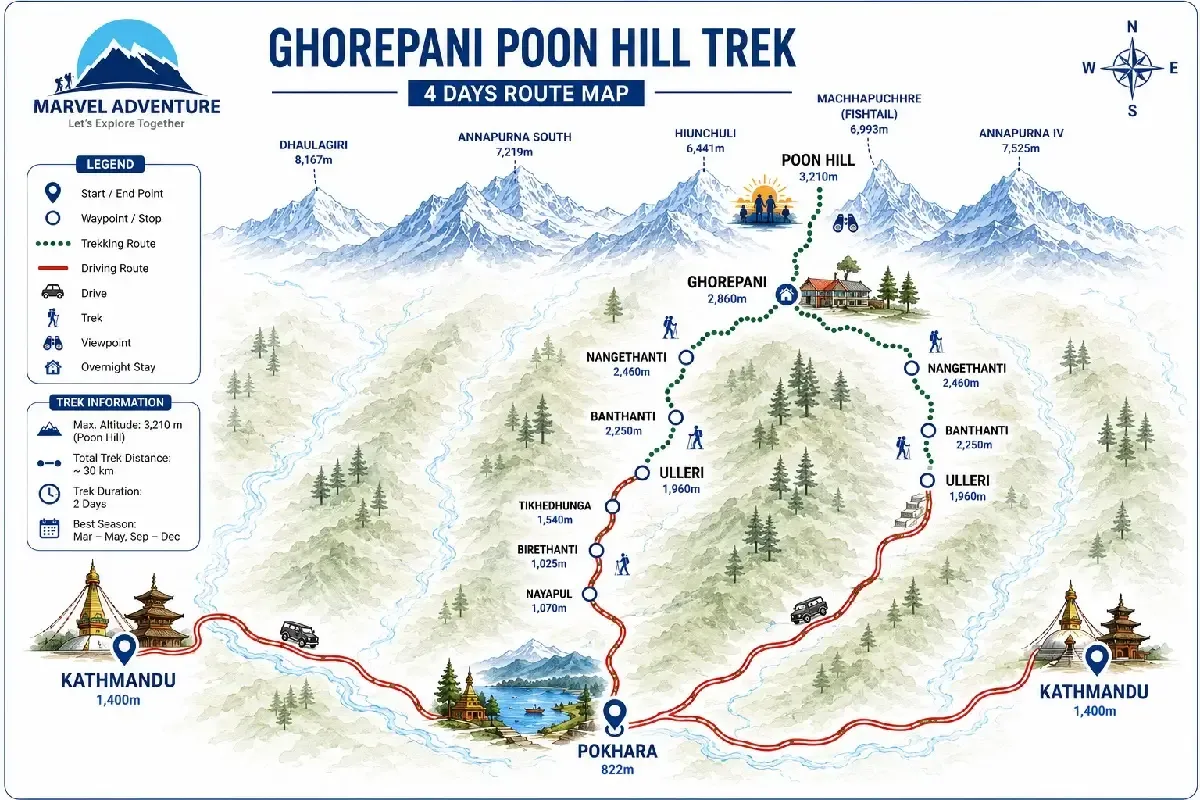
Drive to Pokhara (820m)

The journey begins with a scenic drive to Pokhara, the City of Lakes. The drive takes around 7-8 hours, cruising through beautiful landscapes, terraced fields, rivers, and colorful rural settings. We will stop for lunch on the way. You will have several opportunities to enjoy and capture the beauty of the countryside. On reaching Pokhara, check in at the hotel, take some time for rest, and stroll around the vibrant Lake City in the evening.

Max Altitude: 820m (2,690ft)
Duration: 7-8 hours drive
Distance: 200 km
Meals: Breakfast, Lunch and Dinner
Accommodation: Hotel
Mode of Transportation: Bus
Day 2

Drive to Ulleri (2,050m) and Trek to Ghorepani (2,874m)

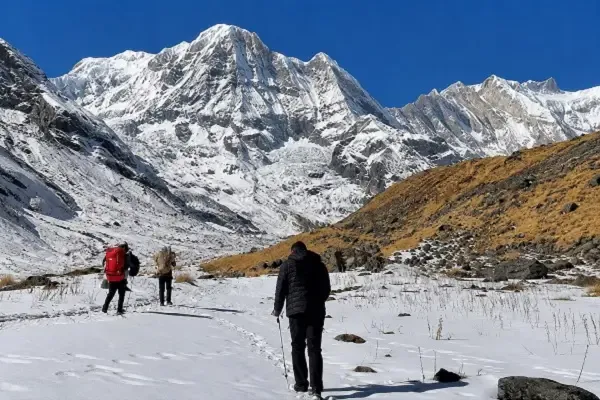
After having breakfast early in the morning, we set off for a 4-hour drive to Ulleri. The drive offers an exciting glimpse into the rugged trails of rural Nepal as we pass through traditional settlements and beautiful villages like Birethanti and Tikhedhunga. Upon reaching Ulleri, the trek begins as we march towards Ghorepani through the charming oak and rhododendron forest. 

The rhododendrons blooming in their full glory in the spring season further add to the beauty of the trails. After walking for around 4 hours, we reach Ghorepani. This beautiful village provides magnificent views of Dhaulagiri and the Annapurna range. 

Max Altitude: 2,874m (9,429ft)
Duration: 5-6 hours trek
Distance: 8 km
Meals: Breakfast, Lunch and Dinner
Accommodation: Lodge
Day 3

Hike to Poon Hill (3,210m), Trek down to Ulleri and Drive back to Pokhara (820m)

Early in the morning, we climb up to Poon Hill to see a spectacular sunrise view over the Himalayas. Poon Hill is one of the most popular viewpoints in the entire Annapurna region. The panoramic view of the Annapurna and Dhaulagiri ranges seen from this heavenly place is stunning. After clicking some remarkable pictures and spending quality time at Poon Hill, we trace our way back to Ulleri. 

With the delightful memory of the short trek, we take a drive back to Pokhara through the rural settlements and various suspension bridges. On reaching Pokhara, make the best use of the time and explore the ever charming Lakeside. Try out various foods, walk through the vibrant streets, and do some last-minute shopping to take souvenirs.

Max Altitude: 820m (2,690ft)
Duration: 6-7 hours trek
Distance: 9.5 km
Meals: Breakfast, Lunch and Dinner
Accommodation: Hotel
Day 4

Drive back to Kathmandu (1,400m)

Enjoy a relaxing breakfast at the hotel before leaving for Kathmandu. The scenic ride passes through hilly terrain, streams, rivers, and terraced fields. The 7-8 hour journey provides one last glimpse of the breathtaking landscapes of the countryside. 

After arriving at Kathmandu, check into the hotel, take some well-deserved rest, and explore the vibrant city of Thamel in the evening.

Max Altitude: 1,400m (4,593ft)
Duration: 7-8 hours drive
Distance: 200 km
Meals: Breakfast and Lunch
Accommodation: Hotel
Mode of Transportation: Public Bus
Have Questions? We're Here to Help
Like this itinerary but want to make a few changes? Every traveler is unique, and your journey should be too. Our local travel experts will design a personalized experience tailored to your interests, preferred pace, travel dates and budget.
Route Map & Altitude Profile

Cost Details

Includes

  • Airport pick-up and drop service
  • Standard meals (breakfast, lunch, and dinner) during the trek
  • Government license holder guide with local knowledge
  • Strong and helpful porter with proper equipment (1 porter for 2 people)
  • Salary, food, accommodation, and insurance for guide and porter
  • Tea house/lodge accommodation during the trek
  • Seasonal fresh fruits every night after dinner
  • All land transportation as per the itinerary
  • TIMS (Trekking Information Management System) card
  • Annapurna Conservation Area Project (ACAP) entry permit
  • Two nights standard Hotel in Pokhara
  • Comprehensive first aid kit with oximeter
  • Government taxes and official expenses

Dates & Availability

Aug 2026
Sep 2026
Oct 2026
Nov 2026
Dec 2026
Jan 2027
Feb 2027
Mar 2027
Apr 2027
May 2027
Jun 2027
Jul 2027
Aug 2027
Sep 2027
Oct 2027
Nov 2027
Dec 2027
Start Date
02 Aug, 2026
End Date
05 Aug, 2026
Status
Guaranteed
Price
US$475
Start Date
05 Aug, 2026
End Date
08 Aug, 2026
Status
Guaranteed
Price
US$475
Start Date
09 Aug, 2026
End Date
12 Aug, 2026
Status
Guaranteed
Price
US$475
Start Date
12 Aug, 2026
End Date
15 Aug, 2026
Status
Guaranteed
Price
US$475
Start Date
16 Aug, 2026
End Date
19 Aug, 2026
Status
Guaranteed
Price
US$475
Start Date
19 Aug, 2026
End Date
22 Aug, 2026
Status
Guaranteed
Price
US$475
Start Date
23 Aug, 2026
End Date
26 Aug, 2026
Status
Guaranteed
Price
US$475
Start Date
26 Aug, 2026
End Date
29 Aug, 2026
Status
Guaranteed
Price
US$475
Start Date
30 Aug, 2026
End Date
02 Sep, 2026
Status
Guaranteed
Price
US$475

There will be an additional cost of USD 100 in case of a single pax.

Meet Our Expert Guides

Phinjo Sherpa
Trekking Guide
Dibash Mainali
Trekking Guide
Dinesh Rai
Trekking Guide
Kumar Karki
Trekking Guide

Equipment List

Upper Body Layers
  • Breathable, quick-dry base layers
  • Comfortable t-shirts
  • Lightweight insulating jacket
  • Down jacket for cold conditions
  • Waterproof and windproof jackets
Lower Body Layers
  • Thermal base layer
  • Waterproof trekking pants
  • Comfortable pants for evenings in teahouses
  • Comfortable hiking shorts for warmer sections
  • Waterproof and windproof outershell for rain or snow
Footwear & Accessories
  • Trekking boots with ankle support (preferably Waterproof)
  • Multiple pairs of quick-dry socks
  • Warm socks for cold nights
  • Gaiters for snowy, muddy, or dusty trails
  • Trekking poles to reduce strain on knees
Head & Sun Protection
  • A hat or a cap to block the sun
  • Warm beanie for cold mornings and evenings
  • UV-protected sunglasses
  • Neck gaiter or buff to prevent dust, cold, and sunburn
  • Sunscreen (30-50+ SPF) for face and exposed skin
  • Lipbalm with SPF
Personal & Medical Kits
  • Personal medications
  • Diamox (Acetazolamide) for altitude sickness
  • Ointment
  • Hand sanitizers and wet wipes
  • Quick-dry towel
Travel Documents
  • Valid Passport
  • Passport-sized photos for permits
  • Travel insurance
  • Flight tickets
  • Cash in Nepali Rupees
  • Emergency contact details
Miscellaneous
  • Daypack (30-45L) with raincover
  • Reusable water bottles
  • Headlamps for early morning hikes
  • Water purifying tablet or filter
  • Phone or Camera for capturing the adventure
  • Powerbank for an easier charging option
  • Notebook, books, or cards for free time
  • Snacks like energy bars and chocolates
  • Drybag to keep your gear safe from rain

Essential Information

..

Sunrise Experience at Poon Hill

This is the reason most people book this trek, and it genuinely delivers on the hype more often than not.

Best time to hike

  • Departure from Ghorepani is timed for roughly 4:30-5:00 am, giving you 45 to 60 minutes to reach the summit before first light.
  • October and April mornings offer the most consistently clear skies for the climb.

What to expect

  • A steep, dark, cold 45-minute ascent on stone steps with a stream of headlamps moving up the hillside alongside you — it's social in a way that surprises a lot of first-timers.
  • A viewing tower at the top that gets crowded in peak season (October and April). So arriving 20-30 minutes before sunrise secures a good spot.
  • The light shifts fast once the sun clears the horizon, so remember the most dramatic colours often happen in the 10 minutes before actual sunrise, not after.

Weather conditions

  • Temperatures at the summit before dawn typically are between -2°C and 5°C, depending on season, colder than most people expect given how mild Ghorepani feels at the lodge.
  • Wind chill at 3,210m makes it feel noticeably colder than the thermometer reading, and this is the single coldest moment of the entire trek.
  • Cloud can roll in without warning, even in peak season. We've had mornings with zero visibility after three clear days running. It's the Himalayas where nothing is guaranteed.

Photography opportunities

  • Dhaulagiri, Annapurna I, Annapurna South, Hiunchuli, and Machhapuchhre are all visible in a single panoramic sweep on a clear morning.
  • Bring a spare battery, as most trekkers don't realize that the cold temperatures drain camera batteries faster than you'd expect, and nobody wants a dead battery at sunrise.
  • A tripod is genuinely useful here. Low light before the sun clears the peaks rewards a steady shot over a handheld one.
Trek Difficulty and Fitness Requirements

Daily walking hours

  • 4 to 6 hours per day on average, with some shorter days around 3 hours, depending on the itinerary.
  • The longest day is typically Tikhedhunga to Ghorepani, broken into two stages by most operators to manage the elevation gain properly.

Stair climbing (Ulleri)

  • The climb from Tikhedhunga to Ulleri is the singular defining physical challenge of this trek. You will be walking through a relentless stone staircase, gaining around 700m in roughly two hours.
  • It comes on day one of trekking, before most trekkers have found their rhythm, which is exactly why it catches people off guard.
  • Once you're past Ulleri, the trail eases considerably as nothing else on the route matches that first climb.

Suitable for beginners?

  • Yes, this is consistently our top recommendation for a first Himalayan trek.
  • Maximum altitude (3,210m at Poon Hill) is low enough that serious altitude sickness is uncommon.
  • The trail is clear, well-signed, and busy enough in season that you're rarely walking alone for long.

Recommended fitness level

  • A base level of regular walking fitness is enough as you don't need gym training specifically for this trek.
  • If you can comfortably manage a long day walk at home, you can manage this. The Ulleri stairs are the one section where some extra cardio prep genuinely helps.
  • Trekking poles make a noticeable difference on both the Ulleri ascent and the knee-testing descent from Ghorepani toward Tadapani.
Accommodation and Tea Houses

Room types

  • Standard twin-share rooms throughout the route. Expect two single beds, simple wooden walls, and a small window.
  • Ghorepani has some of the better-built teahouses on any short Annapurna route, a reflection of how long this trek has been an established trekking destination.

Hot showers

  • Available at most teahouses for a small additional charge, usually NPR 200-300.
  • Solar-heated in the lower villages and gas-heated backup at higher elevations like Ghorepani, where solar isn't always reliable.

Food options

  • Full teahouse menus throughout: dal bhat, fried rice, noodle soup, momos, pancakes, porridge, and a decent attempt at pizza in some of the busier lodges.
  • Dal bhat remains the smartest order at every meal as they are freshly cooked, filling, and usually with free refills.
  • Ghorepani and Ghandruk in particular have noticeably better food variety than higher-altitude teahouses elsewhere in Nepal, simply because supply access is easier.

Private room availability

  • Most teahouses can offer a private twin room rather than a shared dorm, though availability tightens during the October and April peak seasons.
  • Solo trekkers should expect to pay a single supplement in most cases, since rooms are priced per room rather than per bed.

Transportation to and from the Trek

Kathmandu to Pokhara

  • A 25 minute domestic flight or a 6 to 7 hour drive on the Prithvi Highway.
  • The drive is scenic along the Trishuli River, but long. We recommend a flight if your schedule is tight.

Pokhara to Ulleri

  • A 2-2.5 hour drive on a paved but winding mountain road.
  • A private jeep is more comfortable than the local bus and is what we arrange as standard.

Return options

  • If your schedule allows, we can finish the loop at Ghandruk or Birethanti, both with road access back to Pokhara by jeep, which is roughly 1.5–2 hours.

Road conditions

  • Generally good between Pokhara and the trailhead, though landslide-related delays occasionally happen during the months bordering the monsoon.
  • We monitor road conditions and adjust pickup timing if needed. This is a road trek, not a flight, so weather delays are rare compared to Everest region treks.
Communication, WiFi, and Charging Facilities

Connectivity on this route is noticeably better than on longer, higher Annapurna or Everest region treks.

WiFi is present in most teahouses below Ghorepani, generally reliable for messaging and light browsing. Above Ghorepani: signal becomes slightly slower but rarely disappears completely, unlike on remoter circuits where connectivity vanishes entirely. We highly recommend a local Nepali SIM (NTC works best in this region), which gives decent coverage through most of the route.

Charging facilities ​​​​​​are also available at all teahouses, usually for a small fee of NPR 100-200 per device.

Grid electricity reaches most villages on this route, supplemented by solar in some of the smaller stops, which is a genuine advantage over higher, more remote treks where solar is the only source. Trekkers need to realize that power cuts do happen occasionally, but it's rarely a real problem given how short this trek is.

Drinking Water and Hygiene

Safe drinking water

  • Tap and stream water should not be drunk untreated anywhere on this route.
  • Bottled water is available at every teahouse, but it gets more expensive the higher you climb, and creates unnecessary plastic waste on a trail this popular.

Water purification

  • A filter bottle or purification tablets are the most practical solution and what we recommend to every trekker.
  • Boiled water is available at teahouses for a small charge and is a reliable backup option throughout the route.

Toilet facilities

  • Most teahouses on this trek have proper attached or shared bathrooms, opposite to the remote circuits where squat toilets dominate.
  • Western-style toilets are common in Ghorepani and Ghandruk specifically, but less guaranteed in smaller stops along the way.

Hygiene tips

  • Hand sanitizer is worth carrying regardless of bathroom quality. The Communal dining rooms mean everything is shared.
  • Wet wipes are a practical substitute on days without a hot shower, particularly useful after the Ulleri climb.
Trek Crew and Support Team

Licensed guide

  • Mandatory under the current Nepal trekking regulations. Every group on this route travels with a licensed guide.
  • Our guides on this specific trek know the Gurung and Magar communities personally, which often means small cultural moments that a map or guidebook can't offer.

Porter service

  • Standard on all our Poon Hill packages. Typically, one porter per two trekkers, carrying up to 15kg combined.
  • This is one of the lighter porter loads we manage across our trek offerings, given the trek's short duration.

Safety monitoring

  • Our guides carry a basic first-aid kit and monitor pace, particularly on the Ulleri climb, where exertion can catch people off guard.
  • Altitude here is low enough that serious AMS monitoring isn't the priority it is on higher routes. Your pace and hydration matter more than altitude readings on this specific trek.

Head office support

  • Our Kathmandu office stays in contact with every guide throughout the trek, particularly useful given how close this route is to the city compared to remoter circuits. Therefore, support can reach you faster here than almost anywhere else we operate.
Photography Tips and Mountain Viewpoints

Best photography locations

  • The Poon Hill summit viewing tower is the headline location, but the trail itself between Ulleri and Ghorepani offers excellent rhododendron forest shots in March and April.
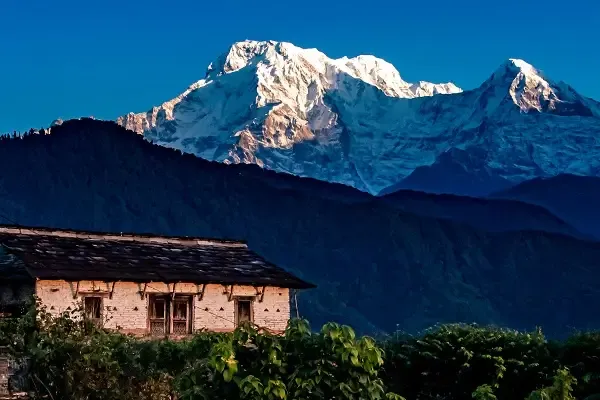
  • You can also include Ghandruk village in your itinerary, which offers a striking foreground of traditional Gurung stone houses with Annapurna South and Machhapuchhre as a backdrop, making it one of the most photogenic villages on the entire route.

Mountains visible

  • Dhaulagiri (8,167m), Annapurna I (8,091m), Annapurna South, Hiunchuli, Machhapuchhre (Fishtail), and Nilgiri are all visible from Poon Hill on a clear morning.
  • Machhapuchhre's distinctive fishtail peak is best photographed from Ghandruk, where the angle and foreground genuinely beat the Poon Hill view.

Best time for photos

  • The 15 minutes before actual sunrise consistently produce the richest colour on the peaks, which most casual photographers wait too long for and miss.
  • Late afternoon light in villages, an hour or so before sunset, gives a softer, warmer look to the village and mountain backdrop than the harsher midday sun.
Price Per Person
US$475
US$400
All inclusive price
  • 2 - 4 paxUS$400
  • 5 - 9 paxUS$380
  • 10 - 20 paxUS$360
Book This Trip
Talk to Our Travel Experts

What Our Clients Say

April 22, 2025
3d/2n Poon Hill Trek

First trip to Nepal with a trekking trip planned with Marvel Adventures. I am not a regular hiker and really appreciate the kindness and patience shown by my experienced guide, Shalik. I will use him...

C
Carol Lynne L
England
June 23, 2024
Family trek to Poon Hill

Our family trek to Ghorepani/Poon Hill was absolutely wonderful! Exceeding expectations! Marvel was able to accommodate my request to add me on to the trip at the very last minute. They made everything seamless! Phinjo...

E
Erin C
United Kingdom

You May Also Like

mardi himal trek
Duration: 7 Days
5.0(5 Reviews)

Mardi Himal Trek

US$495US$495
Difficulty Level: Easy
ghorepani poon hill ghandruk trek
Duration: 7 Days
5.0(3 Reviews)

Ghorepani Poonhill Ghandruk Trek
US$525US$525
Difficulty Level: Easy
7 day annapurna base camp trek
Duration: 7 Days
5.0(3 Reviews)

7 Days Annapurna Base Camp Trek

US$725US$725
Difficulty Level: Moderate
Need Help? Call Us+977 986-0313572
Ghorepani Poonhill Trek | Short Trek in Annapurna Region