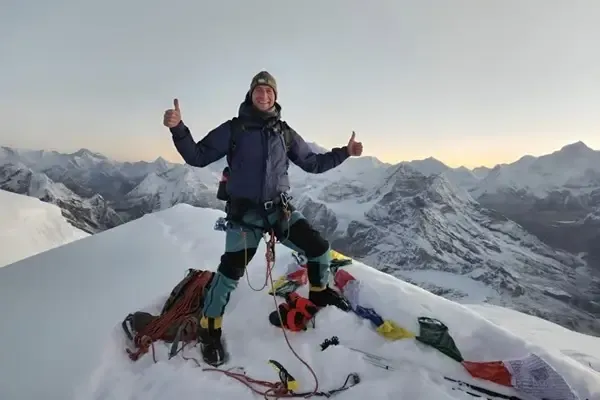
Mera Peak Summit Day at a Glance
| Summit Day |
What to Expect |
| Starting Point |
Mera High Camp (5,780m) |
| Start time |
Usually 2:00 - 3:00 am, depending on the guide's call |
| Terrain |
Glacier and snow slopes on the Mera Glacier with a harder, steep climb near the top |
| Main equipment |
Mountaineering boots, crampons, harness, helmet, ice axe, ascender, headlamp |
| Main challenge |
Altitude, cold, and strong wind near the summit |
| Technical section |
A 40-50 metre snowy climb right below the summit, climbed with a fixed rope and an ascender |
| After the summit |
Down to High Camp, a short rest and a meal, then on to Khare the same day |
| Total duration |
Approx. 10 - 12 hours from High Camp to the summit and down to Khare, sometimes longer depending on pace, conditions, and breaks. |
The table above roughly shows what the day could look like. Snow conditions can sometimes move the start time around, while the group’s pace affects the timing. However, the overall sequence remains the same.
The Evening and Early Morning Preparation at High Camp
Climbers usually reach High Camp in the afternoon after ascending from Khare over rocky terrain and snow or glacier sections. You spend the remaining hours eating, drinking, organising equipment, and resting before the early start.
Before dinner, our guides run a final check on the weather and route conditions. Your itinerary says 2 to 3 am, but what happens depends on wind, snow, and what the sky looks like that specific night. The mountain has the final call.
Dinner is served early. This is where you need to eat enough even if you’re not hungry, because you will need the fuel for the climb. Same goes for water too. Fill your bottles and thermoses before you sleep, and keep the bottles close to your body overnight.
Before getting into the sleeping bag, our guides will do one final equipment check. Climbers need to lay out their gear: climbing boots, crampons, harness, helmet, ice axe, ascender, headlamp, and spare batteries all need to be exactly where a cold hand can find them. You would not want to be searching your backpack with a headlamp at 1:00 am while your fingers are numb from the cold.
Finally, you get into your sleeping bags early, but the reality is, sleep at High Camp is rarely good. You are lying there with nerves about the next day. So, if you are still awake at midnight, that doesn’t necessarily mean something’s wrong. It’s simply a part of the Mera Peak experience.
From Mera Peak High Camp to Summit
This is the part the whole evening was pointing toward. Three important stretches: the walk in the dark, the long grind across the glacier, and the short, technical bit right before the top.
Starting in Darkness
Teams usually move out somewhere between 2 and 3 am. That might not always be the case, as your guide makes the call depending on the snow. We often get asked, “Why this early?”
Because during this time the snow is colder and firmer for climbers. Leave too late, and the glacier starts softening under the afternoon sun. It also builds enough time to reach the summit and get back down before the wind gets strong on the upper mountain.
The early moments out of the camp are deliberately slow. Our guides sort the group into rope order before the actual climbing starts. There's little conversation as most of the early effort goes into finding a rhythm that can be sustained for hours.
The altitude effect shows up quickly. Within the first twenty minutes, you notice you’re actually thinking about breathing. Your hands feel slower than normal. Normal things like reaching down to adjust a strap or stepping over a rock take extra concentration. It’s just what 5,800 metres does to a body running on less oxygen than it’s used to.
A controlled, slow pace at the start is what keeps that effect manageable rather than rushing through the day. Our guides actively hold climbers back here, because moving too fast in the first hour is one of the more common ways people arrive at the technical section near the summit already exhausted.
Moving Across the Glacier
Above High Camp, the ground changes under your feet. You are on the Mera Glacier now. It’s not technical climbing by Himalayan standards, but it’s real glacier: snow sitting over ice, solid in one step and hollow in the next, and you will find your guide reading the surface multiple times here.
Your guide checks that everyone’s crampons are securely fitted before continuing across the glacier. This is where decent boots and properly fitted crampons play their role, because the ground can flip from packed snow to bare ice with zero warning.
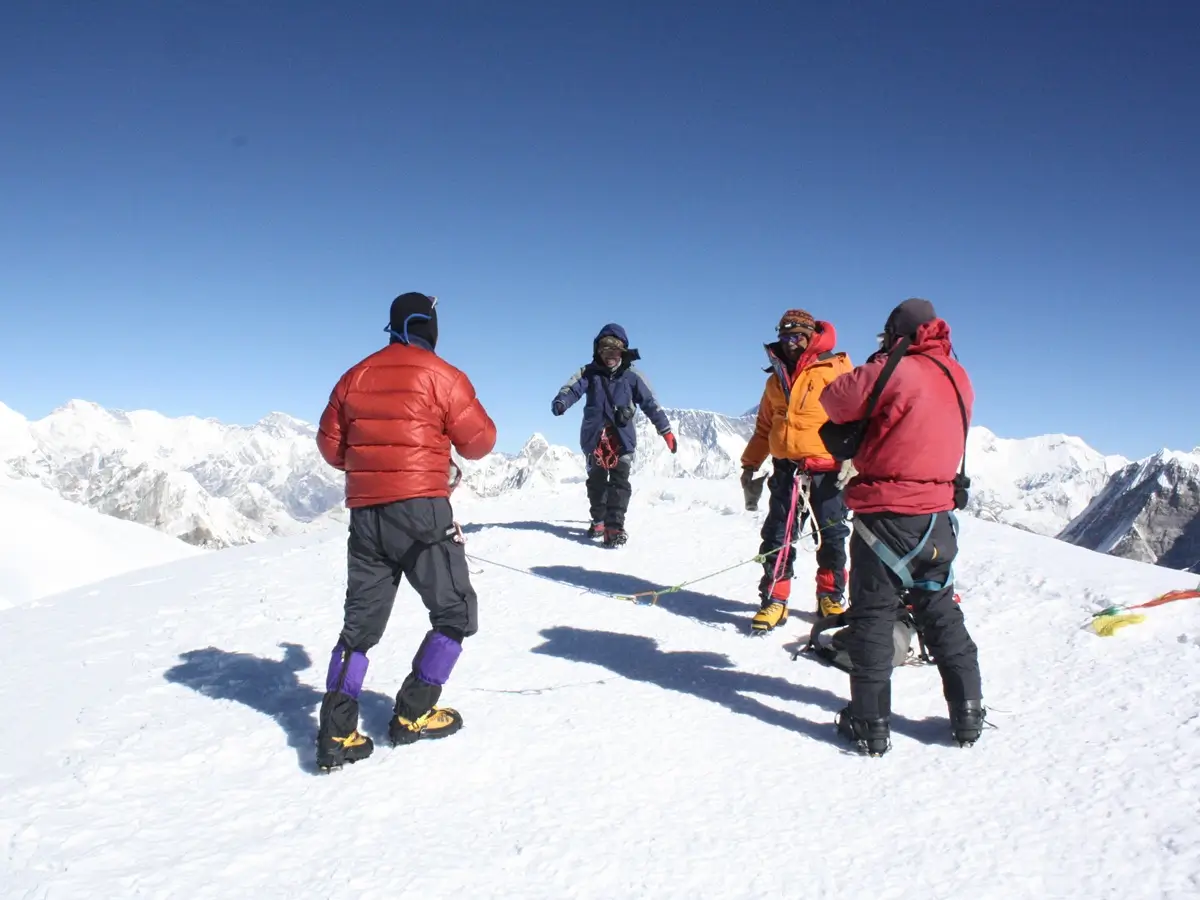
You will be moving across the Mera Peak summit route while roped to the guide and the rest of the team. This is less about anyone’s climbing skill and more about what happens if a boot slips. Until the entire group has found its rhythm, your guide will keep instructing you to keep your spacing and follow the person in front without rushing.
The burn sneaks up on you rather than hitting all at once. Nothing here looks especially steep in the first few hours. But altitude and the simple grind of walking uphill in crampons stack up faster than anyone expects.
There are rest stops throughout the climb where you can have snacks and water. You will be sweating under your jacket while the air itself sits well below freezing, so every short stop the guide calls becomes a quick trade-off between cooling down and not getting cold.
The Final Section Before the Summit
Here's where the day changes. Forty, maybe fifty metres below the top, the route tips up into a short snowy dome. The Mera Peak final summit section needs jumars and a fixed rope instead of the looser rope-team movement used lower down. It's also the reason Mera now carries an 'Alpine Grade PD' rating instead of the easier grade it used to have, back before the glacier conditions shifted.
By now, clipping in, weighting a foot, and managing the ascender take more out of a person than they would lower down. It's not that this section is hard, technically. It's that you're doing it after everything else that's already happened that night. Guides read people closely right here: can this person still manage the equipment safely, or has fatigue started making the decisions for them?
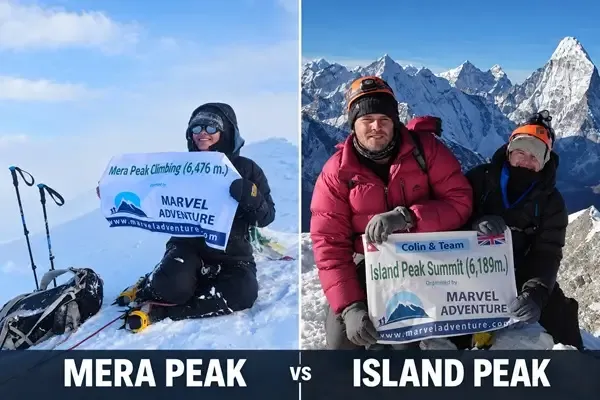
And this is where Mera and Island Peak actually split from each other, if you’re trying to decide between the two. Island Peak has a longer, steeper fixed-rope section near its summit than the short final section on Mera.
Focus matters more than speed here. Follow the sequence your guide sets. Resist the pull to rush past a slower climber just because the top's finally visible. And let’s be clear here: the summit isn't guaranteed. Conditions change. People run out of energy. Sometimes the right call is turning around thirty metres short, and that call belongs to the guide.
What Reaching the Summit Actually Feels Like
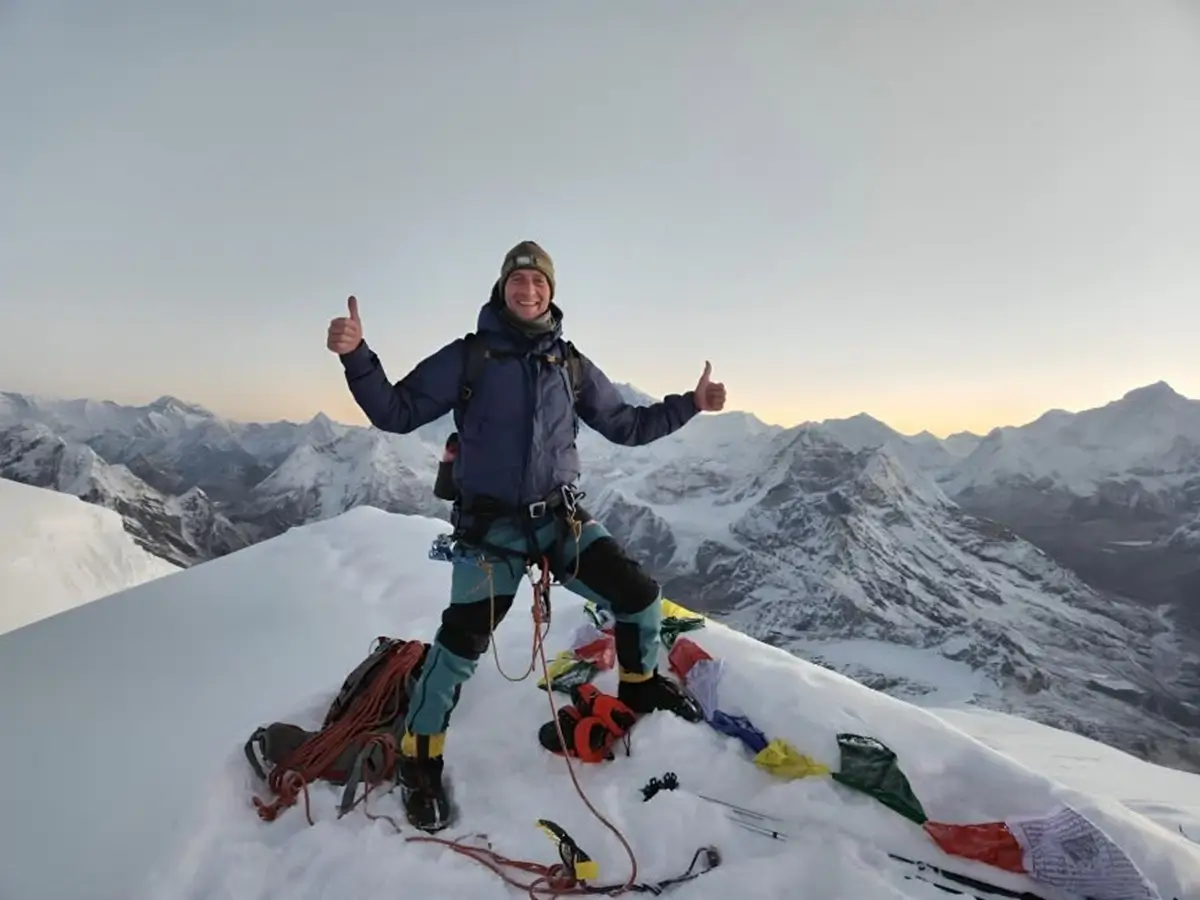
You get to Mera Central somewhere around mid-morning, and the first thing you feel is relief. Your body hasn’t caught up with the fact that the climbing’s done, as it’s still working as hard as at 6,461 metres as it was twenty minutes ago, and that doesn’t change just because you have finished climbing.
What you truly get is the view. Five 8,000-metre peaks lined up in one frame on a clear morning: Everest, Lhotse, Makalu, Cho Oyu, and Kanchenjunga, with a whole crowd of smaller giants behind them that most people have only ever seen labelled on a map. You will have one of the best summit views you’ll find on any permitted trekking peak in the country. For a moment, the cold and effort of the climb feel worthwhile.
Nobody gets long up there, though. You get a few photos, maybe just a few minutes where you actually look and take it all in, and then the guides are already moving to check people over. Because going down starts almost immediately, whether anyone feels ready or not. The summit’s a milestone, not the finish line, and keeping that moment short without making it feel cut off is one of the harder things a guide does all day, and most people never notice it happening.
Descent from the Summit to High Camp and Khare
Many climbers prepare mentally for the climb up and underestimate what the descent from Mera Peak summit to Khare actually demands.
Returning to High Camp
Going down off the dome and back across the glacier still demands the same roped discipline as going up. In fact, it requires more attention, since fatigue after a summit push messes with footing and focus more than people expect.
Guides keep the same structure on the way down: rope order, controlled pace, regular check-ins. Once you have left behind the summit, your instinct is to relax, speed up a little, and let the guard down. This is where you could be making a big mistake, because a slip going down costs just as much as one going up, and tired legs make that slip more likely, not less.
Back at High Camp, there's a short window for rest, to eat and drink, and repack your gear before moving again. How long that window lasts depends entirely on the group and the weather that day. On Marvel Adventure's itinerary, High Camp here is a stop, not the finish line. The plan is to keep moving to Khare the same day, if the conditions allow.
Continuing from High Camp to Khare
The walk down to Khare isn't technical. It's just long and mostly downhill. You have been moving since before 3 am, and this is the reason why a straightforward trail feels stretched out due to the fatigue.
Food and water matter even more here. Guides encourage regular snacks and drinks rather than waiting for a proper meal at Khare.
Pace here depends entirely on the group. A team feeling good might cover the ground close to normal trekking speed. A team with someone exhausted from the climb moves slower and stops more often. Every now and then, the group doesn't quite make it all the way to Khare that day, and that's fine. Let your guide read the situation correctly and make the call.
Getting to Khare is what our clients often describe as a real moment. This is where you get the first proper chance to feel what just happened, rather than simply managing it minute to minute, which is mostly what the Mera Peak summit to Khare stretch has demanded up to that point.
What Climbers Commonly Underestimate About Summit Day
Ask anyone who's done it what surprised them most, and it's rarely the thing you'd guess.
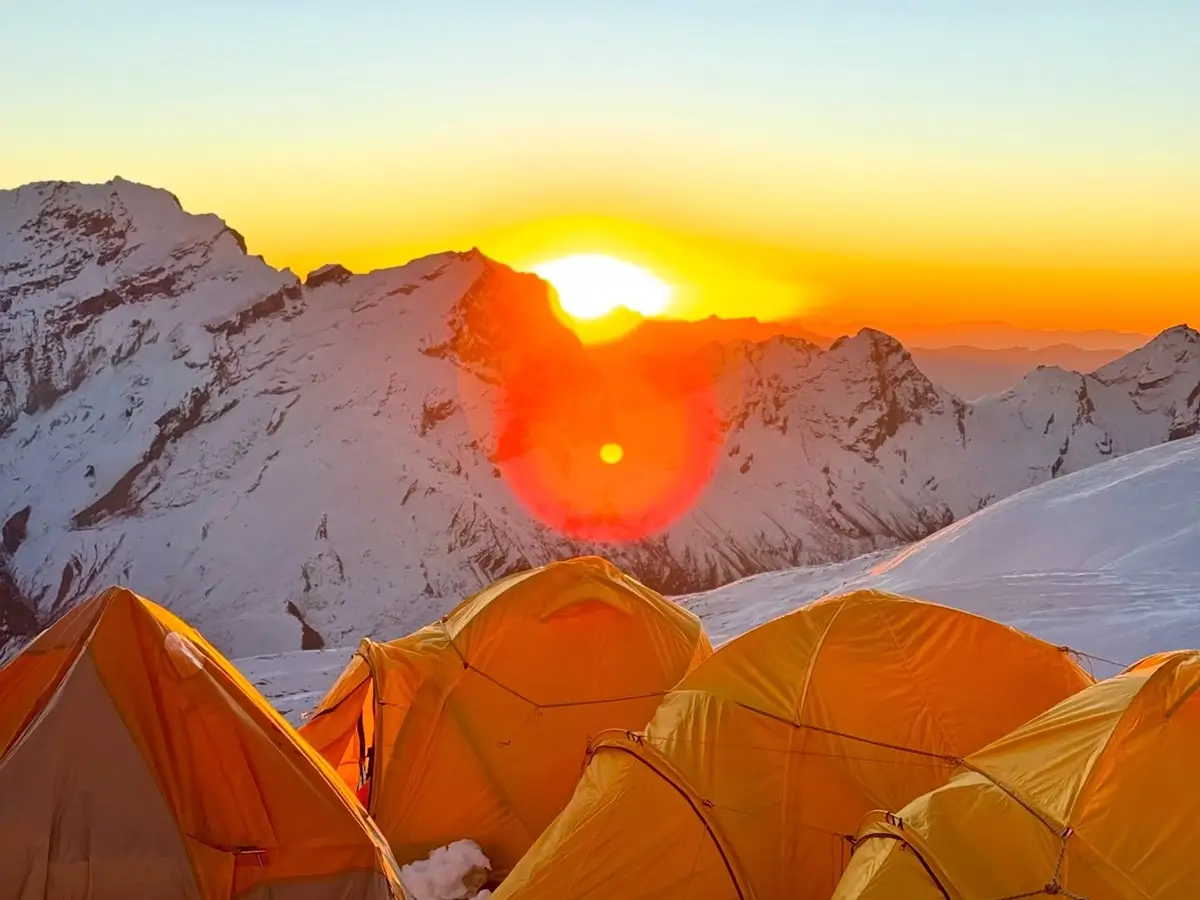
The cold before sunrise:
It is colder than almost anyone's prior trekking experience prepares them for. Cold enough that your hands might struggle to manage even a stuck zipper.
The effect of altitude on pace:
Your normal walking speed simply isn't available up here. People who are doing well often tend to push early and pay for it by hour four.
The difficulty of eating and drinking:
Your appetite falls off above 5,500 metres, right when the body needs the calories most. We recommend eating small amounts frequently.
The length of the descent:
Summiting is roughly the halfway point, not the finish. Getting back down needs real energy that most climbers have already half-spent by the top.
The mental effort:
Staying switched on, following instructions, and watching your footing throughout a long summit day, beginning in darkness. This is a different struggle from the physical effort.
This doesn’t make the Mera Peak climbing difficulty unmanageable. It just means the climbers who do well aren't usually the fastest ones in the group; they're the ones who keep something left in the tank for the way down.
How Marvel Adventure Manages Mera Peak Summit Day
A good summit day isn’t actually decided at 2 am. Most of the real work happens days before that.
- We get climbers hands-on with crampons, harnesses, ropes, and ascenders on the acclimatization day at Khare, along with a full walkthrough of the summit route.
- Our guide reads the sky the evening before to determine when the team leaves. This is far more important than whatever time is in your itinerary.
- We run one last check on boots, crampons, harnesses, and headlamps at High Camp before anyone moves, so nobody’s fumbling with a loose strap once the team’s already on the glacier.
- Our guide sets the pace, the spacing, and the line the whole group follows across the Mera Glacier.
- Our guides will be checking the pace, breathing, how someone’s feet are landing, and the general mood of the entire group throughout the climb.
- Whether we push through that final technical section comes down to how the team’s doing, what the weather’s doing, and how much time’s left.
- We stay just as switched on going down as we are climbing up, because fatigue after the summit makes close attention matter more.
- We build summit day to flow straight into the recovery part of the trip where you get real beds, a hot meal and a breather at Khare before the trek back down the valley.
- Marvel Adventure includes a contingency day to allow flexibility if weather or a climber’s condition delays the summit attempt. However, if the conditions don’t allow a safe attempt, that extra day doesn’t change the outcome.
Not sure whether Mera Peak is right for you? Share your trekking and climbing experience and intended travel dates with us. We’ll help you assess the challenge and understand how to prepare.
Frequently Asked Questions
What time does Mera Peak summit day begin?
Somewhere between 2 and 3 am, usually. It’s not a fixed time, though. The guide calls it on the night based on weather and snow conditions.
How long does Mera Peak summit day take?
Approximately 10-12 hours from High Camp to the summit and down to Khare, sometimes longer depending on pace, conditions, and breaks.
Is Mera Peak summit day technical?
Most of the route involves roped glacier travel, with a short, steeper section near the summit that may require fixed ropes and an ascender. Climbers need basic equipment skills and pre-climb training, even without advanced mountaineering experience.
Do climbers sleep at High Camp again after the summit?
Usually not. After a short break at High Camp, the plan is to continue to Khare for the night, although the guide may adjust this depending on conditions and the team’s health.
What’s the hardest part of Mera Peak summit day?
Honestly, most climbers expect it to be the final push to the top. It’s usually the descent afterwards. Your legs are already tired, but several hours of descent may still remain, which is why saving energy for the return matters.