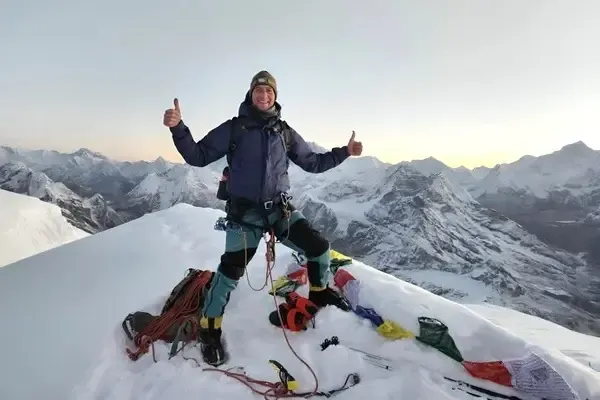
Mera Peak vs Island Peak at a Glance
Before the full breakdown, here's what we tell climbers who ask us: "Mera Peak or Island Peak?"
Mera Peak (6,461 m) wears you down slowly with a remote route and a long summit day. Island Peak (6,189 m) sits almost 300 m lower but concentrates more technical climbing in the upper route, with a steep headwall near the summit. Neither is the easier peak; they're just hard in different places.
If long days and altitude don't scare you, Mera may suit you better. If you'd rather face one technical obstacle than quiet days of grinding, Island Peak would be the one for you.
| Factor |
Mera Peak |
Island Peak |
| Altitude |
Higher at 6,461 m |
Lower at 6,189 m |
| Technical difficulty |
Generally less technical |
Steeper and more technical |
| Physical challenge |
Longer and more altitude-intensive |
Technically more demanding |
| Main challenge |
Altitude, endurance and cold |
Steep climbing, altitude, endurance and exposure |
| Trekking environment |
Quieter Hinku Valley |
Popular Everest Base Camp region |
| Acclimatization |
Gradual approach through Hinku Valley |
Namche and Dingboche acclimatization days |
| EBC Combination |
Not normally part of the standard approach |
Naturally compatible with EBC itineraries |
| Best suited to |
Strong trekkers progressing into climbing |
Prepared trekkers seeking a more technical climb |
| Overall experience |
Remote high-altitude expedition |
Classic trek combined with a technical peak |
Which is Harder: Mera Peak or Island Peak?
Mera Peak is harder on your lungs, legs, and patience. Island Peak is harder on your technique and nerves. So rather than asking which mountain is harder, ask yourself what difficulty you can handle best. Mera keeps you at high altitude for days. Island Peak saves it all for one steep stretch near the top, where you're clipped in and working with ascenders with cold fingers.
Why Mera Peak Feels Harder Physically
At 6,461 m, the air holds almost half the oxygen of sea level, and you feel it in every step. In our 15-day Mera Peak itinerary, you walk seven days through forested foothills to reach Khare at 5,045 m. You spend the night before the summit in a tent at Mera High Camp (5,780 m), where sleep is rarely good. Summit day starts around 2:00 to 3:00 am, runs about seven to ten hours depending on pace and conditions, and finishes with a long descent to Khare.
None of the Mera Peak climbing difficulty is highly technical, which is exactly why people underestimate it. Lower technical difficulty does not mean lower physical difficulty. Cold, slow movement, poor appetite, and thin air break climbers down more than steep ground does. Glacier conditions also tend to change from season to season and even week to week, therefore, a guide reading the route properly that morning matters as much as your fitness.
Why Island Peak Feels Harder Technically
Island Peak asks for technique. Above the Imja Valley, the route leads to a steep snow and ice slope below the summit ridge. The upper route usually involves fixed ropes on steep snow or ice and you climb it in crampons, clipped in with a harness and ascender.
There's also a crevasse on the headwall that has required a ladder in past years, and honestly, what you find there depends on how much snow fell that week. By the time you hit the summit ridge, it's narrow enough that you just feel the exposure the whole way across.
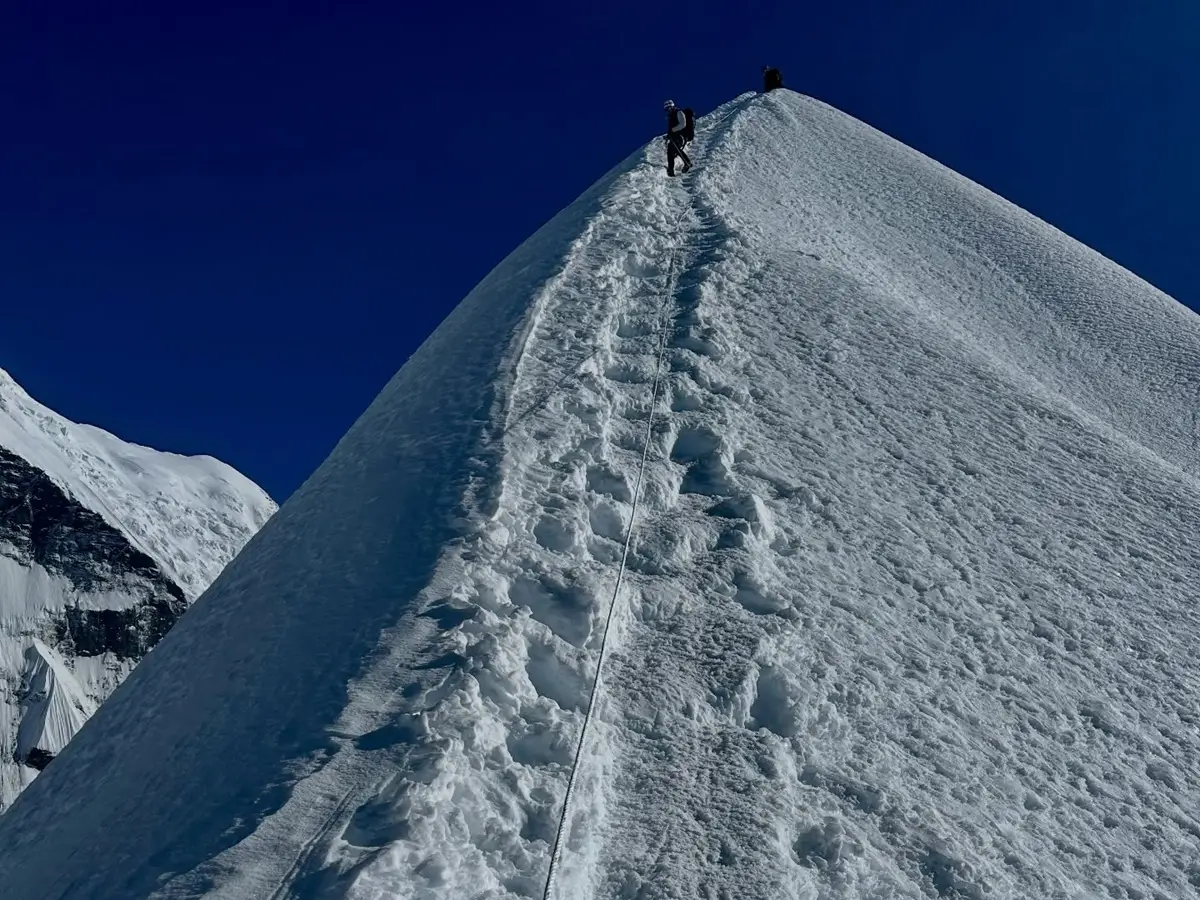
We provide you with instructions and a guide who's done this headwall multiple times, and you will find it completely manageable. This is just the one part of the climb where practice actually shows, where the difference between a climber who's trained and one who hasn't becomes pretty obvious.
Technical Skills and Previous Experience
Neither peak is just another walk. Both of them use the same basic gear and equipment. The packing list for both of them is almost the same. What changes is how much of the day depends on it, and how steep the ground is. Thus, here are the skills that are actually helpful when you are at the base camp.
Skills Used on Mera Peak
On Mera Peak, you use crampons on snow and glacier, carry an ice axe, and move as part of a roped team while having crevasse awareness. On the final section, about 40 to 50 m below the summit, you will clip into a fixed rope and use a jumar. Beyond that, the skills are mostly about moving well at Mera Peak altitude: steady pacing, sensible layering, and eating and drinking when you do not feel like it. Our pre-climb training day at Khare covers belaying, rappelling, knots and harness use, and ends with a gear check.
Skills Used on Island Peak
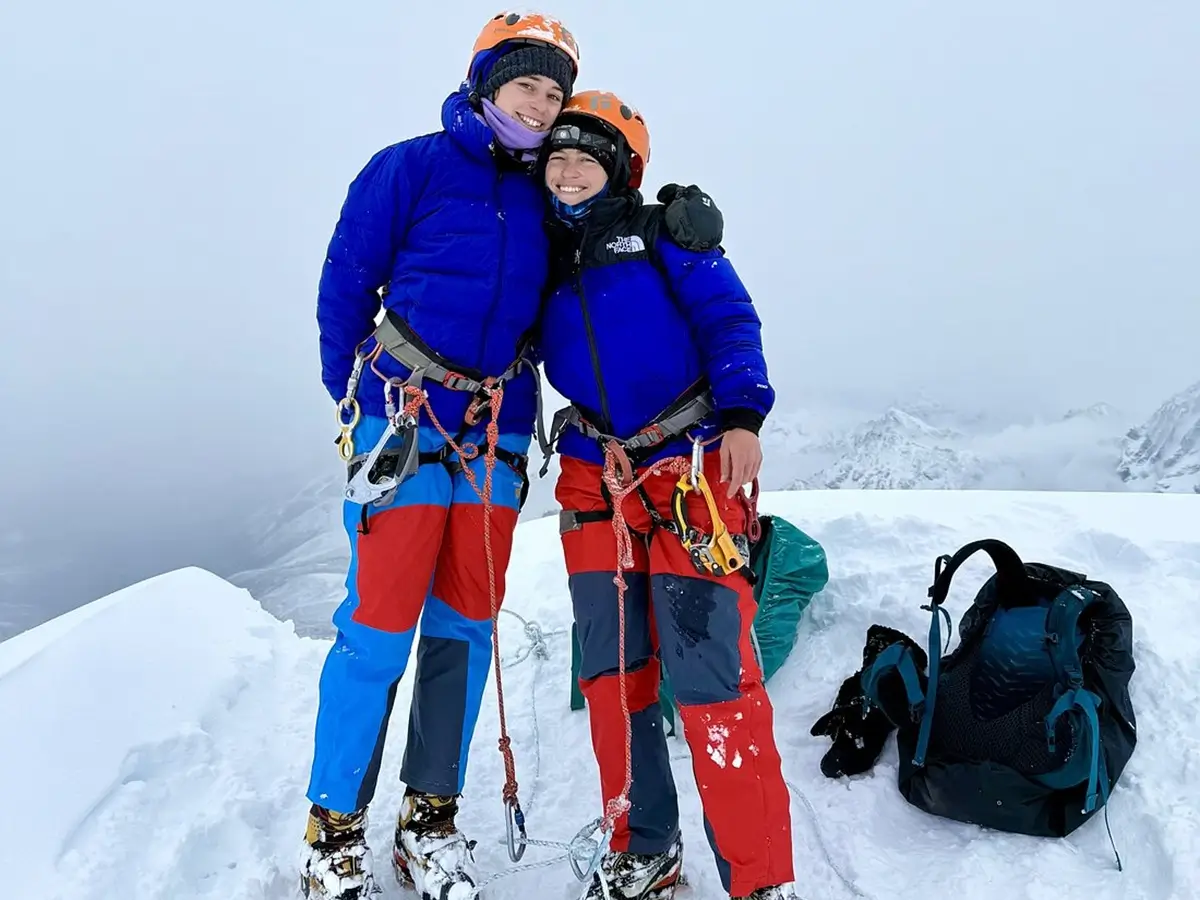
Island Peak depends on the same gear, just more heavily. Crampons matter more on that steeper snow and ice. You will be working with an ascender on a fixed line, handling a harness and carabiners, moving as part of a rope team, and rappelling your way back down at the end. And you're doing all of it with cold hands and thin air, trying to stay calm while you're exposed on steep ground. That's why we run a training session at Island Peak Base Camp before anyone heads up. Here, we also conduct a real check on whether you're actually ready for the summit push.
Do You Need Previous Experience?
Neither one's a place to start from zero. During the Mera and Island peak comparison, we always tell people to start preparing four to six months out, no matter which peak they pick.
- If you're a complete trekking beginner, start with a high-altitude trek first.
- If you've already trekked above 4,500 m and know how your body handles altitude, Mera may be the more suitable option. You can choose Island Peak too, but practice your crampon and rope work beforehand. Find out in detail how beginners can climb Island Peak.
- If you're newer to climbing, Island's headwall is where good coaching really pays off. Mera's technique is gentler, but its altitude and cold are not.
- Got some basic mountaineering training already? Either peak works. Pick Island to put that training to use, or Mera to find out how you handle higher summit altitude.
Altitude, Acclimatization and Physical Demands
Altitude is the biggest single difference between the two peaks. A few hundred metres sounds small until you are above 6,000 m.
Mera Peak’s Higher Altitude
Mera’s higher summit adds to the altitude challenge, although both climbs take you above 6,000 m. You move slower and recover slower. Sleep can be disrupted at high camp, and poor rest may add to summit-day fatigue. Appetite drops off hard at high camp too, which is a real problem. Eating and drinking can become difficult at high camp, so climbers need to maintain their intake before and during the summit attempt. Steady pacing becomes especially important. If you go too hard early, you'll hit that final steep section completely drained. Mera Peak altitude doesn't care how fit you are, which is why our guides keep watching for symptoms and adjust the plan as they go.
How the EBC Approach Can Support Island Peak Acclimatization
Island Peak's acclimatization works differently. The standard Everest route helps you a lot. You get Namche and Dingboche acclimatization days, spend nights at Lobuche and Gorak Shep on the way to Everest Base Camp, before dropping back to the base camp at 5,100 m. That's a lot of nights spent above 4,000 m, and it's a big part of why Island Peak often feels more forgiving even though it’s technical.
However, altitude sickness can still end a summit attempt here too. And if you skip the Everest Base Camp portion and head straight for Island Peak, you'll want extra rest days around Chhukung to make up for the acclimatization.
Which Requires Better Fitness?
There is honestly no universal answer. Mera asks for sustained endurance above everything else. You should be able to handle long days on the trail, tolerate altitude, pace yourself right, and recover between consecutive trekking days.
Island Peak asks for a mix of cardio, strong legs, some real upper-body work when you are up that fixed rope, and the ability to just climb efficiently.
Either way, you end up in the same place. A tough summit day, followed by a descent that tires people out way more than they ever expect going in.
Comparing the Trekking Routes and Overall Experience
The trail you walk matters just as much as the peak you climb. One takes you somewhere quiet, the other takes you somewhere famous, and that changes everything about the whole trip.
Mera Peak - Remote Hinku Valley Experience
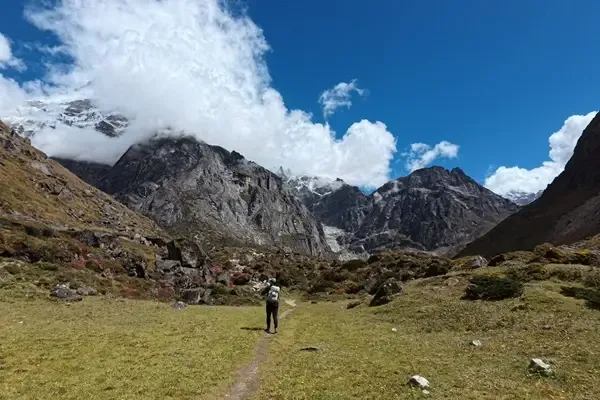
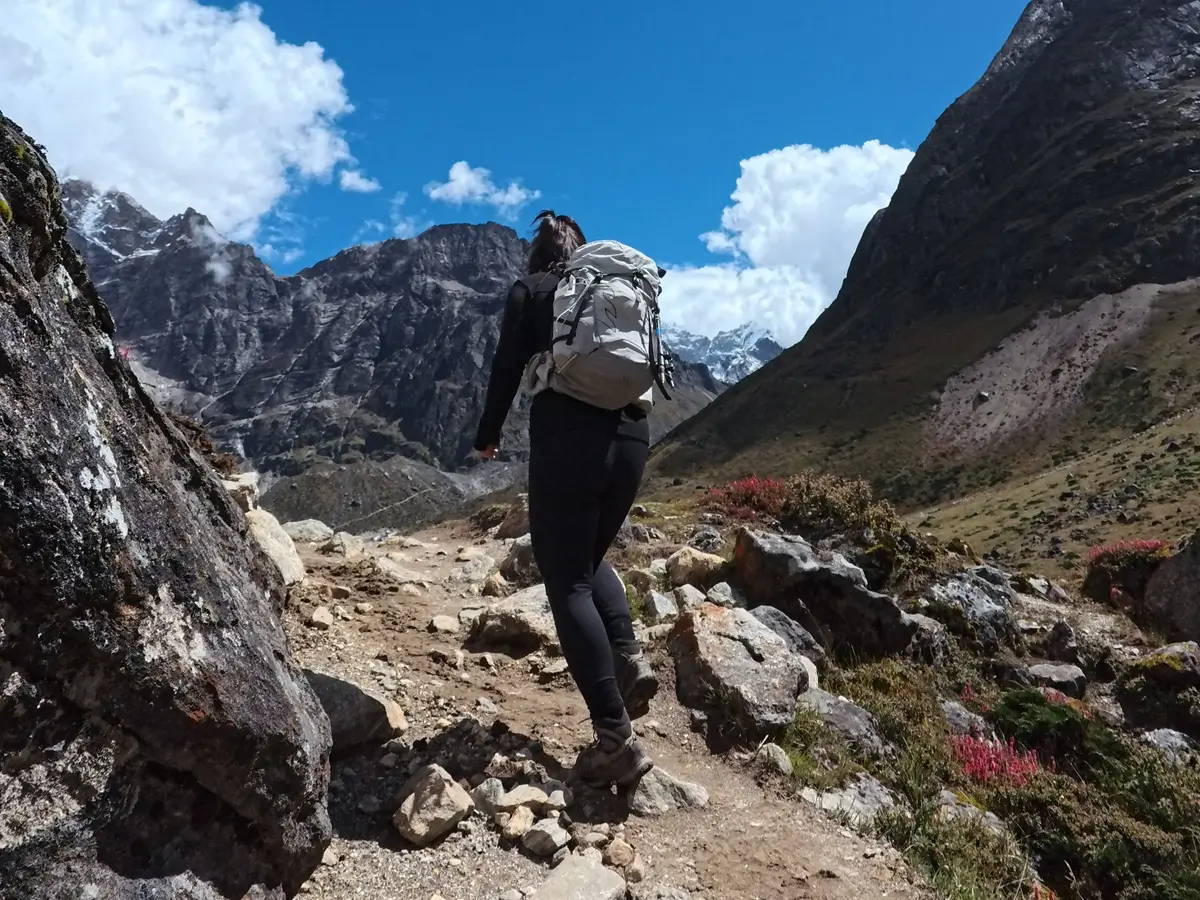
Mera leaves the busy Everest trail immediately. In our itinerary, you fly to Lukla, and instead of Namche, you head to Paiya, Panggom and Ramailo Dada, while crossing Chutok La, Kari La and Panggom La passes. During the early days, there are around five to eight hours of walking between roughly 2,700 and 3,700 m. On day four, you enter Makalu Barun National Park. Beyond Kothe (3,691 m), the forest thins, the valley widens, and you reach the yak pastures of Thaknak.
Lodges are basic, rooms are shared, and menus are simple, as supplies require a long way to travel. You will see far fewer trekkers than on the Khumbu trail, and rescue infrastructure is also thinner than in Khumbu.
Khare (5,045 m) is where our trek turns into a climb. It has a handful of lodges, gear rental outlets, and a view of Mera's north face. It is where we run the pre-climb session and check everyone's equipment before the move to high camp. Finally, on the way out, you will be crossing Zatrwa La (4,610 m) to get back to Lukla.
Island Peak - The Classic Everest Experience
Island Peak follows the classic Khumbu trail that most Everest trekkers know. You fly to Lukla, head to Phakding, and then to Namche Bazaar, Tengboche and Dingboche. You cross the Hillary Suspension Bridge, get a first look at Everest from Namche, and walk up the Imja Valley to Chhukung before finally reaching the Island Peak Base Camp (5,100 m), where you will sleep in tents.
Marvel Adventure's 16-day itinerary adds Everest Base Camp and Kala Patthar before heading to Chhukung, which is how you can trek to the Everest Base Camp with Island Peak and explore the wider Everest region.
Infrastructure here is different. Lodges are more comfortable, menus are broader, trails are well maintained, and porters, guides, and other trekkers are everywhere. Since you will be walking through the classic Everest route, the trail often gets busier during spring and autumn.
Which Peak Has the Better Summit Views?
Mera may appeal more if you want a broad Himalayan panorama, while Island Peak offers closer views of the surrounding mountain faces. The views differ, and the better one is the one that matches what you want from the summit.
Mera Peak Views
Mera's summit stands well back from other peaks, giving you a broad panoramic view of multiple major Himalayan peaks. On a clear morning, you might see five 8,000 m peaks: Everest, Lhotse, Makalu, Cho Oyu and Kangchenjunga. You can also see Ama Dablam, Baruntse and Chamlang in the panorama.
Island Peak Views
Island Peak puts you right up close. As you stand on the top, you can witness Lhotse, Nuptse, Numri and Ama Dablam nearby and Makalu sitting further off in the distance. You will also see the Imja Lake right below from the summit.
While climbing the peaks in the Everest region, people commonly make the mistake of imagining that there will be a great view of Mt Everest from the top. Yes, Everest is only about ten kilometres away, but you won't see it. Lhotse's wall blocks it completely from the summit.
So really it comes down to what kind of view you're after. Wide-open panorama, or mountains close enough to feel. Timing plays a huge role in both, and we've covered the seasons properly in our guide on when to climb Island Peak.
Summit Day on Mera Peak vs Island Peak
Whether it's Mera Peak or Island Peak, everything before the summit day is preparation. Summit day is where it actually counts, and on these two peaks, it plays out in completely different ways.
Mera Peak Summit Day
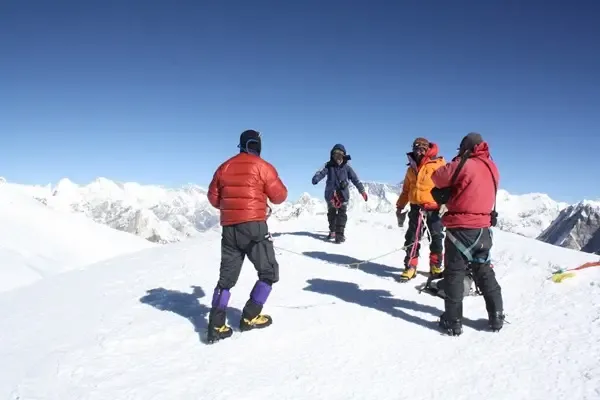
You leave Mera High Camp somewhere between 2 and 3 am, and it's cold in a way that's hard to explain until you're standing in it. Headlamps on, crampons on, roped up to the people around you, hands already numb inside your gloves. For the first few hours, it's just you and the glacier in the dark. Slow, steady steps, nobody talking much, with just the sound of crampons biting into snow. The slope starts steepening as you get closer, and in those last 40 to 50 m before the top, you clip into a fixed rope and get yourself up the final section on a jumar.
Then comes the part people don't talk about enough: the descent. Back down to high camp, then all the way to Khare. Overall, you're looking at seven to ten hours, depending on how the snow is and how your legs are holding up, and by the final stretch, you will feel it.
Here is the most important part: nobody can predict the weather in the mountains. Therefore, if your guide says turn around, that call matters more than anything written in your itinerary.
Island Peak Summit Day
Island Peak starts the same way, somewhere around 2 to 3 am, with headlamps on. From base camp, you move through a rocky section first, then onto the glacier, climbing toward the steep section below the ridge. This is where the day actually becomes a climb.
Crampons digging in, fixed rope under your hands, ascender doing its job, and you ascend the fixed line using an ascender and the safety attachments demonstrated by your guide. Then finally you're on the summit ridge itself. The ridge is quite narrow, exposed, the kind of place where you don't look around too much and just keep moving.
Coming down means rappelling through some of it. On our itinerary, the day doesn't end at the summit. You keep walking all the way back to Chhukung, which stretches the whole thing out to eight or ten hours.
Mera Peak vs Island Peak Cost
Comparing prices between these two isn't as simple as putting two numbers side by side. Many different factors move the final number around, such as the itinerary length, permits, how much climbing support you get, whether gear is rented or you bring your own, the kind of accommodation and camping setup, how many climbers per guide, porters, meals, transport, reserve days built in, group size, and the route itself.
Then there's the bigger question: does the Island Peak trip include Everest Base Camp? Our itinerary does. And the remoteness of Mera's longer approach adds its own cost on top of everything else.
Both packages cover permits, Lukla flights, a guide, a porter, meals and lodging along the way. Personal climbing gear is usually on you, so we can help you confirm exactly what you can rent here in Kathmandu and what you'll need to pack yourself.
- Our Mera Peak package costs USD 2,275 per person
- Island Peak package costs USD 2,195 per person
Note: These prices differ depending on the group size, season, and your customized itinerary.
Permits are different too. Mera needs an NMA climbing permit plus a Makalu Barun National Park entry permit. Island Peak needs an NMA permit, a Sagarmatha National Park permit, and a local municipality permit.
The service charges are determined by the Nepal Mountaineering Association (NMA) and shift depending on the season. And here's the thing you need to remember before you pick based on price alone: the cheapest package you find isn't always the same thing as a properly supported climbing trip.
Mera Peak or Island Peak - How to Choose
Forget about the reputation of these mountains. Choose this based on your goals and what you actually want.
Choose Mera Peak if you:
- Want the higher summit and that five-8,000 m panorama in front of you
- Don't mind basic lodges and a quieter trail through the Hinku Valley
- Prefer a climb where sustained endurance and higher altitude are the main challenges
- See this as your first real step from trekking into mountaineering
- Can spend more time above 5,000 m, including a genuinely cold tented night at 5,780 m
Choose Island Peak if you:
- Want a climb involving steeper snow and ice and more fixed-rope movement
- Want real time on crampons, in a harness, working an ascender with your own hands
- Prefer the popular Khumbu route with lodges, other trekkers, and the energy of a well-walked trail
- Like the idea of pairing the climb with Everest Base Camp
- Already have some training, or are ready to learn properly from guides who know the mountain
A lot of climbers do Mera first to get a feel for real altitude, then come back a season later for Island Peak once they're ready for the technical side. On the other hand, many of them choose Island Peak first to get that proper climbing experience at a lower altitude.
Can You Climb Both Mera and Island Peak?
Yes, people do climb both, but as part of a bigger, longer expedition, and only if you're genuinely fit and trained for it. We can link the two by crossing Amphu Labtsa, a high pass sitting around 5,700 m that connects the Hinku side to the Khumbu side.
That one pass changes everything about the trip. You're now looking at more days on the mountain, more acclimatization built in, properly remote terrain, weather that can pin you down without warning, and a support team that actually knows how to manage a glacier crossing with fixed rope.
Permits get more complicated too, since you need them for both peaks, and pass conditions change season to season. So confirm all of that before you even think about booking, and we will handle the rest for you.
This isn't a trip we'd suggest to just anyone. But if you've already done Mera Peak or Island Peak, or have a genuine high-altitude mountaineering experience, and you're looking for something bigger, this is exactly the kind of expedition we like putting together.
Tell us what you've climbed so far and what kind of timeframe you're working with, and we'll talk through whether the Mera - Island Peak combination with Amphu Labtsa makes sense for you.
Final Verdict: Which Peak Is Right for You?
If you want altitude, endurance, remoteness, and a summit day that's less about technical climbing, Mera Peak is for you. If you want steeper terrain, real technical climbing, and the classic Khumbu and Everest scenery around you the whole way, that's Island Peak.
We can’t promise you a summit, as the weather might turn, bodies react to altitude in ways you can't predict, and routes change condition week to week. We can’t fix any of that. What actually gets you to the top is being prepared for the specific mountain you've chosen.
So tell us what you've climbed before, how fit you are right now, how much time you've got, and what you're really hoping to get out of this. We'll help you work through the route, the acclimatization plan, and exactly what technical preparation and support you'll need before you commit to either peak.
FAQs
Which is harder, Mera Peak or Island Peak?
Depends on what kind of hard you mean. Mera wears you down with altitude, cold, and long days. Island Peak's lower but has a steep headwall and fixed rope near the top. One tests your patience, and the other tests your nerve.
Is Mera Peak higher than Island Peak?
Yes, by almost 300 m. Mera sits at 6,461 m, Island Peak at 6,189 m. That gap is basically why Mera's summit day is so much more about altitude than technique.
Which peak is better for a beginner?
For an experienced trekker making a first Himalayan climb, Mera is often the more suitable option because its normal route generally requires less technical climbing. Island Peak can also suit a prepared first-time climber with appropriate training and guide support.
Which peak has better views?
Both are different, not better. Mera gives you five 8,000 m peaks in one sweep, Everest included. Island Peak puts you right under Lhotse and Ama Dablam, though Lhotse actually hides Everest from view.
Can Island Peak be combined with EBC?
Yes. Our 16-day itinerary already builds in Everest Base Camp and Kala Patthar, since both routes share the trail up to Dingboche anyway.
Does Mera Peak require climbing experience?
No. We teach crampons and rope work at Khare. But you'll want high-altitude trekking experience, since Mera's real fight is the thin air, not the technique.
Which peak is less crowded?
Mera is the less crowded one. The Hinku Valley sees much less traffic than Island Peak gets through Namche and Dingboche. If you want quiet, Mera is the one for you.