
Nir Karki
Talk to an Expert (Nir Karki)
Last-minute Deals

Makalu Base Camp Trek

257 reviews
29 reviews
Duration
17 Days
Trip Grade
Strenuous
Country
Nepal
Maximum Altitude
4,870m
Starts
Kathmandu
Ends
Kathmandu
Group Size
Min 2 pax
Activities
Trekking
Best Time
(Sep-Nov) and (Mar-May)

Makalu Base Camp Trek with Marvel Adventure, where you will experience exciting and glorious moments on less ventured region of Nepal, the Far Eastern Himalaya.

Makalu Base Camp Trek adventure takes you within Makalu and Barun National Park & Conservation area, covering 2,330 sq kms located within Sankhuwasabha district, which is east of Mt. Everest and west of the Mt. Kanchenjunga mountain range. 

Mt. Makalu ranks as the world's 5th highest peak at the height of 8,463 m, which makes this trek more interesting, walking within serene high country and into the mist-filled forest of tall rhododendron, magnolia, and pine trees.

This trek offers fabulous moments overlooking the dramatic scenery of beautiful landscapes with green rolling hills, valleys, and snow-capped peaks on daily walks to reach our goal and destination at Makalu base camp.

The special and unique aspect of this Makalu base camp trek is that it covers both the beautiful and scenic valleys of Arun and Barun. Some of the rare and endangered herbs, vegetation, and mammals almost extinct on this planet are found only around this area.

Makalu Base Camp trek itinerary starts with a scenic short flight from the capital Kathmandu to land at the far eastern areas of Nepal in Tumlingtar, a low-lying farm area. An exciting drive then leads us to begin our marvelous adventure trek.

We will walk into remote rural farm villages of Num-Seduwa and the last village of Tashi-Gaon, inhabited by the high-altitude tribe of Makalu, the Sherpa people. Then we will be heading into complete wilderness within dense deep forest and into the wild country to reach Makalu base camp.

As we walk through the scenic Barun valley, where tree lines stop for remorseless fields of ice and glaciers within the arctic terrain of mountains and snow, right beneath towering Mt. Makalu.

At base camp, with time to explore around hidden areas of Makalu, facing magnificent scenery, which includes rare views of Mt. Everest known as the ‘Kangsung’, the Eastern Face of Mt. Everest.

Enjoy marvelous moments, then the return journey leads back to Tumlingtar on the same scenic route. The panoramic flight brings you to Kathmandu after a grand experience with a remarkable adventure on the Makalu Base Camp Trek. Contact us for package details.

Trip Highlights

  • Enjoy the adventure with a wonderful experience of the world's 5th-highest Mt. Makalu
  • Explore the least-visited region of Nepal, the Far Eastern Himalaya, with glorious scenery
  • Walk into the clouded alpine forest of tall rhododendron, oaks, pines, and fir tree lines
  • Rare species of mammals and herbs are found, which are nearly extinct in the world
  • Grand views of the world's highest mountains from Makalu-Everest to Kanchenjunga
  • Within the scenic and beautiful Barun Valley, enclosed within high, giant mountains
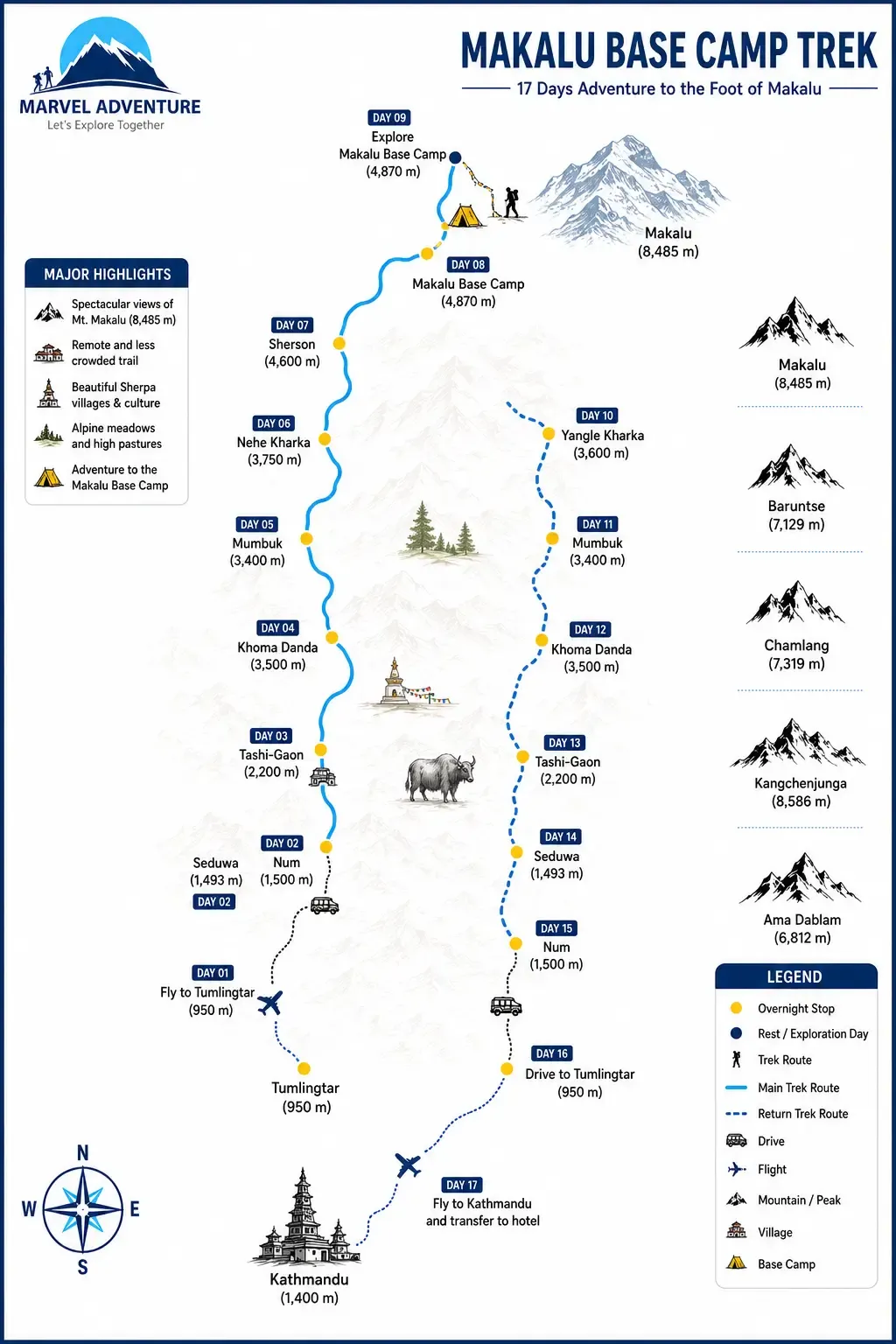
Makalu Base Camp Trek Detailed Itinerary

Day 1

Fly to Tumlingtar (410 m)

As per your morning flight time, transfer to Kathmandu domestic airport for a short scenic flight to reach Nepal's Far Eastern Himalaya in Sankhuwasabha district, within the mid-hills, in Tumlingtar, a nice, busy town.

Flying for a short hour to land at Tumling airport, located on a plateau, with superb views of the Himalayan range of peaks, including Everest, Makalu, and Kanchenjunga.

Tumlingtar is located in warmer subtropical temperatures. From the airport terminal, we transfer to a nice local lodge for an overnight stop, with a free afternoon to explore the eastern people's culture and a mix of hill tribes.

Max Altitude: 410m (1,345ft)
Duration: 45 minutes
Meals: Breakfast, Lunch and Dinner
Accommodation: Lodge
Mode of Transportation: Flight
Day 2

Drive to Num (1, 560m) and Trek to Seduwa (1,530 m)

From Tumlingtar start the morning taking a local jeep drive to reach Num village in the upper mid hills, the ride leads past farm villages and Khandbari, a headquarters town of Sankhuwas -Sabha district within Makalu area.

Continue driving up to a ridge at Chinchela and downhill to Num village, a farm area slowly turning into a town due to the arrival of a motorable road. From here, the walk begins with a long descent to cross a bridge over Arun River.

From the bridge climb to reach a small farm village of Runruma, after a short break, the last climb for a few hours to Seduwa village for an overnight camp near its local school yard. 

Max Altitude: 1,530m (5,019ft)
Duration: 4-5 hours trek
Distance: 9 km
Meals: Breakfast, Lunch and Dinner
Accommodation: Teahouse
Day 3

Trek to Tashi- Gaon (2,065 m)

After Seduwa morning leads with a gentle walk to Tashi-Gaon on a winding path past many smaller farm areas to reach at Tashi Gaon, mostly inhabited by Sherpa people, this is the last village for a week on the route to Makalu base camp.

Afternoon free to explore around this nice small farm village and catch the local immense culture of the Makalu area Sherpa people, interwoven with Buddhism religion and ancient heritage.

Max Altitude: 2,065m (6,774ft)
Duration: 4-5 hours
Distance: 8 km
Meals: Breakfast, Lunch and Dinner
Accommodation: Teahouse
Day 4

Trek to Khoma Danda (3,500 m)

On leaving the last village of Tashi Gaon, the walk heads into the cool shade of forest covered by rhododendron, pines, oaks, and birch tree lines, where the route leads past scattered huts of cattle herders.

A steep climb leads you all the way to reach on top of Khoma danda, a high scenic ridge.

Overnight at Khoma rewards you with grand views of Kanchenjunga towards far-east includes Mt. Makalu in the North. 

Max Altitude: 3,500m (11,482ft)
Duration: 6-7 hours
Distance: 12 km
Meals: Breakfast, Lunch and Dinner
Accommodation: Teahouse
Day 5

Trek to Mumbuk (3,570 m)

Morning walk starts downhill to reach an open area past glacial ponds of Thulo Pokhari (larger pond) and Sano Pokhari (smaller pond).

From here cross over a ridge line of Tutu-la pass at 4,075 meters then on downhill back into tree lines to Mumbuk a place in the middle of forest for overnight camp.

Max Altitude: 3,570m (11,712ft)
Duration: 6-7 hours
Distance: 15 km
Meals: Breakfast, Lunch and Dinner
Accommodation: Camp
Day 6

Trek to Nehe Kharka (3,660 m)

From Mumbuk, the morning starts with a descent to Barun Valley, a unique and scenic valley, an unspoiled and pristine area within the Himalaya, as few trekkers often travel around these remote corners of Barun Valley.

The valley is famous for rare wildlife, herbs, and rare species of plants and vegetation, almost lost in this part of the world. From here, the walk leads to a slow climb heading North West to camp at Nehe Kharka, a wide field around a grazing area. 

Max Altitude: 3,660m (12,007ft)
Duration: 6-7 hours
Distance: 14 km
Meals: Breakfast, Lunch and Dinner
Accommodation: Camp
Day 7

Trek to Sherson (4,615 m)

After Nehe Kharka walk heads at the end of Barun Valley enclosed within high mountains and rock cliffs, the walk takes you close to Makalu base camp at Sherson. The morning walk follows the Barun River to reach Sherson for an overnight camp with views of Mt. Makalu, Baruntse, and Peak IV. 

Max Altitude: 4,615m (15,141ft)
Duration: 6-7 hours
Distance: 8 km
Meals: Breakfast, Lunch and Dinner
Accommodation: Camp
Day 8

Trek to Makalu Base Camp (4,870 m)

From Sherson, on leaving the last green vegetation, heading into the moraine of ice and glaciers, the climb takes a higher route towards an isolated zone to reach Makalu base camp for an overnight stop.

Located close to the snout of Barun glacier and glacial pond, afternoon rest and enjoy the surrounding marvelous views of giant peaks and glaciers on the highest spot of the adventure.

Max Altitude: 4,870m (15,977ft)
Duration: 3-4 hours
Distance: 4 km
Meals: Breakfast, Lunch and Dinner
Accommodation: Camp
Day 9

Explore Makalu Base Camp

Rest day at Makalu base camp with grand views of Mt. Makalu, Baruntse Himal, and peak IV. At base camp, hike to some scenic hills to catch the best panorama of surrounding peaks with the rare East Face of Mt. Everest, the famous ‘Kangsung Face’ include views of Lhotse and the range of mountains. 

Max Altitude: 4,870m (15,977ft)
Meals: Breakfast, Lunch and Dinner
Accommodation: Camp
Day 10

Trek to Yangle Kharka (3,600m)

From Makalu base camp, retrace the journey towards the low area of Barun valley to reach Yangle Kharka for an overnight stop enclosed within high rocky cliffs with views of waterfalls.

Max Altitude: 3,600m (11,811ft)
Duration: 7-8 hours
Distance: 16 km
Meals: Breakfast, Lunch and Dinner
Accommodation: Camp
Day 11

Trek to Mumbuk (3,570 m)

After a great time around beautiful Barun valley, morning walk to the end of Barun valley, then climb into forested at Mumbuk for an overnight camp.

Max Altitude: 3,570m (11,712ft)
Duration: 6-7 hours
Distance: 12 km
Meals: Breakfast, Lunch and Dinner
Accommodation: Camp
Day 12

Trek to Khoma Danda (3,500m)

Morning walk on the same scenic trail to Khoma ridge, with a climb for an hour into forest areas to reach a high ridge where the tree line stops for a while, as the walk leads past glacial ponds and over Tutu la and Shipton la to reach Khoma hill for an overnight stop.

Max Altitude: 3,500m (11,482ft)
Duration: 6-7 hours
Distance: 15 km
Meals: Breakfast, Lunch and Dinner
Accommodation: Teahouse
Day 13

Trek to Tashi-Gaon (2,065m)

From Khoma, after being in complete wilderness for many days, a morning walk leads to reaching back into a human settlement, as the route leads to a long descent into the forest to reach back at Tashi Gaon for an overnight stop.

Afternoon is free and walk around Nawa or Narbu Gaon village to explore the Sherpa farm village.

Max Altitude: 2,065m (6,774ft)
Duration: 6-7 hours
Distance: 12 km
Meals: Breakfast, Lunch and Dinner
Accommodation: Teahouse
Day 14

Trek to Seduwa ( 1,530 m)

Morning walk follows toward Seduwa village on a pleasant winding path, taking time to observe local farm life as day ends at Seduwa for an overnight stop.

Max Altitude: 1,530m (5,019ft)
Duration: 4-5 hours
Distance: 8 km
Meals: Breakfast, Lunch and Dinner
Accommodation: Teahouse
Day 15

Trek to Num (1,560m)

The last day trek of the adventure morning leads to a long descent above the Arun River, after crossing over a bridge, with the last final steep climb for an hour to reach back at Num village for the final overnight stop around the high hills of Makalu Himalaya.

Max Altitude: 1,560m (5,118ft)
Duration: 4-5 hours
Distance: 9 km
Meals: Breakfast, Lunch and Dinner
Accommodation: Teahouse
Day 16

Drive back to Tumlingtar (410m)

An exciting and interesting drive up to the farm village at Chinchela village, from here drive to reach the low warm area at Khandbari, a headquarters town of Sanka-Sava district within Makalu region.

From here, a short downhill to reach Tumlingtar for the last overnight halt around Nepal Makalu and around the Nepal Far Eastern area.

Max Altitude: 410m (1,345ft)
Duration: 4-5 hours drive
Distance: 47.7 km
Meals: Breakfast, Lunch and Dinner
Accommodation: Lodge
Mode of Transportation: Jeep
Day 17

Fly to Kathmandu and Transfer to hotel

After a great adventure around the high Barun Valley and at Makalu base camp, a short walk to Tumlingtar air-strip, then board the aircraft for a scenic short flight to Kathmandu, on landing at Kathmandu airport, transfer back to your respective hotels.

Max Altitude: 1,400m (4,593ft)
Duration: 45 minutes
Meals: Breakfast and Lunch
Accommodation: Hotel
Mode of Transportation: Flight
Have Questions? We're Here to Help
Like this itinerary but want to make a few changes? Every traveler is unique, and your journey should be too. Our local travel experts will design a personalized experience tailored to your interests, preferred pace, travel dates and budget.
Route Map & Altitude Profile

Cost Details

Includes

  • Round-trip flight fare (Kathmandu - Tumlingtar - Kathmandu)
  • All land transportation as per the itinerary
  • Standard meals (breakfast, lunch, and dinner) during the trek
  • Highly experienced trekking guide with vast knowledge of the terrain
  • Strong and helpful porter with proper equipment (1 porter for 2 people)
  • Salary, food, accommodation, and insurance for the guide and porters
  • Tea house/lodge accommodation during the trek
  • Makalu National Park Permit
  • Comprehensive first aid kit with an oximeter 
  • Government taxes and official expenses

Dates & Availability

If there is only one person for the trip, there will be a USD 300 additional cost.

Meet Our Expert Guides

Khilaraj Nachhiring
Trekking Guide
Phinjo Sherpa
Trekking Guide
Dibash Mainali
Trekking Guide
Kumar Karki
Trekking Guide

Equipment List

Upper Body Layers
  • Breathable, quick-dry base layers
  • Comfortable t-shirts
  • Lightweight insulating jacket
  • Down jacket for cold conditions
  • Waterproof and windproof jackets
Lower Body Layers
  • Thermal base layer
  • Waterproof trekking pants
  • Comfortable pants for evenings in teahouses
  • Comfortable hiking shorts for warmer sections
  • Waterproof and windproof outershell for rain or snow
Footwear & Accessories
  • Trekking boots with ankle support (preferably Waterproof)
  • Multiple pairs of quick-dry socks
  • Warm socks for cold nights
  • Gaiters for snowy, muddy, or dusty trails
  • Trekking poles to reduce strain on knees
Head & Sun Protection
  • A hat or a cap to block the sun
  • Warm beanie for cold mornings and evenings
  • UV-protected sunglasses
  • Neck gaiter or buff to prevent dust, cold, and sunburn
  • Sunscreen (30-50+ SPF) for face and exposed skin
  • Lipbalm with SPF
Personal & Medical Kits
  • Personal medications
  • Diamox (Acetazolamide) for altitude sickness
  • Ointment
  • Hand sanitizers and wet wipes
  • Quick-dry towel
Travel Documents
  • Valid Passport
  • Passport-sized photos for permits
  • Travel insurance
  • Flight tickets
  • Cash in Nepali Rupees
  • Emergency contact details
Miscellaneous
  • Daypack (30-45L) with raincover
  • Reusable water bottles
  • Headlamps for early morning hikes
  • Water purifying tablet or filter
  • Phone or Camera for capturing the adventure
  • Powerbank for an easier charging option
  • Notebook, books, or cards for free time
  • Snacks like energy bars and chocolates
  • Drybag to keep your gear safe from rain

Essential Information

Can I do this trek?

That depends less on your gym routine than you'd think, though it still matters. Makalu asks for five to eight hours of walking most days, sometimes on a narrow trail and sometimes crossing a stream that wasn't there in your itinerary notes. 

We will be completely honest: this shouldn’t be your first Himalayan trek. There is more elevation gain with fewer rest days. What we actually look for in trekkers who make it here isn't athletic perfection. It's stubbornness, a working set of lungs, and the humility to slow down the moment your guide tells you to.

Guide and Porters

Hiring a licensed guide isn't optional on this route, but it's the rule. Makalu doesn't have the infrastructure of Everest or Annapurna. There's no rescue helicopter pad every few hours, no cafe with WiFi, and no fellow trekkers around if something goes wrong. 

Our guides have walked this valley enough times to know which teahouse owner still has spare blankets in October, where the trail washes out after heavy rain, and when a client's headache is ordinary fatigue versus something that needs attention. 

Porters carry the load, yes, but they also read the weather better than any app on your phone. We pair each group with crew from the region itself, local Sankhuwasabha porters who grew up watching this mountain, not just guiding around it.

Our package includes the cost for both the guide and the porter.

Permits

You will need the Makalu Barun National Park entry permit, since the trail runs through the conservation area for most of its length. You will also need a local rural municipality permit.

We arrange all of this before you land in Kathmandu, along with your flight paperwork to Tumlingtar. 

Trekkers need to realize that patience is required at the checkpoints as the officers check names against permits by hand, and in peak season that means a short wait with your pack still on your shoulders.

Accommodation along the Trail

Below Tashigaon, teahouses are simple with a bed, a blanket, and a stove burning wood or yak dung, depending on the village. Past that point, especially through Khoma Danda and up toward base camp, the trail moves into camping territory.

We carry tents, and our kitchen crew usually sets up the camp after arriving at the destination. Don't expect hot showers past the first few days. You might get a bucket of warm water from the locals if you ask nicely.

Food and Water

Dal bhat carries you through the lower villages, same as everywhere in Nepal, though the menu thins out fast once you're past Tashigaon. 

Higher up, expect simpler food such as noodles, soup, and whatever the kitchen crew can carry and cook at altitude without much fuss. 

We treat all drinking water ourselves rather than relying on bottled water, which the region can't really supply in the quantities a trekking group needs anyway. It also helps keep plastic off a trail that doesn't see enough cleanup crews.

Challenges in the trail

Here are some challenges that you would be facing while you are walking through the trail:

  • Long and exposed days with limited shelter that could turn into a big problem if the weather turns.
  •  A trail that is prone to landslides and washouts after heavy rain, particularly around the lower river crossings.
  • There is genuine remoteness, which means evacuation takes longer here than almost anywhere else we operate.
  • The nights are really cold, which settles into camp faster than people expect once the sun drops behind the ridgeline.

None of this is meant to talk you out of it. We run this trek every season and bring people through it safely. We just want you to know what the trail actually asks of you before you discover it halfway up the Barun Valley.
 

Alltitude Factor

You'll climb from roughly 1, 560 meters at Num to 4,870 meters at base camp in about two weeks. 

Above 4,000 meters, you begin to notice reduced appetite, headache or disturbed sleep. Trekkers stop wanting to eat right when their bodies need calories most, and this is where we push people to eat anyway, even if it's just half a plate of dal bhat. 

Nighttime temperatures at base camp drop to minus fifteen or lower even in clear season, so the cold does its own work on your sleep and your patience long before it does anything to your lungs.

Communication and Connectivity

Signal disappears early on this route, and we mean that literally, as you might not have any signal just on Day 2. Past Num, most phones go dark until you're back in range days later. 

We carry a satellite phone with every group for emergencies, and it's the only reliable way to reach the outside world for most of the trek. No news for a week and a half is normal out here, not a warning sign.

Make sure you carry extra batteries and fully charged power banks from Tumlingtar to charge your camera equipment, as nothing is reliable from Day 2.

Travel Insurance and Emergency Evacuation

Don't leave Kathmandu without insurance that specifically covers high-altitude trekking and coverage to at least 5,000 m + helicopter evacuation. General travel insurance rarely does that, and we've seen a few trekkers standing at a teahouse counter with a policy that turned out to be worthless here.

Makalu is remote enough that if something does go wrong, a rescue isn't a quick call and a short wait. Weather in the Barun Valley closes in fast, and a chopper that could fly at ten in the morning might be grounded by noon.

We check every client's policy before departure, and not after, as that would be the wrong time to find out it doesn't cover the altitude you're actually walking at.

Why choose Makalu Base Camp Trek?

The honest answer is it's still empty, mostly. Everest and Annapurna have earned their reputations, but they also earned queues at teahouse doors. Makalu never got that treatment. We've had days on the Barun trail where the only fresh tracks ahead of us belonged to a langur troop, not another trekking group. 

The mountain does a lot of the convincing on its own, too. Makalu is the fifth-highest peak on Earth, and the base camp view isn't just a distant postcard shot. You're close enough some mornings to hear ice crack loose off the face before you see it fall. 

What really sells the trek is how much ground you are covering. You start near Tumlingtar, drop through terraced fields and river gorges, then climb into rhododendron and oak forest, before the trees thin out past Khoma Danda and the trail turns to rock and glacier for the final stretch to base camp. 

Guides on our team who have led Everest routes for years still say Makalu is the more interesting trek to walk, not just the harder one. And most of our clients who've already ticked off EBC or Annapurna tell us the same thing on the way down.

Makalu Base Camp Trek FAQs

How difficult is the Makalu Base Camp Trek?

The Makalu Base Camp Trek is one of the most demanding treks in Nepal. It involves remote trails, high mountain passes, rugged terrain, and long trekking days. From our experience at Marvel Adventure, it is best suited for trekkers looking for a true expedition-style adventure.

Is the Makalu Base Camp Trek suitable for beginners?

Generally, no. While very fit beginners may attempt it, we usually recommend having previous high-altitude trekking experience before taking on the Makalu Base Camp trek.

How fit do I need to be for the Makalu Base Camp Trek?

You should have excellent fitness and endurance. Most days involve 6–8 hours of walking, often at high altitude and on rough terrain. Good preparation before the trek is extremely important.

What is the highest altitude of the Makalu Base Camp Trek?

Makalu Base Camp itself is the highest point of the trek, which sits at approximately 4,870 meters above sea level, offering spectacular views of Makalu and the surrounding Himalayan peaks.

What is the best time to do the Makalu Circuit Trek?

Spring (April–May) and autumn (September–November) are the best seasons for trekking in Nepal. These periods generally offer more stable weather and safer conditions on the high passes.

Is altitude sickness common on the Makalu Base Camp Trek?

You spend several days above 3,500m, and mild headaches and fatigue are the most common symptoms, particularly in the first two days above Khoma Danda.

Do I need a guide for the Makalu Base Camp Trek?

Yes. While regulations may vary depending on the exact route, we strongly recommend trekking with an experienced guide due to the remoteness and technical challenges involved.

Can I do the Makalu Circuit Trek solo?

No, the Restricted Area permit requires a licensed guide and a minimum group of two trekkers, enforced at checkposts along the route. A guide keeps you on track, keeps the itinerary moving efficiently, and gives you access to local knowledge and community hospitality that simply doesn't happen when you're walking alone.

Why is the Makalu region considered remote?

The Makalu region receives far fewer trekkers than Everest or Annapurna. Villages are sparse, facilities are limited, and once you move deeper into the valley, help and services become very limited.

What permits are required for the Makalu Circuit Trek?

You need the Makalu Barun National Park Permit and other applicable local permits. Marvel Adventure handles all permit arrangements before the trek begins.

Is the Makalu Base Camp Trek camping-based?

In most cases, yes. Lower sections may have simple teahouses, but the full Makalu Circuit typically requires camping support due to the lack of accommodation in remote areas.

What kind of accommodation is available during the trek?

Trekkers usually stay in a combination of simple lodges and camping tents. The higher and more remote sections are generally fully supported camping expeditions.

Are hot showers, charging, and Wi-Fi available during the trek?

Facilities are very limited in this trek. Some lower villages may offer basic charging services, but reliable Wi-Fi, hot showers, and modern amenities should not be expected throughout most of the trek.

What food is available during the Makalu Circuit Trek?

During camping sections, meals are prepared by the expedition guide. Typical meals in teahouses at lower sections include rice, pasta, soups, vegetables, potatoes, eggs, and traditional Nepali dishes.

How many hours do we walk each day?
What transportation is used for the Makalu Circuit Trek?

Our standard itinerary begins with a domestic flight from Kathmandu to Tumlingtar, followed by a drive the next day to Num, which is the starting point of the trek. The return follows a similar route.


Is prior high-altitude trekking experience recommended?

Absolutely. Most trekkers don't realize how physically demanding the Makalu Circuit can be. Previous experience on treks such as Everest Base Camp, Annapurna Circuit, or Manaslu is highly beneficial.

What is included in the Makalu Base Camp Trek package?

Our package includes permits, domestic transportation, guide services, camping equipment, support staff, meals during the trek, and logistical support. At Marvel Adventure, we clearly explain all inclusions before departure.

Why book the Makalu Base Camp Trek with Marvel Adventure?

Based on our experience, the Makalu Circuit is one of Nepal's most complex trekking expeditions. We focus on experienced mountain guides, proper acclimatization planning, reliable camping logistics, and strong safety management so trekkers can confidently explore one of the wildest and least-visited regions of the Himalayas.

Price Per Person
US$1875
US$2025
All inclusive price
  • 2 - 4 paxUS$1875
  • 5 - 9 paxUS$1850
  • 10 - 20 paxUS$1800
Talk to Our Travel Experts

You May Also Like

Forbidden Kingdom
upper mustang trek
Duration: 14 Days
5.0(6 Reviews)

Upper Mustang Trek

US$1750US$1950save upto 10%
Inclusion
Difficulty Level: Moderate
True Wilderness
kanchenjunga circuit trek
Duration: 20 Days
5.0(2 Reviews)

Kanchenjunga Circuit Trek

US$1995US$1995
Inclusion
Difficulty Level: Strenuous
Last Frontier
upper dolpo trek
Duration: 22 Days

Upper Dolpo Trek

US$4200US$4400save upto 5%
Inclusion
Difficulty Level: Strenuous
Need Help? Call Us+977 986-0313572